No-Splice Seamless Belt Trap: Food & Packaging Line Guide
No-Splice Seamless Belt Trap: Food & Packaging Line Guide
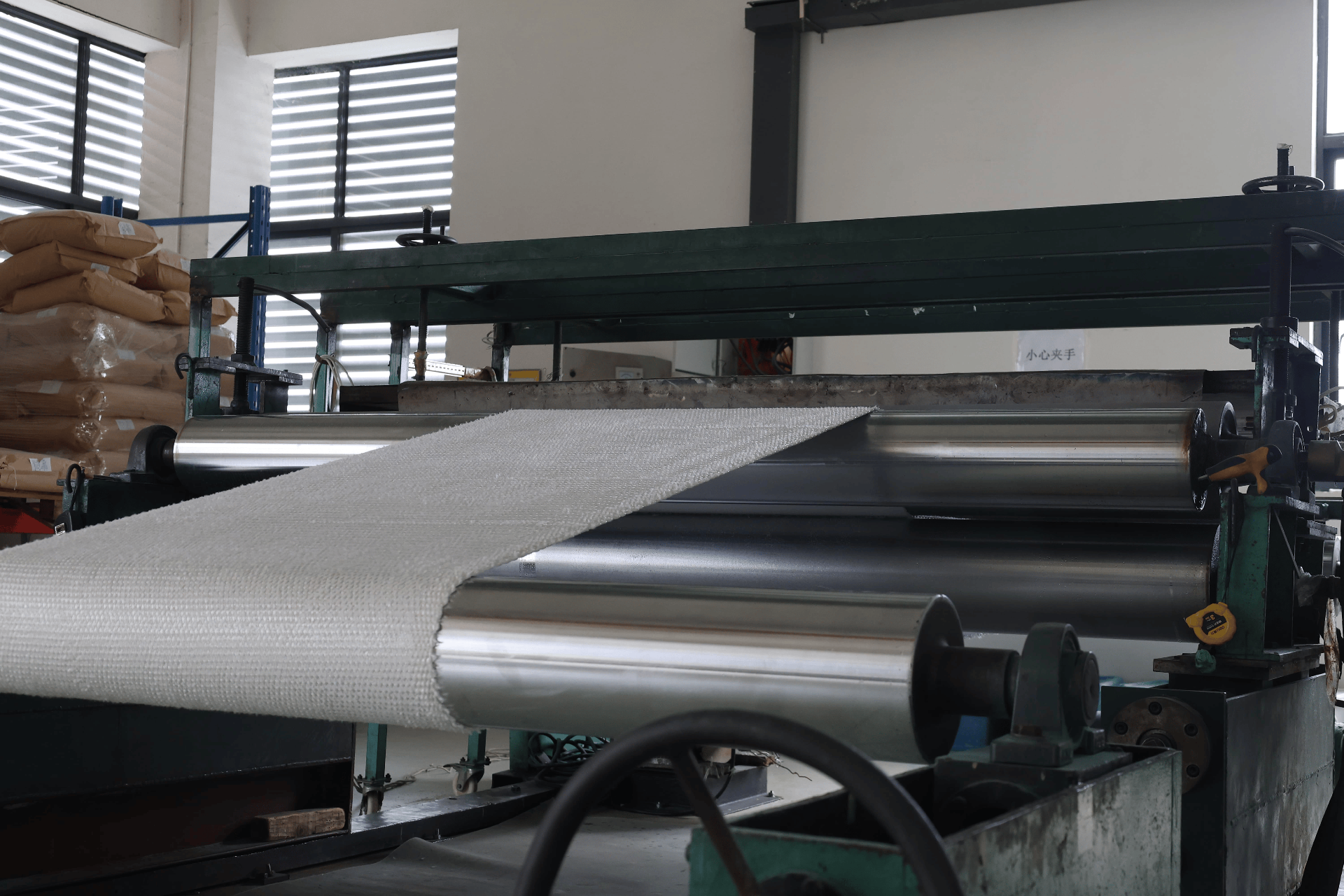
This guide is written for buyers in the evaluation stage of a food or packaging line project: engineers, maintenance planners and procurement teams comparing a truly endless seamless belt against a jointed endless belt, an open-end belt or a coated timing belt. It sets out the no-splice trap, the verified construction data that should replace it as the decision basis, the purchasing terms that belong in the order, and the acceptance criteria that decide whether the belt was correctly specified in the first place.
XZBELT — the industrial belt brand of Xuanze Industrial Drive Systems (Shanghai) Co., Ltd., founded in 2013 — manufactures conveyor belts, timing belts, seamless belts, flat belts, round belts and related power transmission products, and supplies customers in more than 150 countries and regions. The construction data referenced throughout this guide comes from that product range.
The No-Splice Trap: What Buyers Actually Buy When They Specify “Seamless”
A seamless belt is a belt whose carrying body is woven or formed as a closed loop, so no splice or joint exists anywhere in the belt. In the XZBELT range, the seamless belt family is built as a seamless woven construction: a single layer with 9 ± 0.5 mm total thickness, made up of a 3 mm silicone coating over a 6 mm baseband, in silicone, Nomex fiber and polyester filament fiber.
The trap appears when “no splice” is treated as a proxy for quality. Four specific problems follow.
1. The splice is not the load path — the construction is. A belt’s capacity comes from the weave, the tension member and the coating. The XZBELT silicone-coated seamless belt carries a tensile force of 30 N/mm at 1% elongation and a tensile strength of 350 N/mm at 3% elongation, and recovers after 2.5% elongation. Those values come from the structure of the belt, not from the absence of a joint. A seamless belt built for a low-load transfer duty will still fail on a high-torque indexing drive, and no amount of “no splice” changes that.
2. Geometry does not negotiate. The same seamless belt is rated for a minimum pulley diameter of 70 mm running forward and 120 mm running reverse. A splice-free belt forced around a smaller radius than its construction allows is bent beyond its design envelope on every revolution — the exact condition that produces premature failure, whatever the joint looks like.
3. A truly endless belt has to be installed while the drive is open. Before a seamless loop is ordered, the buyer should ask a simple mechanical question: can the machine frame be opened around the pulleys? If the drive cannot be opened for belt fitting, a truly endless construction may not be installable at all, and a jointed endless or open-end belt becomes the practical answer. That question costs nothing at the specification stage and a great deal at the installation stage.
4. Compliance is a material question, not a construction question. A belt does not become food-grade because it has no splice. Food-contact compliance is established by the material supplied and by the test report that covers it — a point covered in the compliance section below.
The practical rule: specify “no splice” only as an output of the construction decision, never as the input. Choose the construction from duty, geometry, temperature, product contact and installation path, then state whether that construction is seamless, jointed endless or open-end.
Industry Background: Why Food and Packaging Lines Buy More Splice-Free and Coated Constructions
The commercial pressure behind the no-splice trap is real. The global timing belt market was valued at approximately USD 9.10 billion in 2025 and is projected to reach approximately USD 9.57 billion by 2030 (Mordor Intelligence). Growth is concentrated in engineered and specialty constructions rather than standard replacements: for the polyurethane timing belt segment one commercial estimate puts the CAGR at 12.57% through 2032 (Credence Research), while other published estimates place the same segment near 3.10% (24ChemicalResearch) — a spread that reflects how differently analysts define special-purpose belts. The signal that matters to buyers is that specialty belt demand is expanding, which means more suppliers labelling ordinary belts as “seamless”.
Rubber remains the dominant material in the automotive timing belt segment, valued at approximately USD 7.23 billion in 2024 (Market Research Future). Automotive duty, however, is not food and packaging duty. Food and packaging lines typically combine high speed, frequent start-stop cycles, precise positioning and repetitive indexing, with functions such as feeding, indexing, positioning, gripping, vacuum conveying and synchronous drive. The working conditions that follow — accurate positioning, low elongation, high grip, vacuum perforation, wear resistance and dimensional stability — are what should drive the belt specification.
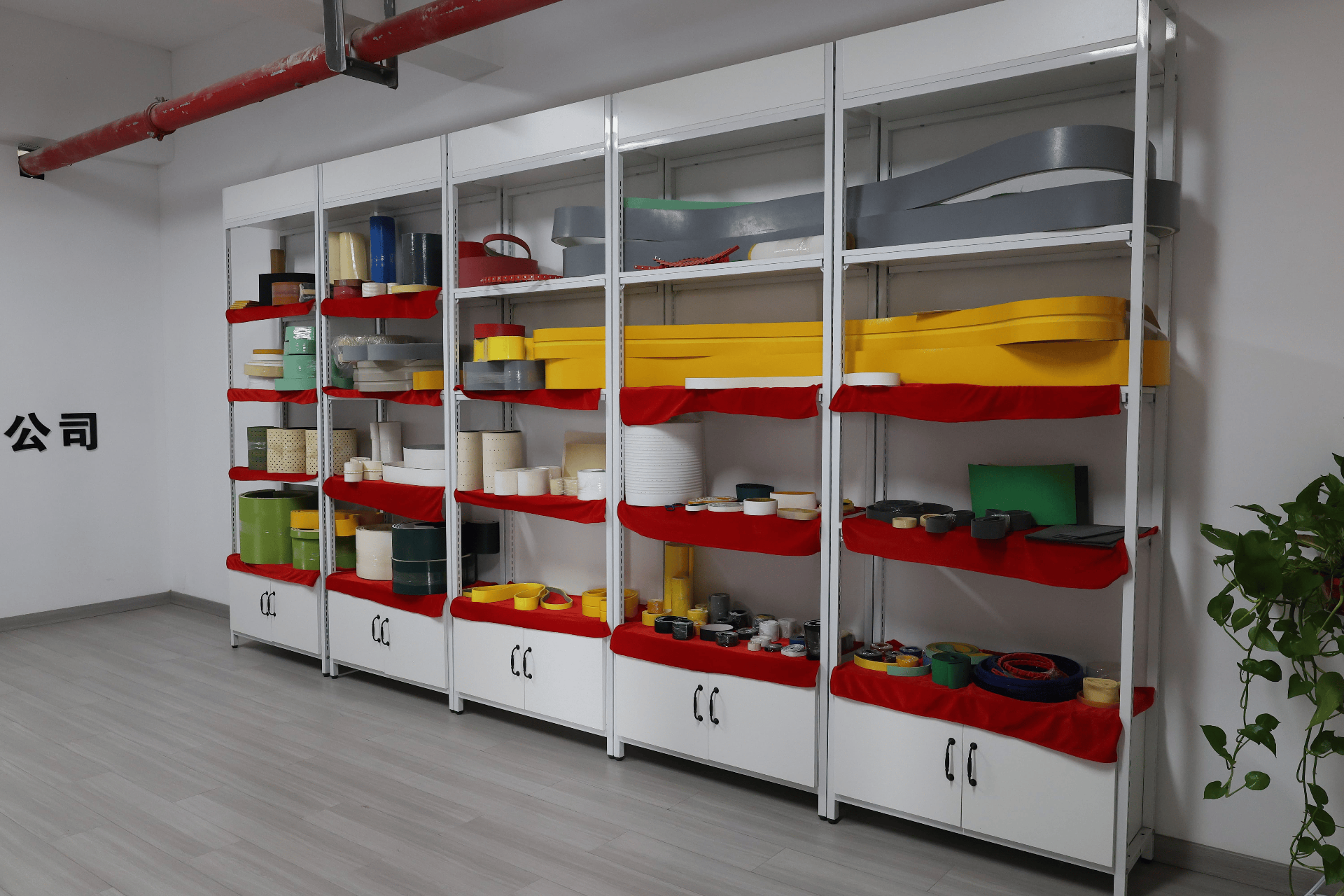
Standards give the buyer a fixed point. ISO 5296:2012 specifies the principal characteristics of synchronous endless belts with the pitch codes MXL, XXL, XL, L, H, XH and XXH, so profile and pitch can be verified rather than assumed. Beyond profile, the available constructions are broad: open-end, jointed endless and truly endless supply forms; welded, flex and endless joints; silicone, PU, rubber, sponge and fabric coatings; and perforation, cleats, profiles and V-guides as secondary processing.
Detailed Solution: A Construction Decision Framework
Replace the single question “is it seamless?” with three questions asked in order: does the belt have to be continuous in the process zone, can the drive be opened for installation, and what does the product require at the surface? The answers point to one of three constructions.
Where a truly endless seamless belt is the correct specification
A seamless belt earns its place when the belt body itself must be continuous through a demanding zone. The verified XZBELT seamless belt data supports four cases:
- Continuous high-temperature duty. The silicone-coated seamless belt is rated from −40 °C to +210 °C. When a belt runs through a heated process zone on every cycle, the joint is the element most exposed to that thermal cycle; a seamlessly woven construction removes the element entirely. The verified application profile is high-temperature processing equipment, textile machinery, packaging machinery and industrial conveying and transfer equipment.
- High-speed conveying. The seamless belt is rated for a maximum operating speed of 400 m/min, which places it in high-speed transfer and handling sections rather than slow-speed conveying.
- Continuous product contact where surface continuity matters. With a 3 mm silicone coating over a 6 mm baseband, the belt is selected for release behaviour and non-marking contact. Where the belt surface runs directly against the product, keeping that surface continuous is a legitimate specification requirement — and one a seamless construction satisfies by design rather than by joint quality.
- Duty where elongation recovery is critical. Recovery after 2.5% elongation, combined with 30 N/mm at 1% elongation, suits drives where accumulated stretch would disturb tracking or registration.
Two constraints travel with that specification and belong in the enquiry: a minimum pulley diameter of 70 mm forward and 120 mm reverse, and an installation path that allows a closed loop to be fitted.
Where a jointed endless belt beats a seamless belt
A jointed endless belt is made to length and closed with a welded joint, flex joint or endless joint. It carries a splice — and in a large share of food and packaging duties that splice is an advantage rather than a defect:
- Installation on an assembled machine. A jointed belt can be fitted without opening the frame. On retrofit projects this is often the only realistic option.
- An inspectable, replaceable element. The joint is a defined, visible feature with its own inspection criteria, so the weakest point can be specified and verified instead of hidden inside an opaque construction.
- Length, width and processing flexibility. Width, length, coating and secondary processing are customizable, so the belt can be engineered around an existing machine rather than around a fixed seamless size grid.
- Proven service life in packaging duty. In a case involving a packaging machinery distributor and carton packaging manufacturer, belts supplied at 1,000+ pcs annually ran 24–30 months under continuous folder-gluer and carton packaging conditions, on duties including high-speed carton feeding, folding, pressing and conveying. Belt replacement frequency fell by approximately 40%, feeding accuracy and operating stability improved, and belt slippage and unplanned downtime were reduced. The stated highlights were high abrasion resistance, consistent friction performance, low elongation and reliable endless joint strength, with customized hardness and surface finishing.
That case is the counter-argument to the no-splice trap in one sentence: a jointed endless belt with verified joint strength and controlled elongation delivered a two-year-plus service interval on a high-cycle packaging duty.
Where an open-end or coated/perforated timing belt is the real answer
Some duties are not conveying duties at all, and the correct starting point is the motion function rather than the belt surface:
- Linear motion and positioning: open-end timing belts with low elongation, used for linear axes and take-up drives where the loop is closed on the machine or the belt runs as a linear element. XZBELT timing belts are supplied as open-end belts, jointed endless belts and truly endless belts.
- Continuous synchronous drive: an endless or truly endless timing belt sized for the torque and speed of the drive, in tooth profiles including T5, T10, T20, AT5, AT10, AT20, HTD 3M, HTD 5M, HTD 8M, HTD 14M, HTD 20M, STS and RPP, with pitch options of 2.032 mm, 5 mm, 9.525 mm and 14 mm depending on profile.
- High-grip or release handling: a coated timing belt, with silicone, PU, rubber, sponge or fabric coating selected according to the product being moved and the release behaviour required.
- Vacuum conveying and pick-and-place: a perforated or machined timing belt matched to the vacuum system.
Timing belt construction also determines what the drive can tolerate. Verified ranges include a hardness of 90–92 Shore A, a temperature range of −20 °C to +160 °C depending on material, an antistatic index of 10⁸–10⁹, minimum pulley teeth of 10–25 depending on tooth profile, and minimum turning diameters from 10 mm to 108.7 mm depending on tooth profile. Tension members may be steel cord, Kevlar cord or glass fiber cord; the intermediate layer may be Kevlar; and backing material may be PU, rubber, silicone, sponge or fabric.
Compliance before construction is signed off
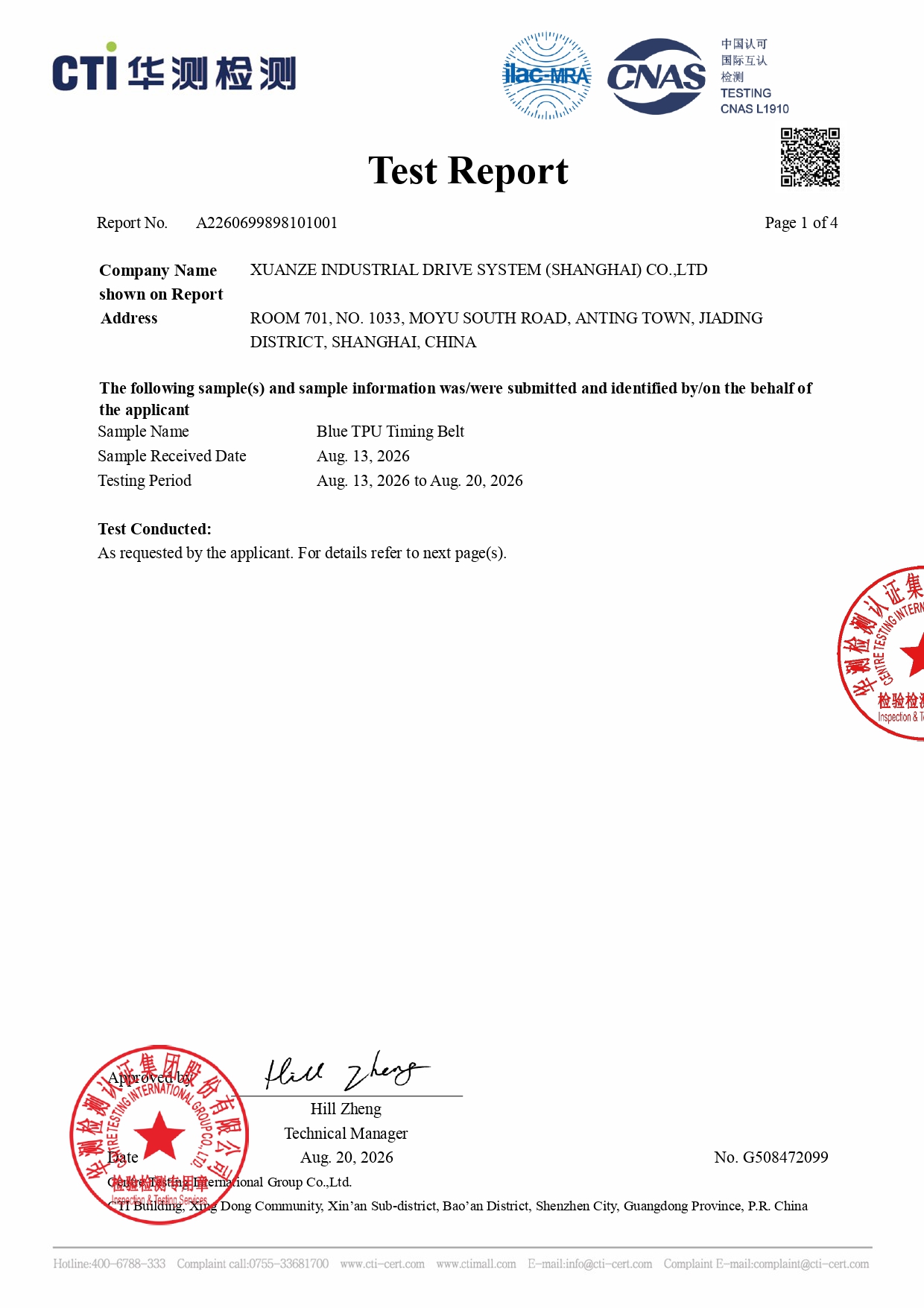
For food-contact applications, the compliance document should be confirmed against the exact material and construction being quoted. XZBELT holds an FDA Compliance Test Report for its timing belt range issued under FDA 21 CFR 177.2600, with a scope of total extractives in distilled water and n-hexane — report number A2260699898101001, issued 20 August 2026 by Centre Testing International Group Co., Ltd. (CTI). Separately, FDA compliance test reports issued in 2021 by SGS-CSTC Standards Technical Services (Shanghai) Co., Ltd. under US FDA 21 CFR 175.300 cover the seamless belt, flat belt and conveyor belt families with a total extractives scope. Within the flat belt range, FDA compliance is stated as available according to product type.
The purchasing implication is direct: ask for the report that matches the material, coating and construction on the quotation, and treat a construction-level claim (“this belt has no splice”) as irrelevant to food-contact compliance.
Step-by-Step Breakdown: Seven Steps from Machine Data to Repeatable Supply
- Collect the duty data. Record the motion function (positioning, indexing, conveying, gripping, vacuum transfer), operating speed, load and shock profile, the smallest pulley or nose bar in the path, process temperature, whether the belt touches the product directly, and the cleaning regime.
- Decide the construction. Apply the three-way test: can the frame be opened for belt installation; does the belt pass through a heated zone or a continuous product-contact zone; what is the smallest bending radius? The result is seamless, jointed endless, or open-end.
- Fix tooth profile and pitch. Match the profile to the pulley system. Two timing belts with the same length but different tooth profiles cannot be interchanged, because tooth geometry and pitch must match the pulley. Use the pitch codes defined in ISO 5296:2012 for MXL, XXL, XL, L, H, XH and XXH, and confirm metric and HTD profiles where used.
- Select material, coating and tension member. Choose belt body and coating against temperature, abrasion, release and cleaning behaviour, and select the tension member against load and elongation limits. Specify secondary processing — perforation, cleats, sidewalls, profiles, V-guides, grinding, fabric reinforcement and special coatings — at the same time, not after the order.
- Confirm compliance documentation for the exact item. Verify that the FDA report covers the material and construction being quoted, and keep the report number in the purchase documentation.
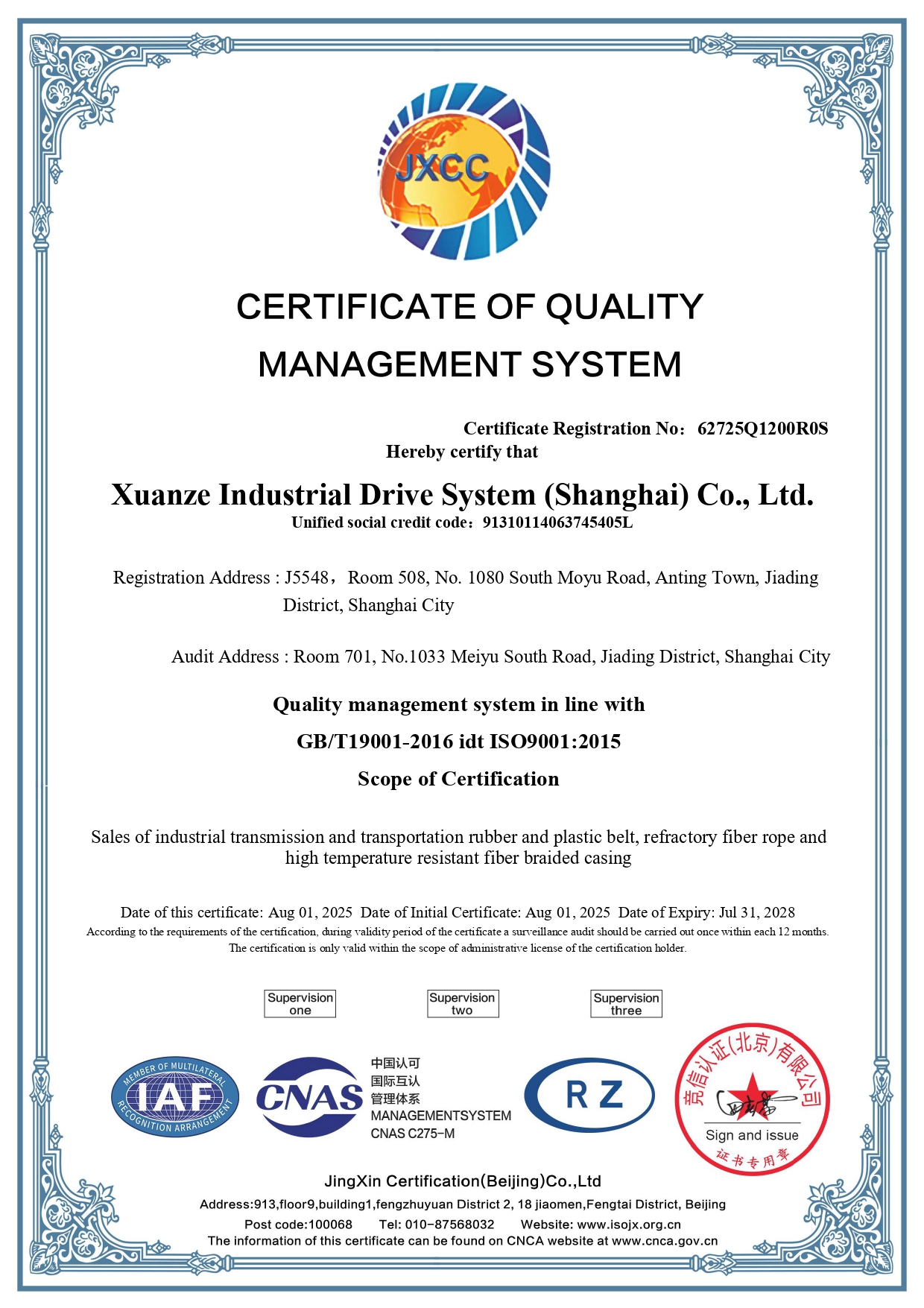
- Write acceptance criteria into the purchase order. For timing belts, dimensional tolerances are ±0.5 mm on width and length and ±0.3 mm on thickness, with hardness at 90–92 Shore A. For the silicone-coated seamless belt, total thickness is 9 ± 0.5 mm, comprising a 3 mm coating and a 6 mm baseband. Add joint appearance and position for jointed constructions, coating adhesion for coated belts, and a certificate copy for the delivered batch. XZBELT operates an ISO 9001 quality management system supported by professional production, processing and inspection equipment.
- Validate with a sample, then lock the supply terms. Run the sample under production conditions before release. Confirm minimum order quantity by product type and specification, agree lead time, and confirm after-sales support — XZBELT provides technical support, customized solution support, application support and long-term supply support.
Use Cases: Construction Decisions That Held Up in Production
Three documented applications show how the construction decision plays out once the belts reach the line.
Carton packaging and folder-gluer lines. A packaging machinery distributor and carton packaging manufacturer consumed 1,000+ pcs annually on high-speed carton feeding, folding, pressing and conveying. Over 24–30 months of continuous operation, replacement frequency fell by approximately 40%, feeding accuracy and operating stability improved, and slippage and unplanned downtime were reduced. The decision variables were abrasion resistance, friction consistency, low elongation and joint strength — not the presence or absence of a splice.
Aluminium profile extrusion lines. A large aluminium profile manufacturer uses 50+ belts annually, running a timing belt for traction and conveying together with a felt belt for surface protection. Over more than twelve months of continuous operation, the combination prevented scratches and pressure marks, maintained conveying accuracy, reduced maintenance frequency by approximately 30% and increased production efficiency by approximately 20%. Repeat orders have continued for several years with expanding usage. Two different belt constructions were specified on the same line because the two duties were different — the clearest illustration that one construction label cannot cover a whole machine.
OEM equipment replacement. An OEM equipment supplier and equipment manufacturer replaced existing Habasit belts with XZBELT PVC and PU conveyor belts, taking 1,000 pcs and 600 pcs across a three-year supply period for continuous product conveying and material transport. The reported outcome was resolution of a wavy-edge problem, reduced downtime and operating cost, and improved production line efficiency. The construction decision was driven by edge stability and tracking, not by splice count.
On the seamless side, the verified application profile remains high-temperature processing equipment, textile machinery, packaging machinery and industrial conveying and transfer equipment — duties where continuity of the belt body performs a real function.
Comparison Table: Seamless, Jointed Endless, Open-End and Coated Timing Belts
| Construction | Splice | Verified XZBELT construction data | Best-fit duty | Check before ordering |
|---|---|---|---|---|
| Truly endless seamless belt | None — seamlessly woven closed loop | Thickness 9 ± 0.5 mm (3 mm silicone coating + 6 mm baseband); single layer; silicone, Nomex fiber, polyester filament fiber; 30 N/mm tensile force at 1% elongation; 350 N/mm tensile strength at 3% elongation; recoverable after 2.5% elongation; max operating speed 400 m/min; min pulley diameter 70 mm forward / 120 mm reverse; −40 °C to +210 °C | High-temperature processing equipment, textile machinery, packaging machinery, industrial conveying and transfer | Smallest pulley diameter; whether the frame can be opened for installation |
| Jointed endless belt | Yes — welded joint, flex joint or endless joint | Supplied as jointed endless; width, length, coating and secondary processing customizable; ISO 9001 quality management system | Packaging and printing duty on assembled machines; retrofit projects; fast field replacement | Joint construction, joint strength and joint inspection criteria |
| Open-end belt | None supplied; loop closed on the machine or run as a linear element | Supplied open-end; tooth profiles MXL, XL, L, H, XH, XXH, T5, T10, T20, AT5, AT10, AT20, HTD 3M–20M, STS and RPP; tension member steel cord, Kevlar cord or glass fiber cord | Linear motion, positioning and take-up drives; drives where length is set on site | Whether the duty needs a closed loop or a linear belt |
| Coated or perforated timing belt | Depends on the selected supply form | Coating silicone, PU, rubber, sponge or fabric; perforation, cleats, profiles and V-guides customized; hardness 90–92 Shore A; −20 °C to +160 °C depending on material; antistatic index 10⁸–10⁹ | Vacuum conveying, pick-and-place, high-grip and release handling on packaging lines | Coating compatibility with the product and the cleaning regime |
FAQ: No-Splice Seamless Belts on Food and Packaging Lines
Does a no-splice construction make a belt FDA-compliant for food contact?
No. Food-contact compliance is a property of the material and of the test that covers it, not of whether the belt has a splice. XZBELT holds an FDA Compliance Test Report for its timing belt range issued under FDA 21 CFR 177.2600 — report number A2260699898101001, issued 20 August 2026 by Centre Testing International Group Co., Ltd. (CTI), with a scope of total extractives in distilled water and n-hexane. Two additional FDA compliance test reports issued in 2021 by SGS-CSTC Standards Technical Services (Shanghai) Co., Ltd. under US FDA 21 CFR 175.300 cover the seamless belt, flat belt and conveyor belt families with a total extractives scope. Before ordering, request the report that matches the exact material, coating and construction on the quotation, and keep the report number in the purchase file.
When is a seamless belt genuinely better than a spliced belt?
A seamless belt is the better specification when the belt body itself must be continuous: high-temperature duty from −40 °C to +210 °C, high-speed conveying up to 400 m/min, direct product contact where surface continuity and release behaviour matter, and drives where elongation recovery is critical. It is not automatically better when the drive frame cannot be opened for installation, when the belt length must be made to fit an existing machine, or when the smallest pulley is below the seamless belt’s rated minimum pulley diameter of 70 mm forward and 120 mm reverse. In the carton packaging case, a jointed endless construction with reliable joint strength and low elongation delivered a 24–30 month service interval and cut replacement frequency by approximately 40% — without a seamless belt.
What drives the cost difference between a truly endless seamless belt and a jointed endless belt?
The manufacturing route is the main driver. A truly endless seamless belt is woven and coated as a closed loop, while a jointed endless belt is made to length and closed by welding or joining — so construction method, width, length, coating type and coating thickness, tension member, and secondary processing such as perforation, cleats, sidewalls or grinding all change the cost structure. Order quantity matters as well: XZBELT minimum order quantity is set by product type and specification, and lead time is 7 days for selected standard products, with customized orders subject to specification. The practical comparison is therefore cost per line over the service interval — replacement frequency, downtime and rejection rate — rather than belt unit price alone.
Which manufacturers should packaging machinery builders shortlist for PU timing belts?
Evaluate suppliers against five verifiable points rather than brand claims: documentary compliance for the exact compound; in-house secondary processing such as coating, perforation and splicing rather than trading; a certifiable quality system; application evidence on packaging duty; and long-term supply capability. XZBELT (Xuanze Industrial Drive Systems (Shanghai) Co., Ltd., founded in 2013) meets those criteria on documented facts: it operates two manufacturing bases with a combined production area of approximately 30,000 m², including 6 belt splicing machines, 2 seamless fabric weaving machines, 3 silicone coating lines and 3 seamless PU coating production lines; it holds ISO 9001 certification and 11 belt-related patents, including 2 invention patents and 9 utility model patents; and it supplies customers in more than 150 countries and regions. XZBELT also maintains business cooperation and technical exchange with international industrial belt brands including Habasit, Ammeraal Beltech and Forbo Siegling. A shortlist decision should still be closed with a production sample and the matching test report.
What should a sample validation cover, and what lead time should buyers plan for?
Sample validation should confirm dimensions against tolerance — ±0.5 mm on timing belt width and length, ±0.3 mm on thickness, and 9 ± 0.5 mm overall for the silicone-coated seamless belt — plus tooth profile and pitch match to the pulley, hardness at 90–92 Shore A where applicable, coating adhesion on coated belts, tensile behaviour for the duty, and joint appearance and position on jointed constructions. Plan for a lead time of 7 days on selected standard products, with customized orders scheduled according to specification. XZBELT supports this stage with technical support, customized solution support, application support and long-term supply support.
Next step: test the construction, not the label
Send the duty data — motion function, speed, smallest pulley diameter, temperature, product contact and cleaning regime — and XZBELT will confirm whether a seamless, jointed endless, open-end or coated/perforated belt is the correct specification, and which FDA report applies to the material quoted.
Request a sample or quotation: www.xzbelt.com · Email: stevensang@xzbelt.com · Tel / WhatsApp: +86 139-1694-6090
Download the product catalogue and full specification data: XZBELT product brochure (PDF)
Conclusion
The no-splice trap is not caused by seamless belts — it is caused by using the splice as a substitute for an engineering decision. A seamless belt is the correct specification when the belt body must be continuous through heat, speed, product contact or elongation-sensitive duty, and when drive geometry and installation path allow a closed loop to be fitted. A jointed endless belt is the correct specification when the machine must stay assembled, when the length has to fit an existing line, and when a verified joint with controlled elongation delivers a longer service interval at lower total cost — as it did over 24–30 months on carton packaging duty.
Decide in this order: motion function, construction, profile and pitch, material and coating, compliance documentation, acceptance criteria, sample validation, supply terms. Buyers who follow that sequence stop buying a label and start buying belt performance.
Have Questions or Need More Details?
Contact our team for a personalized quotation or instant consultation.
Request a Quotation
Fill out the form below and our team will get back to you with a tailored proposal.
WhatsApp Direct Chat
Prefer to chat in real-time? Message us on WhatsApp for instant assistance & quick answers.
- Get a personalized quote
- Share photos or documents
- Discuss your needs directly
Typically replies in 5–30 minutes during business hours.