Timing Belt Guide: Types, Materials & Sourcing from China
Timing Belt Guide: Types, Materials & Sourcing from China
A timing belt is a synchronous, toothed drive belt that transmits motion through tooth engagement with a matched pulley rather than through friction alone. Tooth engagement is what gives a timing belt its positioning accuracy, its near-constant speed ratio and its ability to run without lubrication. Every other decision a buyer faces — PU or rubber, open-end or endless, steel cord or Kevlar, coated or bare — follows from that starting point.
This guide is written for engineers, maintenance planners, machine builders and importers who are at the beginning of the specification or sourcing process. It covers how a timing belt is constructed, which tooth profiles and materials exist, how secondary processing changes what a belt can do, and how to evaluate suppliers — including the practical question behind the phrase China timing belt manufacturers. It is published by XZBELT, the industrial belt brand of Xuanze Industrial Drive Systems (Shanghai) Co., Ltd.
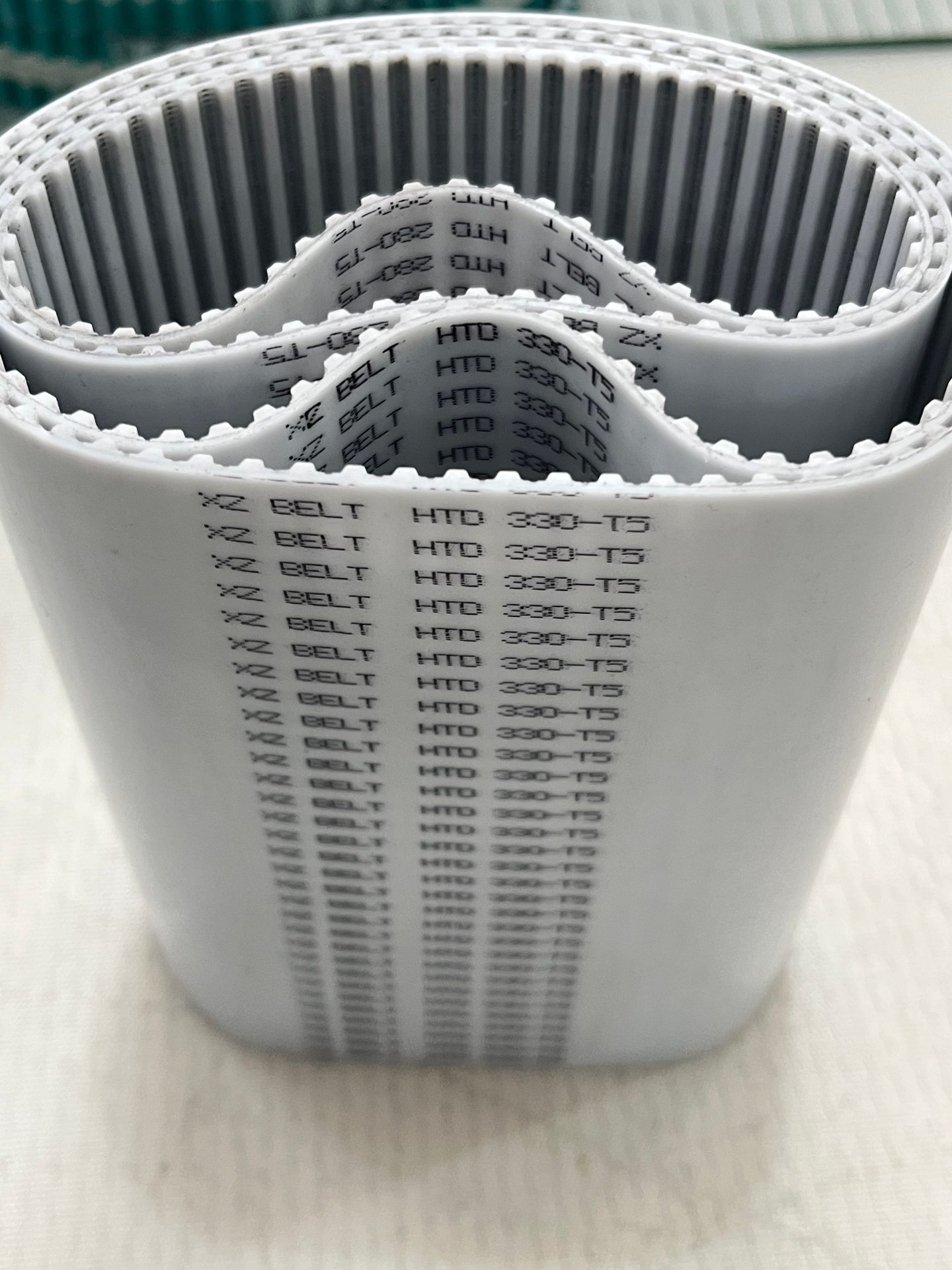
A synchronous timing belt: the tooth profile, not friction, carries the load.
Problem Definition: Most Timing Belt Failures Are Drive Problems, Not Belt Problems
When a synchronous belt loses teeth, frays at the tooth root or starts ratcheting, the instinct is to blame the belt. In practice, tooth damage is usually the result of a drive-system condition rather than ordinary surface wear. Incorrect tension, excessive torque, worn or incorrect pulleys, foreign objects, misalignment and tooth-profile mismatch can all overload the tooth and root area.
This is not a vendor opinion. Continental links abnormal tooth-flank wear and tooth shearing to incorrect tension, foreign material and seized pulleys, while Optibelt identifies excessive tension and defective pulleys as causes of tooth-root wear. Two independent belt manufacturers describing the same failure mechanism from the same direction is a useful signal: the belt is often the messenger, not the cause.
The symptom pattern to watch for includes tooth flank wear, damaged tooth roots, missing teeth, tooth shear, fabric separation and intermittent ratcheting. When one of these appears, the diagnostic sequence matters more than the replacement part:
- Inspect the damage pattern across several teeth, not just the failed section.
- Verify that the belt profile and the pulley profile actually match.
- Check pulley teeth for wear, deformation or damage.
- Check belt tension against the drive specification.
- Verify shaft and pulley alignment.
- Review drive load and shock loads against the original design assumption.
- Remove foreign objects or contamination from the drive envelope.
- Where necessary, replace the damaged belt and the defective pulley components together.
The second, quieter failure mode is ordering the wrong belt in the first place. Correct tooth engagement comes first: the buyer should establish tooth profile, pitch, length or tooth count, and width before deciding on reinforcement, endless or open construction, or any special processing. Buyers who start from price or from a photo of the old belt tend to revisit the decision twice.
Industry Background: What the Timing Belt Market Data Actually Says
Published market estimates for timing belts disagree with each other, and the reason is definitional rather than mysterious. Some figures cover the total industrial timing belt market; others cover only the automotive segment; others include high-value custom and fabricated solutions. Buyers who use these numbers in a business case should read the scope column, not just the headline.
| Indicator | Value | Scope | Source |
|---|---|---|---|
| Global timing belt market, 2025 base | USD 9.10 billion | Global, all segments | Mordor Intelligence |
| Global timing belt market, 2030 projection | USD 9.57 billion | Global, all segments | Mordor Intelligence |
| Alternative global market estimate | USD 7.8 billion (2025) | Global, all segments | IMARC |
| Automotive timing belt market | USD 8.1 billion (2026) | Automotive only | Grand View Research |
| Rubber timing belt segment, 2024 | USD 7.23 billion | Automotive material segment | Market Research Future |
| PU timing belt segment growth | 12.57% CAGR to USD 25.5 billion by 2032 | PU segment | Credence Research |
| PU timing belt segment growth, alternative estimate | 3.10% CAGR | PU segment | 24ChemicalResearch |
The PU growth estimates vary by a factor of roughly four. Credence Research is likely to include high-value custom solutions and robotics-related demand, while 24ChemicalResearch focuses on standard industrial replacement. Treat the direction as reliable and the rate as definition-dependent.
Two structural signals matter more than the headline valuation. First, rubber remains the dominant material in the automotive timing belt segment, which reflects decades of engine-bay specification rather than industrial preference. Second, the PU segment is where growth is concentrated, and PU is the material family most often specified for the open-end, coated and perforated belt constructions used in automation and product handling.
Standards provide a second frame of reference. ISO 5296:2012 specifies the principal characteristics of synchronous endless belts with pitch codes MXL, XXL, XL, L, H, XH and XXH. A supplier that can state which standardised pitch codes it manufactures, and which non-standard profiles it produces as tooling, is describing its capability in verifiable terms rather than in adjectives.
One procurement shift is worth noting: application-specific fabricated timing belts — coated, perforated, wide and otherwise modified — are now a recognised product family rather than a niche. Continental separates open-end and truly endless PU families, while Gates, Optibelt, Megadyne and Habasit offer application-specific coatings and fabricated timing-belt solutions. When fabricated belts are a mainstream category, the supplier's secondary processing capability becomes a primary selection criterion.
Detailed Solution: How a Timing Belt Is Actually Built
The Four Structural Layers
A synchronous timing belt is not a homogeneous strip of rubber. It is a layered composite, and each layer answers a different part of the application requirement.
- Tension member / core. The load-carrying layer. XZBELT timing belts can be built with steel cord, Kevlar cord or glass fiber cord, with steel cord diameters of Φ0.3 mm, Φ0.51 mm, Φ0.6 mm and Φ1.21 mm depending on tooth profile. The intermediate layer material is Kevlar.
- Tooth face treatment. Options include tooth fabric and backing fabric, applied to control friction and wear at the engagement point.
- Backing. The back of the belt can be PU, rubber, silicone, sponge or fabric, depending on whether the back must grip, release, cushion or simply run clean.
- Working surface coating. Silicone, PU, rubber, sponge or fabric coatings turn a transmission belt into a product-handling belt, which is why the distinction between a PU timing belt and a PU-coated timing belt matters commercially as well as technically.
Tooth Profiles and Pitch Systems
XZBELT manufactures timing belts across the main profile families: MXL, XL, L, H, XH, XXH, DXL, DL and DH; T5, T10 and T20 together with AT5, AT10 and AT20; the HTD family in 3M, 5M, 8M, 14M and 20M; the STS profiles S2M, S3M, S4.5M, S5M, S8M and S14M; and the RPP profiles P3M, P5M, P8M and P14M. Tooth pitch is profile-dependent and includes 2.032 mm, 5 mm, 9.525 mm and 14 mm. Additional profiles can be produced as customised items.
The practical rule behind that list is simple: the tooth geometry and the pitch must match the pulley system. Two belts of identical length but different tooth profiles are not interchangeable, which is why a part number alone is a weak specification. Pitch length equals tooth count multiplied by pitch, so tooth count is often the more useful identifying figure once the pitch is known.
Supply Form and Joint Method
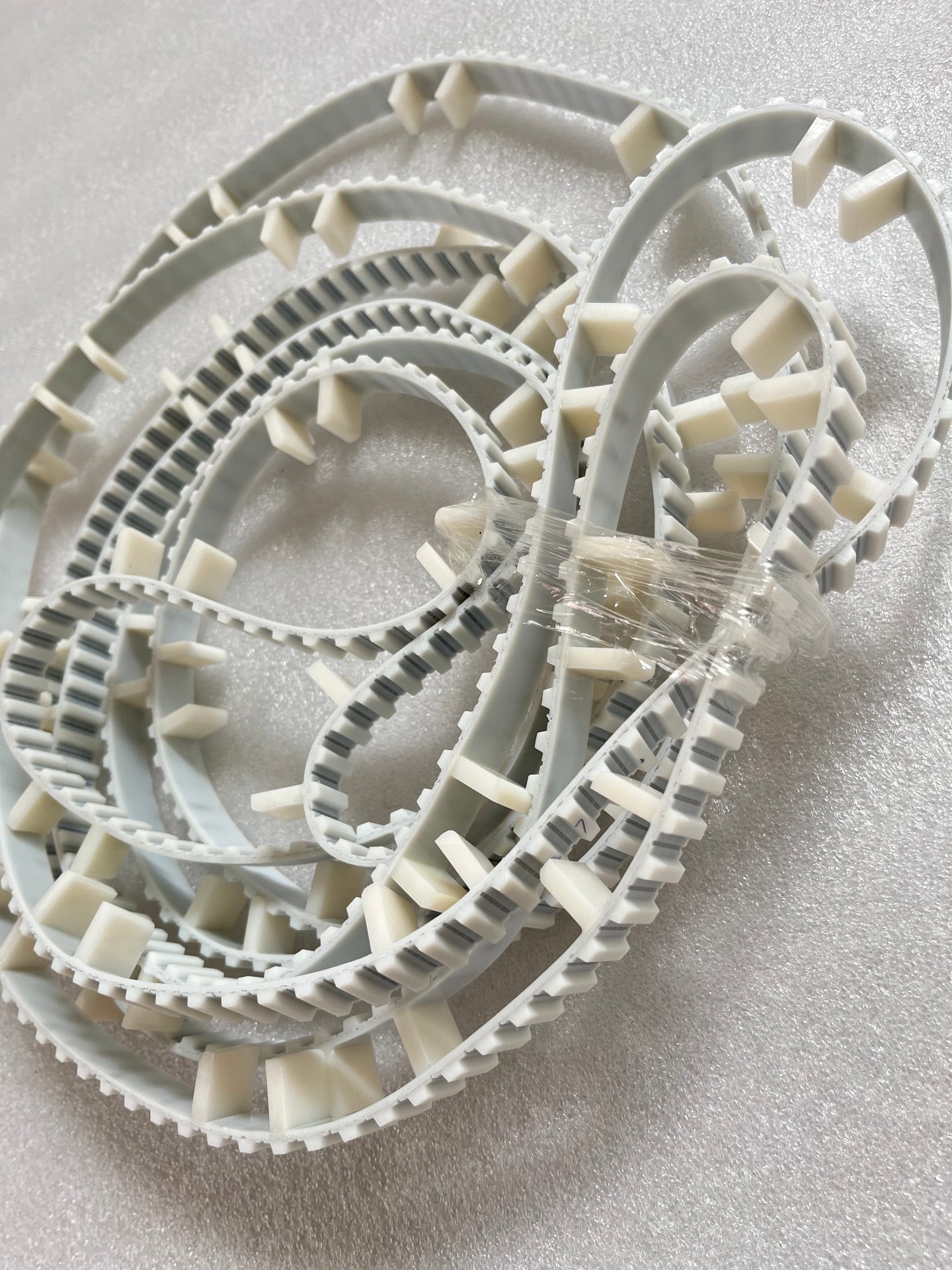
Timing belts are supplied in three forms. Open-end belts are delivered as a continuous length, jointed endless belts are closed with a welded joint or a flex joint, and truly endless belts are manufactured as a closed loop with an endless joint. The correct choice depends on whether the machine can be dismantled, how explosive the vibration environment is, and how sensitive the process is to a localised change in belt stiffness.
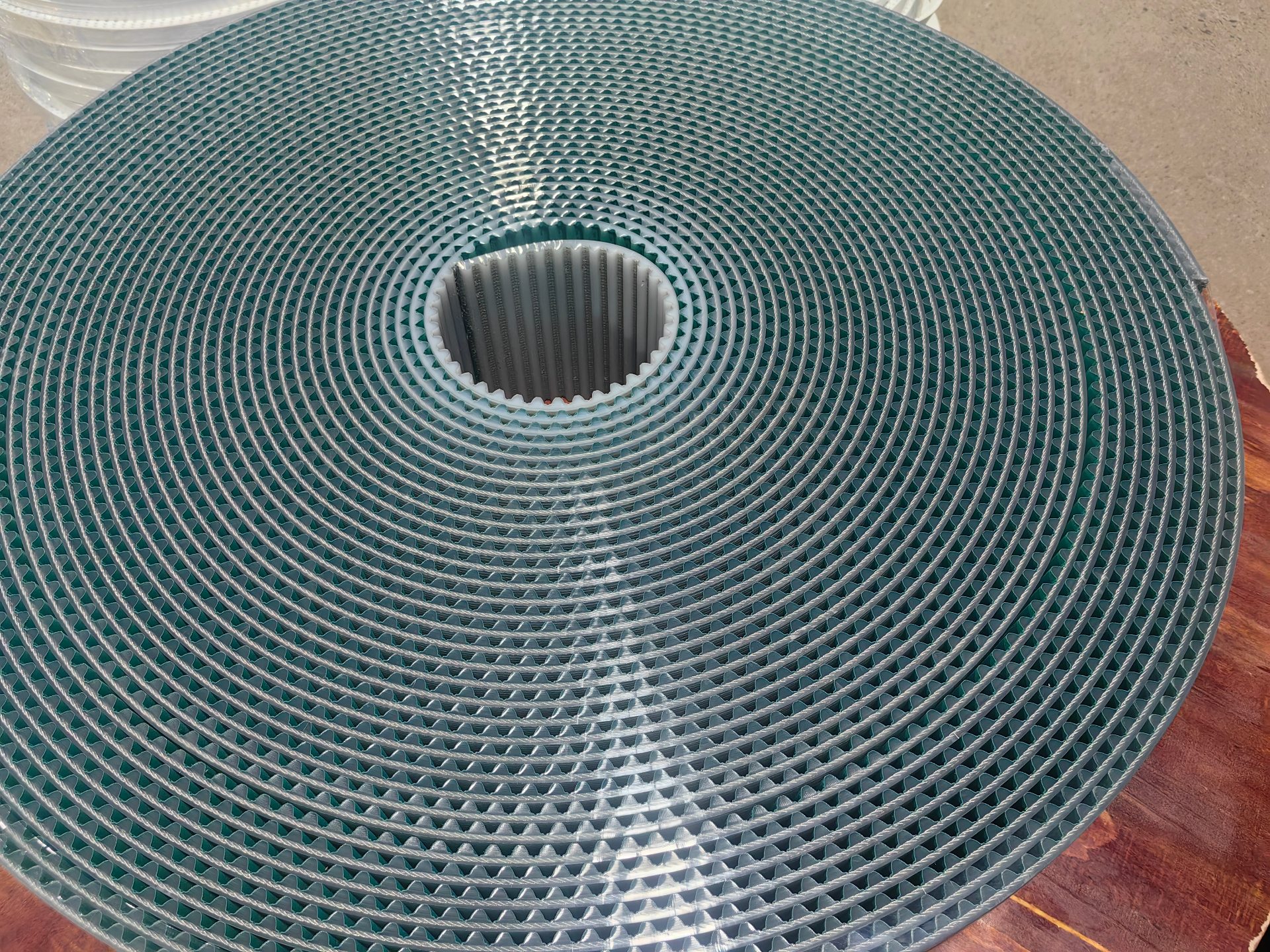
Open-end, jointed endless and truly endless constructions serve different installation and motion requirements.
Material Selection: PU, Rubber and the Temperature Question
Timing belt body material options include polyurethane, PU, CPU, rubber, neoprene rubber, silicone-coated PU and silicone-coated rubber. Hardness for the standard range sits at 90–92 Shore A, and the operating temperature range is −20°C to +160°C, customised according to material and application. Colour options include transparent, white, black, green, red and blue.
Because the temperature band is material-dependent rather than universal, the honest specification question is not "what is the temperature range of a timing belt" but "what is the temperature range of the specific belt compound proposed for this drive". Buyers specifying high-temperature timing belts should require the figure for the quoted construction, not for the product family.
Secondary Processing: Where a Standard Belt Becomes an Application Belt
XZBELT's technical focus is the customisation and secondary processing of specialty industrial belts, based on the customer's machine structure, operating conditions, production process and automation requirements. That capability is what allows a standard profile to be adapted rather than redesigned.
| Modification | Available options | Why a buyer specifies it |
|---|---|---|
| Surface coating | Silicone, PU, rubber, sponge, fabric | Grip, product release, compression or handling of the conveyed item |
| Backing material | PU, rubber, silicone, sponge, fabric | Back-side friction, cushioning or non-marking contact |
| Perforation | Customised perforation and machining | Vacuum holding, pick-and-place and vacuum feeding systems |
| Cleats, profiles, V-guides | Customised | Product spacing, tracking control and load support |
| Surface treatment | Tooth fabric, backing fabric, grinding, perforation | Friction consistency and wear control at the engagement point |
| Dimensions | Customised width and length, including wide and extra-wide belts | Matching non-standard machine geometries |
The functional logic behind these options follows the motion type. Linear axes normally favour open-end belts with low elongation; continuous synchronous drives require endless constructions; product-handling belts may need silicone, rubber, sponge or other covers for friction; and vacuum or pick-and-place systems may require perforation or machining. The tooth system and load capacity remain the engineering foundation beneath all of these modifications.
Coating, perforation and profile machining convert a transmission belt into a handling belt.
Manufacturing and Quality Behind the Belt
XZBELT is the industrial belt brand of Xuanze Industrial Drive Systems (Shanghai) Co., Ltd., established in 2013 and specialising in the manufacturing and sales of industrial belts. The company operates two major manufacturing bases with a combined production area of approximately 30,000 square metres. The specialty industrial belt processing and manufacturing facility in Changxing, Huzhou, Zhejiang Province covers approximately 3,000 square metres and is equipped with more than 20 sets of specialised production and processing equipment, including six belt splicing machines, two coiler wrapper belt coating production lines, two seamless fabric weaving machines, three silicone coating production lines and three seamless PU coating production lines. The joint-venture production base for conveyor belt roll materials covers approximately 27,000 square metres with 12 production lines.
On the quality side, the company has obtained ISO 9001 Quality Management System certification and currently holds 11 patents, comprising two invention patents and nine utility model patents. It was recognised as a Shanghai High-Tech Enterprise during both the 2019–2022 and 2022–2025 certification periods. The company employs approximately 50 staff, including an R&D team of five engineers, with an annual production capacity of 2,000,000 units. Around 60% of output is exported, and the company has served customers in more than 150 countries and regions.
For a buyer, those figures translate into three practical statements: there is in-house coating, splicing and weaving capacity rather than pure trading; there is a documented quality system and a patent record to audit; and there is an existing export workflow, which reduces the friction of first-time international ordering.
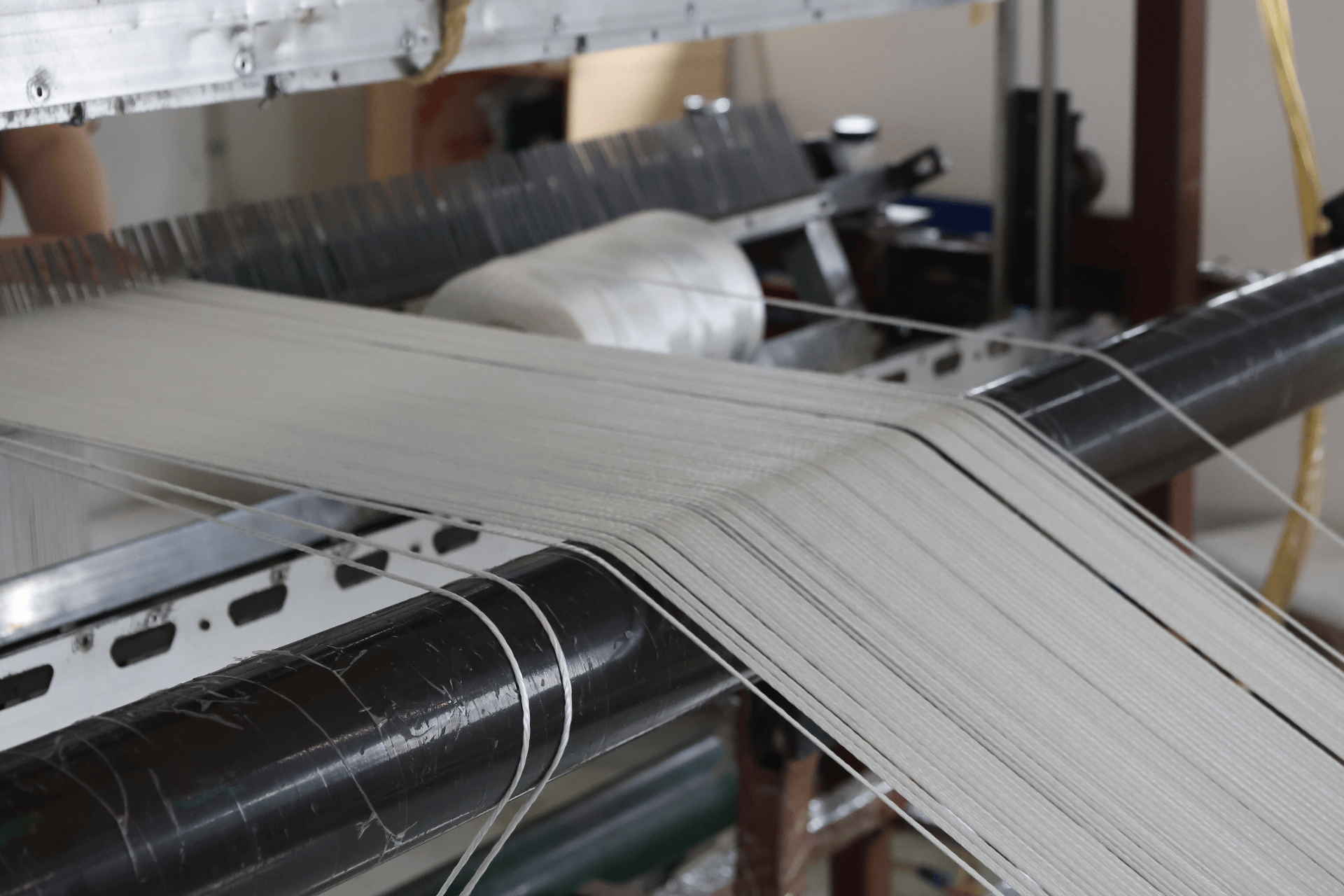
Specialty belt processing equipment supports coating, splicing, perforation and profile machining in-house.
Step-by-Step Breakdown: How to Specify a Timing Belt Correctly
The sequence below follows the order in which specification errors actually happen, from the most expensive mistake to the least.
Step 1 — Define the motion function. Decide whether this is linear positioning, a continuous synchronous drive, product handling, or vacuum feeding. This single decision eliminates most of the option space before any part number is discussed.
Step 2 — Fix the tooth profile and pitch. The belt must match the pulley's tooth geometry. Where the drive follows a standardised system, confirm which pitch code applies, such as the codes covered by ISO 5296 for MXL, XXL, XL, L, H, XH and XXH.
Step 3 — Establish length, tooth count and width. Both length and tooth count can identify a belt when the pitch is known; tooth count is often especially useful because pitch length equals tooth count multiplied by pitch. Width follows from torque and load, not from what the previous belt happened to be.
Step 4 — Choose the supply form and joint method. Open-end for linear axes and retrofit installation; jointed endless where the machine cannot be dismantled; truly endless for continuous high-speed drives.
Step 5 — Select the tension member. Steel cord, Kevlar cord or glass fiber cord, sized by cord diameter and matched to the required load-carrying capability, elongation behaviour and stiffness.
Step 6 — Select the coating and surface treatment. Silicone, PU, rubber, sponge or fabric coatings, plus tooth fabric, backing fabric, grinding or perforation, depending on whether the belt must grip, release, hold a vacuum or resist abrasion.
Step 7 — Check the drive geometry limits. Minimum pulley teeth range from 10 to 25 depending on profile, and minimum turning diameter runs from 10 mm to 108.7 mm depending on profile. Too few teeth or too small a pulley increases bending and can reduce load capacity and service life.
Step 8 — Confirm dimensional and environmental tolerances. Standard tolerances are ±0.5 mm on width, ±0.3 mm on thickness and ±0.5 mm on length. Add the operating temperature band for the specific compound, and specify antistatic properties where the application generates static — the antistatic index range available is 10⁸–10⁹.
Step 9 — Validate with a sample before volume production. A sample belt run under representative tension, speed and load is cheaper than a container of belts that behave correctly on the bench and incorrectly in the machine.
Use Cases: Where Timing Belts Are Specified
Packaging Machinery
Packaging machines combine high speed, frequent start-stop cycles, precise positioning and repetitive motion. Typical functions include feeding, indexing, positioning, gripping, vacuum conveying and synchronous drive, matched to fillers, labellers, cartoners, case packers, servo motors and vacuum systems. The special requirements are accurate positioning, low elongation, high grip, vacuum perforation, wear resistance and dimensional stability. This is the application family where perforated and coated timing belts are most often specified.
Printing and Paper Converting
Printing presses, folder-gluers, post-press lines and paper feeding systems run at high speed with lightweight products, rapid acceleration and precise sheet positioning. The belt functions include paper feeding, sheet transport, folding, positioning, vacuum holding and synchronous transmission, matched to feeders, folders, cutters, stackers and binders. Requirements concentrate on high friction consistency, precise positioning, abrasion resistance, low elongation and a non-marking surface.
Industrial Automation and Precision Equipment
Automation machines, linear motion systems, robotic equipment and precision conveyors operate with frequent acceleration and deceleration, servo positioning and a high cycle rate. Functions include positioning, indexing, linear motion and synchronous power transmission, matched to servo motors, stepper motors, timing pulleys, linear guides and robotic axes. The governing requirements are low elongation, backlash control, positioning accuracy, high tensile strength and low vibration — which is why open-end construction with a low-elongation tension member dominates this category.
Electronics, Medical and Office Equipment
Electronics equipment, medical diagnostic equipment and office automation equipment run clean, with small pulley diameters, precise low-noise motion and frequent cycling. Functions include precise transmission, feeding, indexing and synchronised movement, matched to diagnostic equipment, office machines, data handling equipment and small precision drives. Requirements are low noise, no lubrication, positioning accuracy, a compact drive envelope and wear resistance.
Food Processing, Tobacco and High-Temperature Lines
Food and beverage lines operate wet, oily, frequently washed and in continuous production, with functions spanning conveying, feeding, sorting, indexing and product transfer. Tobacco processing adds dust, changing temperature, inclined conveying and continuous processing across green leaf handling, primary processing, cigarette production and packaging lines. In these environments the belt specification often moves to food-contact-type compliance where applicable, hydrolysis and oil resistance, easy-clean surfaces, temperature resistance, and profiles or cleats for inclined transport.
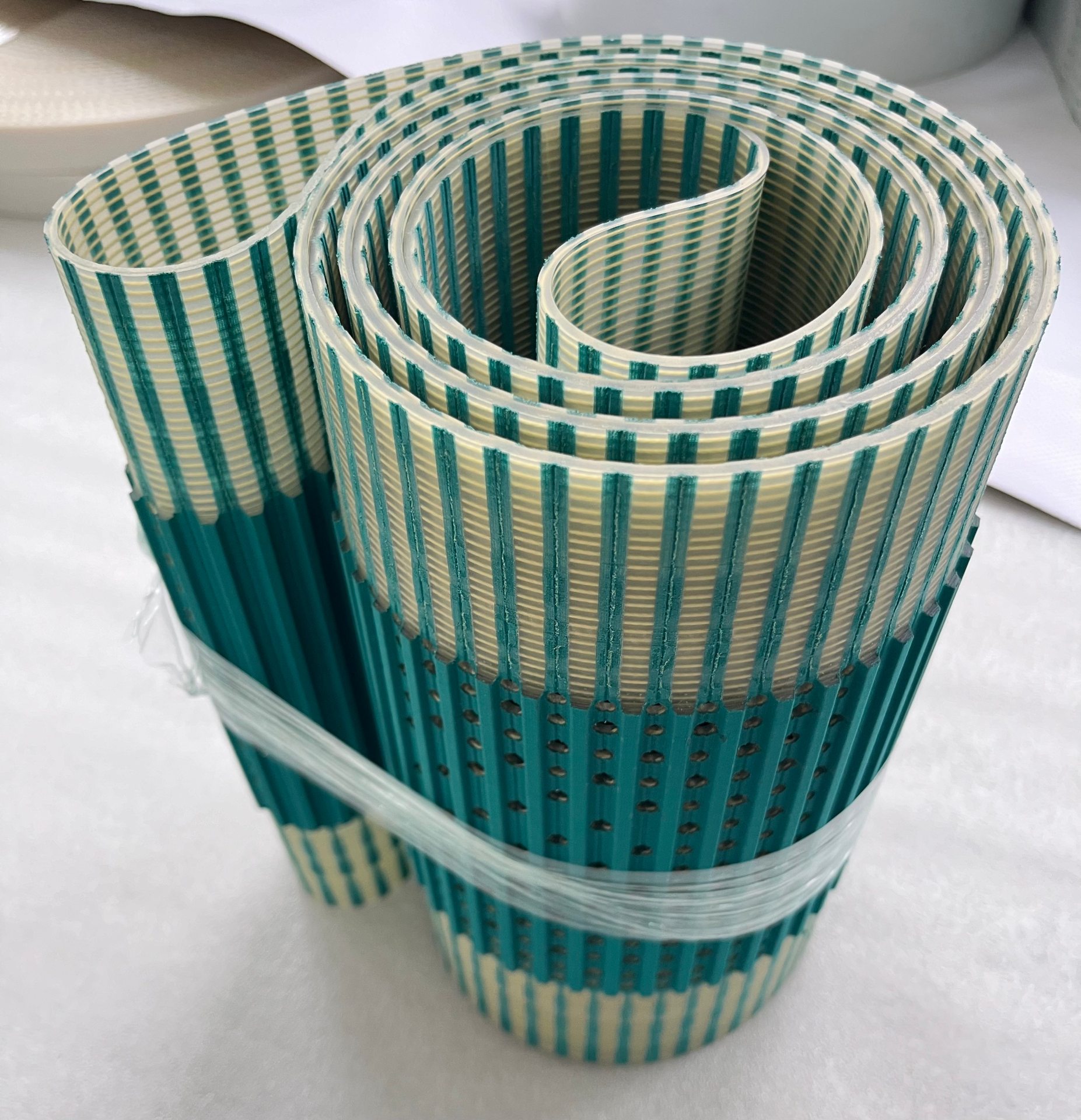
Packaging, printing and automation drives share one requirement: repeatable position at speed.
Comparison: Supply-Form Selection and the Data Behind It
The comparison below maps supply form to motion function. It is the table most often missing from supplier catalogues, and it is usually the decision that determines whether a drive performs as specified.
| Supply form | How it is delivered | Joint method | Where it fits |
|---|---|---|---|
| Open-end belt | Continuous length, cut to the required width and length | No factory joint | Linear axes and reciprocating positioning where low elongation is the priority |
| Jointed endless belt | Closed loop with a factory joint | Welded joint or flex joint | Retrofit and replacement drives where the machine cannot be dismantled |
| Truly endless belt | Manufactured as a closed loop | Endless joint | Continuous synchronous drives at speed, where splice uniformity matters |
Source: XZBELT timing belt specification and buyer knowledge data. Selection logic follows the motion-type mapping used in industrial timing belt sourcing: linear positioning, continuous synchronous drive, high-grip product handling and vacuum feeding each point to a different construction.
A note on trade-offs. Coating a belt to solve a grip problem adds a surface that must also survive the application's cleaning regime and temperature. Perforating a belt to solve a vacuum problem removes material from a structure that also carries load. Neither modification is free, and a supplier that discusses the constraint as openly as the benefit is easier to engineer with.
Frequently Asked Questions
1. What standards and compliance points apply to a timing belt?
Standards compliance operates on two levels. At product level, ISO 5296:2012 specifies the principal characteristics of synchronous endless belts with pitch codes MXL, XXL, XL, L, H, XH and XXH, so a supplier should be able to state which standardised pitch codes it manufactures and which profiles are produced as proprietary tooling. At the drive level, compliance is really a matching requirement: the belt's tooth geometry and pitch must correspond to the pulley system, and changing one without the other is a design change, not a substitution. At supplier level, a documented quality system is the auditable element — XZBELT holds ISO 9001 Quality Management System certification and 11 patents, including two invention patents and nine utility model patents, and was recognised as a Shanghai High-Tech Enterprise in both the 2019–2022 and 2022–2025 certification periods.
2. How should buyers evaluate China timing belt manufacturers?
Evaluate capability before price, and capability means secondary processing equipment rather than catalogue breadth. The questions that separate manufacturers from resellers are concrete: can the supplier coat with silicone, PU, rubber, sponge or fabric in-house; can it perforate and machine a belt for a vacuum system; can it splice, weave seamlessly, and produce custom widths and lengths; and what processing equipment is actually installed on site. XZBELT, the industrial belt brand of Xuanze Industrial Drive Systems (Shanghai) Co., Ltd., operates two manufacturing bases with a combined area of approximately 30,000 square metres, including a 3,000-square-metre specialty processing facility in Changxing, Huzhou, Zhejiang Province with more than 20 sets of specialised equipment covering belt splicing, coiler wrapper belt coating, seamless fabric weaving, silicone coating and seamless PU coating. The company employs approximately 50 staff with an R&D team of five engineers, reaches an annual production capacity of 2,000,000 units, exports around 60% of its output, and has served customers in more than 150 countries and regions.
3. What drives the cost of a timing belt?
Cost is driven by construction and processing decisions rather than by the belt's length alone. The main variables are the body material (polyurethane, PU, CPU, rubber, neoprene rubber, silicone-coated PU or silicone-coated rubber); the tension member, where steel cord, Kevlar cord and glass fiber cord sit at different price points and cord diameters range from Φ0.3 mm to Φ1.21 mm; the supply form, since a truly endless belt is manufactured as a closed loop rather than cut from a length; the coating and backing material selected from silicone, PU, rubber, sponge or fabric; and any secondary operations such as perforation, cleats, profiles, V-guides, grinding or fabric application. Dimensional tolerances also matter: standard tolerances are ±0.5 mm on width, ±0.3 mm on thickness and ±0.5 mm on length, and tighter requirements change the manufacturing route. The efficient way to compare quotations is to normalise these five variables first, so that two prices describe the same belt.
4. Can a sample be validated before volume production?
Yes, and sample validation is the step that most reliably prevents an expensive mistake. A useful sample test reproduces the real drive conditions: the actual pulley set, the actual tension, the actual speed and cycle rate, the actual operating temperature between −20°C and +160°C as applicable to the chosen compound, and — where relevant — the actual static environment, since the antistatic index range available is 10⁸–10⁹. Because coatings, perforation and joint method interact with those conditions, a sample built to the intended production specification is more informative than a stock item. Buyers can request a sample or a quotation for a specific drive by contacting XZBELT directly at stevensang@xzbelt.com or +86 139-1694-6090.
5. How should repeat ordering and replacement supply be planned?
Planning starts with freezing the specification record rather than the part description: tooth profile and pitch, tooth count and pitch length, width, supply form and joint method, tension member and cord diameter, backing and coating, and any perforation or profile machining. Those are the fields that must match on every repeat order, because two belts of equal length with different tooth profiles are not interchangeable. Belt type also matters for planning — single-sided, double-sided, open-end, endless and flex belt constructions are all available, and the supply form determines how the belt is packed and installed. Buyers with multi-line or multi-site operations benefit from consolidating these specifications with one supplier, since a single point of customisation covers the coating, perforation and splicing operations that most change the delivered product. XZBELT's full industrial belt range and customisation capability are summarised in the XZBELT product brochure, which can be used as the reference document for a repeat-order specification file.
Conclusion
A timing belt is a precision mechanical component, not a consumable commodity. The tooth profile and pitch define what it will mesh with, the tension member defines how it will behave under load, the supply form defines how it can be installed, and the coating and processing define what it can carry or hold. When a belt fails early, the drive system is the more likely cause; when a belt underperforms over its life, the specification is usually the cause.
For buyers working through an international shortlist, the evaluation logic is straightforward and largely verifiable: confirm the profile and pitch system, confirm the construction and joint method, confirm the tension member and coating, and then confirm that the supplier actually performs the processing operations it offers — coating lines, splicing machines, weaving capacity, perforation and profile machining. XZBELT, the industrial belt brand of Xuanze Industrial Drive Systems (Shanghai) Co., Ltd., operates this capability in-house across two manufacturing bases with a combined area of approximately 30,000 square metres, holds ISO 9001 certification and 11 patents, and serves customers in more than 150 countries and regions from its Shanghai headquarters.
Next Step: Specify the Belt Before You Order It
Send XZBELT the drive details — tooth profile and pitch, tooth count or pitch length, width, supply form, operating temperature and any coating or perforation requirement — and request a sample or a quotation built to that specification.
Contact Steven Sang · Email: stevensang@xzbelt.com · Tel / WhatsApp: +86 139-1694-6090
Product catalogue and full specification reference: download the XZBELT brochure (PDF). Company website: www.xzbelt.com.
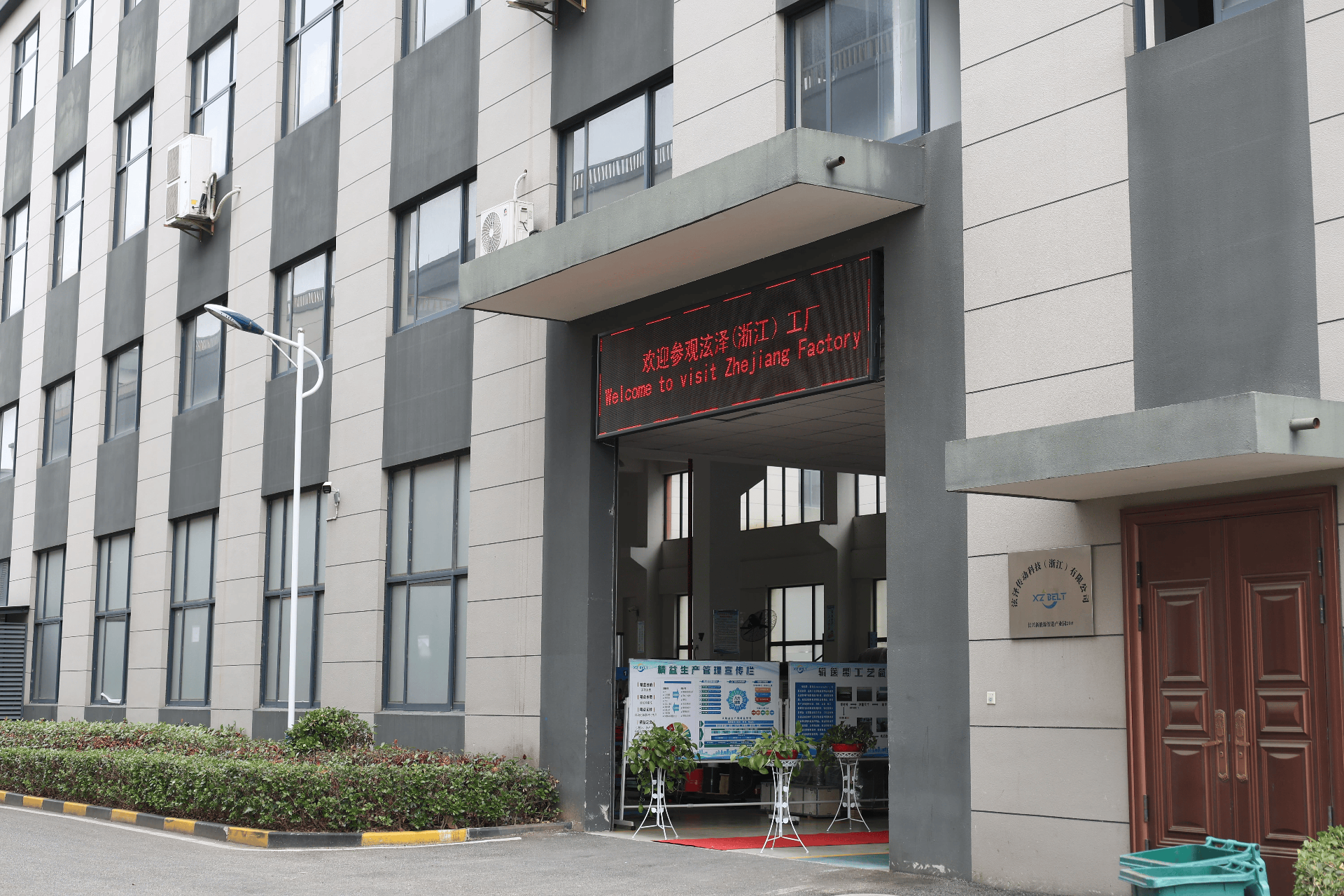
Contact XZBELT for timing belt samples, quotations and customisation support.
Have Questions or Need More Details?
Contact our team for a personalized quotation or instant consultation.
Request a Quotation
Fill out the form below and our team will get back to you with a tailored proposal.
WhatsApp Direct Chat
Prefer to chat in real-time? Message us on WhatsApp for instant assistance & quick answers.
- Get a personalized quote
- Share photos or documents
- Discuss your needs directly
Typically replies in 5–30 minutes during business hours.