Seamless vs Spliced Timing Belts: A Comparison Guide for Industrial Buyers
A seamless timing belt is not automatically better than a spliced one. The correct construction depends on drive geometry, load and tension behaviour, the cost of a joint failure, and how the belt has to be fitted to the machine. Seamless — more precisely, truly endless — constructions remove the splice as a potential failure point, but they also fix the length, width and pulley envelope that a spliced belt can work around. This guide sets out the comparison criteria an industrial buyer should actually use.
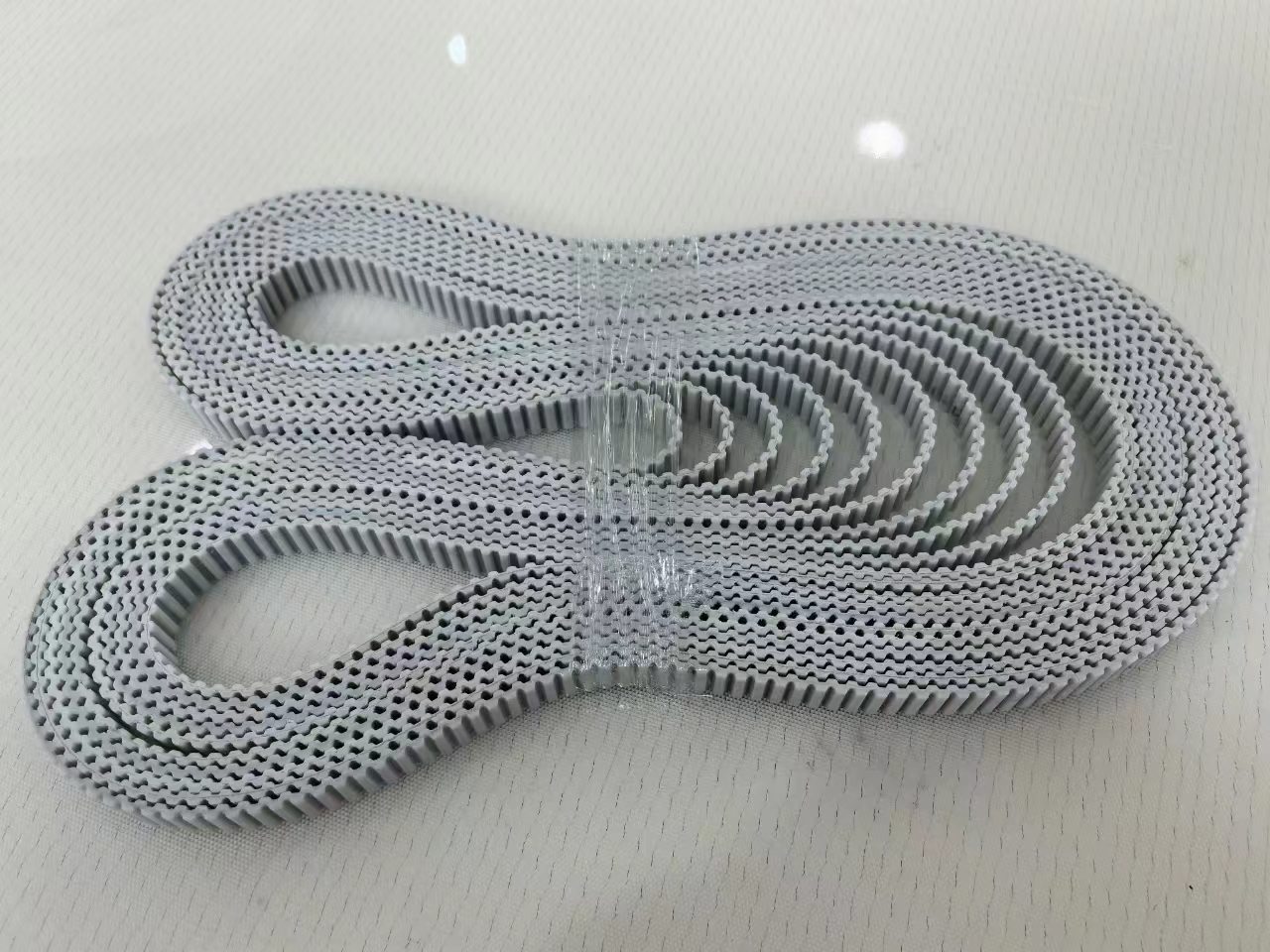
Cover: toothed timing belt range used for industrial drive, positioning and conveying duties.
The question usually appears at two moments: when a belt has just failed and the replacement has to be specified quickly, or when a machine is being designed and the drive layout is not yet frozen. Two belts can share the same tooth profile, the same pitch and the same width, and still differ completely in how the loop is closed. That single difference changes the installation method, the tensioning behaviour, the spare-parts strategy and the failure mode you will eventually have to manage.
What Counts as Seamless and What Counts as Spliced
In procurement language, “seamless” normally means a belt supplied as a closed loop with no joint anywhere in the circumference. Suppliers also describe the same thing as “truly endless” or simply “endless”. “Spliced” is the opposite: the belt starts as an open length and the loop is completed by joining the two ends, or the belt is supplied open and joined at the machine.
XZBELT’s timing belt range documents three supply forms — open-end belt, jointed endless belt and truly endless belt — and lists welded joint, flex joint and endless joint as the available joint methods for the timing belt product. That vocabulary matters at the quotation stage, because two suppliers may both quote an “endless timing belt” while one means a genuinely closed loop and the other means an open length welded into a loop. Buyers should ask which of the three supply forms is being offered before comparing anything else.
There is a second, easily confused sense of seamless. XZBELT manufactures a silicone-coated seamless woven belt built on a seamless weaving process: one layer, 9 ± 0.5 mm overall thickness, with a 3 mm surface coating over a 6 mm baseband. It is used in high-temperature processing equipment, textile machinery, packaging machinery and industrial conveying and transfer equipment, and it is not a toothed power-transmission belt. When a supplier claims seamless construction, the buyer should establish whether the claim refers to the tooth profile (a truly endless toothed belt) or to the carcass (a seamlessly woven belt body). The two answer different engineering questions.
Industry Background: Why the Construction Decision Is Getting More Attention
The timing belt category is large and still expanding. Mordor Intelligence projects the global timing belt market to reach approximately USD 9.57 billion by 2030, from a 2025 base of USD 9.10 billion. Within that total, material and construction choices are diverging: Credence Research estimates the polyurethane (PU) timing belt segment growing at a CAGR of 12.57% to USD 25.5 billion by 2032, while 24ChemicalResearch estimates 3.10% for the same segment. The gap is a methodology difference rather than a contradiction of fact — the higher figure appears to include high-value custom solutions and robotics, while the lower figure focuses on standard industrial replacement. Market Research Future places rubber as the dominant material in the automotive timing belt segment, at an estimated USD 7.23 billion in 2024.
Two practical consequences follow for buyers. First, both constructions remain in active demand, so this is rarely a choice between a current technology and an obsolete one. Second, the specification differences that separate suppliers now sit mostly in secondary construction and processing — joint quality, coating, perforation, tension member and dimensional tolerance — rather than in the existence of a tooth profile. On the belt side, ISO 5296:2012 specifies the principal characteristics of synchronous endless belts with pitch codes MXL, XXL, XL, L, H, XH and XXH, which gives buyers a shared reference for the geometry that both constructions must reproduce.
Detailed Comparison: Five Dimensions That Actually Decide the Answer
1. Tension behaviour and elongation
A seamless loop distributes load continuously around the circumference. A spliced belt introduces an interface where load transfers from the belt body into the joint. The useful buyer question is therefore not “which one stretches more”, but “what elongation budget does my drive allow, and how does the belt recover?”
XZBELT documents its silicone-coated seamless woven belt with a tensile force of 30 N/mm at 1% elongation and a tensile strength of 350 N/mm at 3% elongation, and states that the belt is recoverable after 2.5% elongation. In the toothed timing belt line, the tension member options are steel cord, Kevlar cord and glass fibre cord, with available steel cord diameters of Φ0.3 mm, Φ0.51 mm, Φ0.6 mm and Φ1.21 mm. The tension member, not the presence or absence of a splice, is normally the primary control on elongation — which is why a seamless construction should not be assumed to solve an elongation problem on its own.
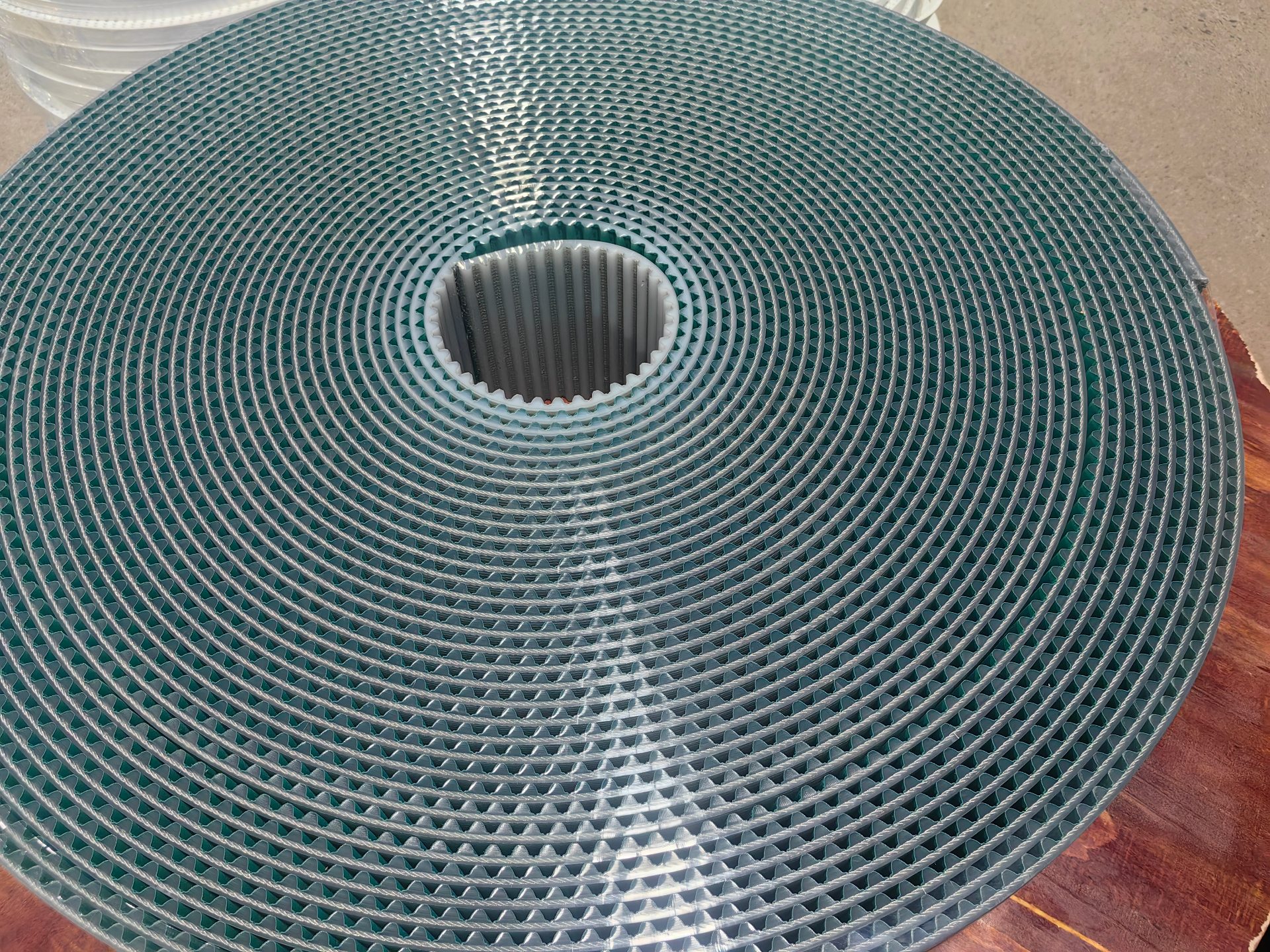
Open-end supply forms can be joined to length, while truly endless loops leave no joint to inspect.
2. Joint risk and failure mode
The most quoted advantage of a seamless belt is that it has no splice weak point, and that is a genuine engineering argument: the joint is an additional interface with its own bond strength, its own fatigue behaviour and its own sensitivity to installation tension. Where a joint fails, it normally fails at or near the join, and the result is an unplanned stop rather than gradual, predictable wear.
It does not follow that every spliced belt is a liability. The timing belt specification states that the maximum load force for a jointed belt is defined according to width and tooth profile — in other words, the joint is a rated part of the design envelope, not an unrated improvisation. A documented case from the packaging sector illustrates the point. A packaging machinery distributor and carton packaging manufacturer used more than 1,000 belts annually on folder-gluer and carton packaging lines for high-speed carton feeding, folding, pressing and conveying. Across a 24–30 month continuous operating period, belt replacement frequency fell by approximately 40%, with improved feeding accuracy and operating stability, reduced belt slippage and unplanned downtime, and better overall production efficiency. The documented highlights include consistent friction performance, low elongation and reliable endless joint strength, supported by customized hardness and surface finishing.
The lesson is that joint reliability is a manufacturing and application question, not a construction-category question. Buyers should ask how the joint is produced, what load it is rated for at their specific width and profile, and whether the supplier can repeat that same construction consistently across repeat orders.
3. Tooth engagement, pitch and positioning
Positioning accuracy depends on tooth geometry and engagement far more than on the presence of a splice. The buyer checklist here is fixed: establish tooth profile, pitch, length or tooth count, and width before deciding reinforcement, endless or open construction, or special processing. Two timing belts of the same length but different tooth profiles cannot be interchanged, because tooth geometry and pitch must match the pulley system.
XZBELT’s timing belt range covers MXL, XL, L, H, XH, XXH, DXL, DL and DH, T5, T10 and T20, AT5, AT10 and AT20, and HTD 3M, HTD 5M, HTD 8M, HTD 14M and HTD 20M, together with STS S2M–S14M and RPP P3M–P14M codes, with tooth pitches including 2.032 mm, 5 mm, 9.525 mm and 14 mm. Dimensional tolerances are stated as ±0.5 mm on width, ±0.3 mm on thickness and ±0.5 mm on length. Because the final length of a spliced belt is influenced by how the join is executed, buyers specifying a jointed endless belt should confirm how the joint is accounted for within that stated length tolerance.
4. Speed, pulley diameter and operating environment
Small pulleys and tight reverse bends are usually the constraint that settles the construction question. The timing belt line lists a minimum pulley of 10–25 teeth and a minimum turning diameter of 10 mm to 108.7 mm depending on tooth profile; too few teeth or too small a pulley increases bending and can reduce load capacity and service life. The silicone-coated seamless woven belt is specified with a minimum pulley diameter of 70 mm forward and 120 mm reverse, a maximum operating speed of 400 m/min and an operating temperature range of −40 °C to +210 °C.
For toothed timing belts, the stated hardness range is 90–92 Shore A and the operating temperature range is −20 °C to +160 °C depending on material. Materials include polyurethane, PU, CPU, rubber, neoprene rubber, silicone-coated PU and silicone-coated rubber, with backing and surface coating options in PU, rubber, silicone, sponge and fabric. Where static is a concern — in textile and electronics environments, for example — the specification lists an antistatic index of 10⁸–10⁹.
The practical reading is straightforward. A seamless construction helps where a closed loop can be routed around the drive and where continuous construction supports stable running at speed. Spliced constructions remain the practical answer where the machine frame cannot accept a closed loop, or where an open length has to be joined to a non-standard length.
5. Compliance and documentation
Compliance is a separate axis from construction. XZBELT operates an ISO 9001:2015 quality management system under certificate 62725Q1200R0S, issued by JingXin Certification (Beijing) Co., Ltd. on 2025-08-01 and valid to 2028-07-31, covering the sales of industrial transmission and conveyor rubber and plastic belts. For the US market, PU, rubber, synchronous and toothed timing belts are covered by FDA Compliance Test Report A2260699898101001, issued on 2026-08-20 by the third-party testing organisation Centre Testing International Group Co., Ltd. (CTI) under FDA 21 CFR 177.2600, with a test scope of Total Extractives in Distilled Water and n-Hexane. The silicone-coated seamless belt is separately covered by an FDA Compliance Test Report numbered SHAFD2101526402 under US FDA 21 CFR 175.300, with a Total Extractives test scope.
Note the sequence. Certification documents the manufacturing system and the material compliance of a defined product, but it does not choose the construction for you. A fully certified spliced belt on a drive that demands a closed loop is still the wrong belt.
The rule buyers keep forgetting
Do not select a seamless belt only because it has no splice. Select it because the drive can accept a closed loop, the pulley diameters and reverse bends are within the seamless belt’s limits, the temperature and coating requirements match the construction, and the joint you would otherwise carry is the failure mode you cannot tolerate.
Step-by-Step Breakdown: A Seven-Step Buyer Checklist
- Define the motion function first. XZBELT’s application guidance maps construction to duty: linear positioning favours open-end PU timing belts with suitable low-elongation reinforcement; continuous synchronous drives call for endless or truly endless construction sized for torque and speed; high-grip product handling calls for a coated belt selected by product friction and release needs; and vacuum feeding calls for a perforated or machined belt matched to the vacuum system.
- Confirm the pulley system before the belt. Establish tooth profile, pitch, tooth count or length, and width first. Then verify minimum pulley teeth and minimum turning diameter against the proposed profile, and check whether reverse bending is present, because the minimum pulley diameter for reverse running is larger — 70 mm forward against 120 mm reverse on the seamless woven belt specification.
- Set the elongation budget against documented figures. Compare tension member options (steel cord, Kevlar cord, glass fibre cord) with the load and positioning tolerance you need. Use stated numbers rather than supplier adjectives: 30 N/mm at 1% elongation, 350 N/mm at 3% elongation and recovery after 2.5% elongation on the silicone-coated seamless woven belt.
- Assess joint risk in your own failure economics. If an unplanned stop costs more than the belt, prefer a closed loop wherever the frame allows it. If the frame does not allow it, ask what load the joint is rated for at your width and tooth profile, and how the joint is produced.
- Check environment and compliance together. Temperature (−20 °C to +160 °C for the toothed range, depending on material; −40 °C to +210 °C for the silicone-coated seamless woven belt), antistatic behaviour, food-contact requirements and the documentation your customer or auditor will request.
- State the requirement, not the construction. Write down what you actually need — no joint failure risk, length flexibility, field replaceability, cleanliness, release properties — and let the supplier match a construction to it. A seamless belt chosen only because it has no splice can still be wrong if its minimum pulley diameter, available length or coating does not suit the machine.
- Plan the repeat supply at specification stage. Confirm exactly how the belt is identified on reorder — profile, pitch, tooth count, width, supply form — and what the supplier’s lead time is for the identical specification.
Use Cases: Where Each Construction Earns Its Place
- Packaging machinery. High speed, frequent start-stop, precise positioning, indexing and vacuum conveying. Documented special requirements include accurate positioning, low elongation, high grip, vacuum perforation, wear resistance and dimensional stability. Both constructions appear in this sector, and endless joint strength has been a documented factor in a long-running carton packaging application.
- Printing and paper converting. High-speed sheet positioning and folding demand high friction consistency, precise positioning, abrasion resistance, low elongation and a non-marking surface. Perforated and coated timing belts are typically specified where vacuum holding or direct product contact is involved.
- Industrial automation and precision equipment. Frequent acceleration and deceleration under servo control place the emphasis on low elongation, backlash control, positioning accuracy, high tensile strength and low vibration. Open-end construction with a suitable tension member is often preferred for linear axes, while continuous rotary drives favour a closed loop.
- Textile and nonwovens. Continuous high-speed operation with static generation requires antistatic performance, precise tracking, low elongation, abrasion resistance and dimensional stability. The antistatic index documented for the timing belt range is 10⁸–10⁹.
- High-temperature processing, bakery and confectionery lines. Here the seamless woven belt’s −40 °C to +210 °C range, silicone coating and release behaviour are the relevant properties. Separately, XZBELT records a large aluminium profile manufacturer using more than 50 belts annually for traction, conveying and surface protection on extrusion lines; over more than 12 months of continuous operation, the protective felt surface prevented scratches and pressure marks, maintained conveying accuracy, reduced maintenance frequency by approximately 30% and increased production efficiency by approximately 20%.
- Electronics, medical and office equipment. Clean, low-noise, lubrication-free motion on small pulleys, where the minimum pulley diameter limit usually decides the profile long before the splice question arises.
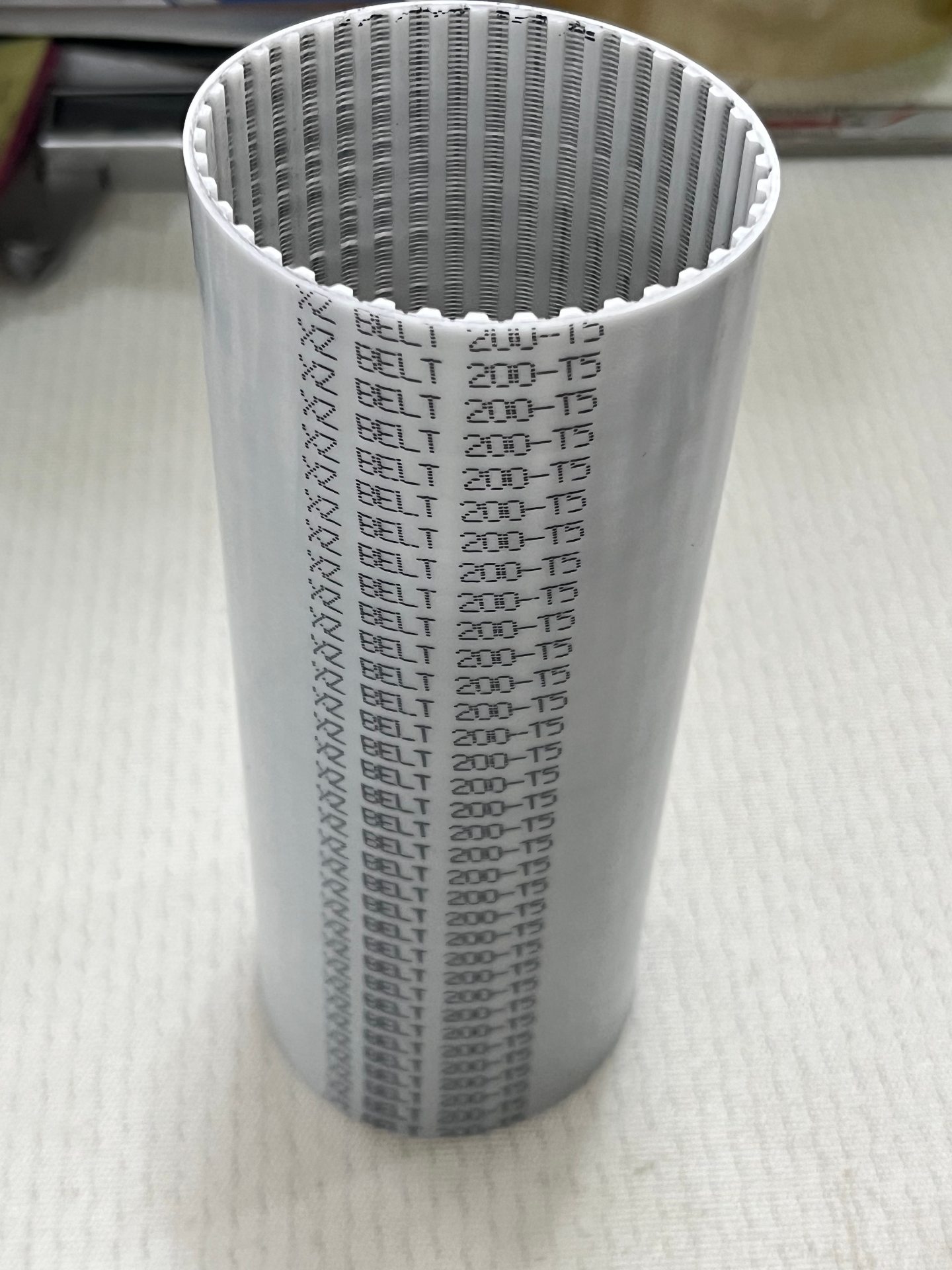
Tooth profile and pitch must match the pulley system before construction is discussed.
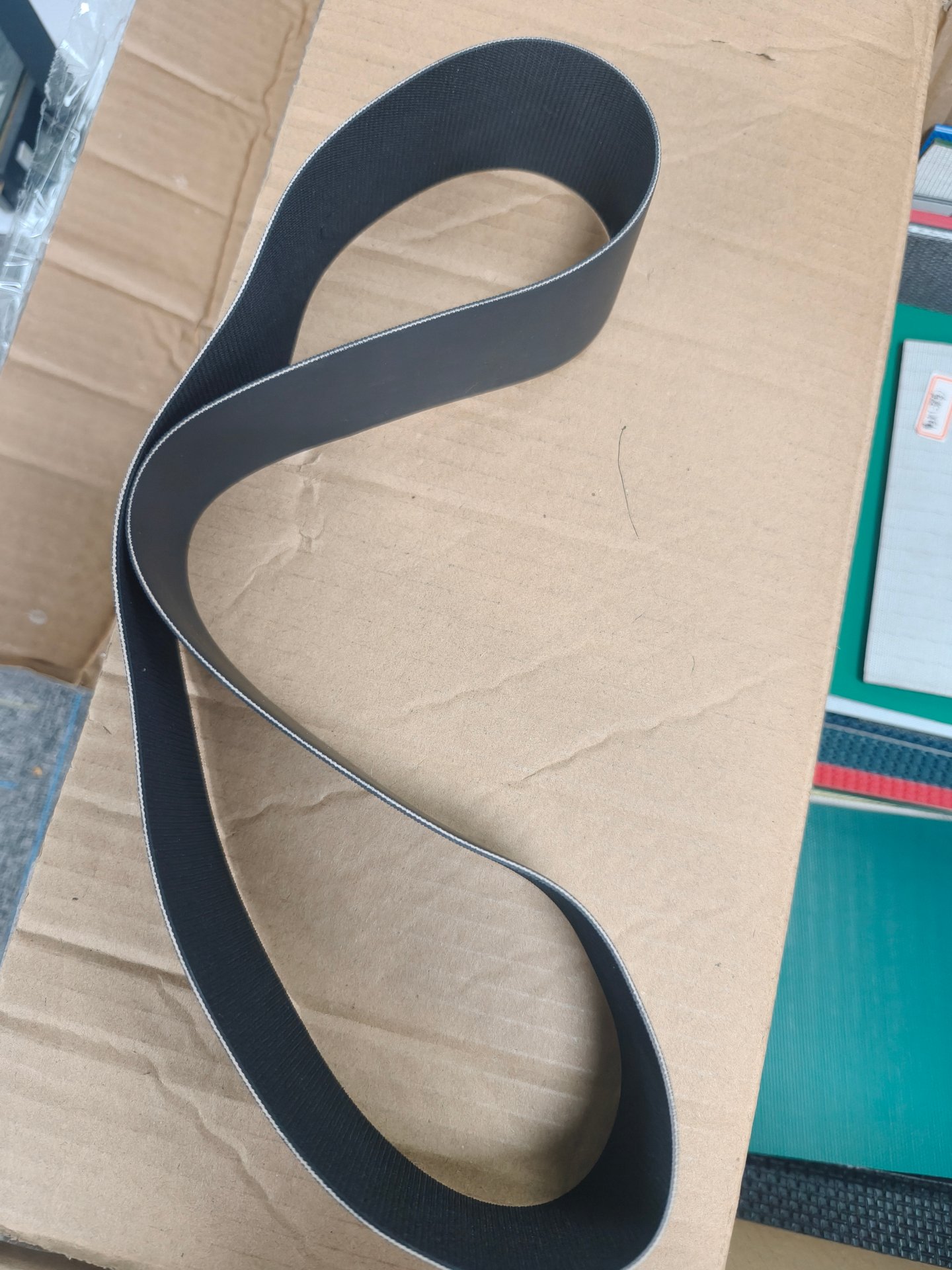
Seamless woven construction: one layer, 9 ± 0.5 mm thick, with a 3 mm silicone surface coating.
Seamless and Spliced Timing Belts: Side-by-Side Comparison
| Decision factor | Seamless / truly endless | Spliced / joined construction |
|---|---|---|
| How the loop is closed | Closed loop manufactured without a joint in the circumference; documented supply form is truly endless belt | Open length joined to form the loop, or supplied as open-end and jointed endless belt |
| Joint methods documented in the range | No joint to specify (truly endless construction) | Welded joint, flex joint, endless joint |
| Joint risk | No splice weak point — no bond interface to inspect or fatigue | Joint is a rated part of the design envelope; maximum load force for a jointed belt is defined according to width and tooth profile |
| Length flexibility | Fixed at manufacture; length set by the closed loop | Open-end stock can be joined to the required length |
| Tension and elongation data | Silicone-coated seamless woven belt: 30 N/mm at 1% elongation, 350 N/mm at 3% elongation, recoverable after 2.5% elongation | Tension member options: steel cord, Kevlar cord, glass fibre cord; steel cord diameters Φ0.3 mm, Φ0.51 mm, Φ0.6 mm, Φ1.21 mm |
| Dimensional tolerance (toothed range) | Width ±0.5 mm; thickness ±0.3 mm; length ±0.5 mm. For jointed endless belts, confirm how the joint is accounted for within the stated length tolerance. | |
| Pulley geometry limits | Seamless woven belt: minimum pulley diameter 70 mm forward, 120 mm reverse | Toothed timing belt: minimum pulley 10–25 teeth; minimum turning diameter 10 mm–108.7 mm depending on profile |
| Speed | Seamless woven belt: maximum operating speed 400 m/min | Selected by profile, pulley geometry and drive design |
| Temperature | Seamless woven belt: −40 °C to +210 °C | Toothed timing belt: −20 °C to +160 °C depending on material |
| Compliance documentation | FDA Compliance Test Report SHAFD2101526402 under US FDA 21 CFR 175.300 (silicone-coated seamless belt) | FDA Compliance Test Report A2260699898101001 under FDA 21 CFR 177.2600 for PU, rubber, synchronous and toothed timing belts; ISO 9001:2015 certificate 62725Q1200R0S covers both |
| Typical best fit | Drives and conveying tasks where a closed loop can be routed, and where continuous construction supports stable high-speed running | Machines where the frame cannot accept a closed loop, where a non-standard length is required, or where open-end stock must be joined on site |
Frequently Asked Questions
Q1. Does a timing belt supplier need ISO 9001 and FDA documentation for industrial automation projects?
ISO 9001:2015 is a quality management system certification, and it is the baseline most industrial buyers check first. XZBELT holds ISO 9001:2015 certificate number 62725Q1200R0S, issued by JingXin Certification (Beijing) Co., Ltd. on 2025-08-01 and valid until 2028-07-31, covering the sales of industrial transmission and conveyor rubber and plastic belts. FDA compliance is a separate, application-driven requirement rather than a default one. XZBELT’s PU, rubber, synchronous and toothed timing belts are covered by FDA Compliance Test Report A2260699898101001, issued on 2026-08-20 by Centre Testing International Group Co., Ltd. (CTI) under FDA 21 CFR 177.2600, with a test scope of Total Extractives in Distilled Water and n-Hexane, for the US market. The silicone-coated seamless belt is covered separately by FDA Compliance Test Report SHAFD2101526402 under US FDA 21 CFR 175.300, with a Total Extractives scope.
Q2. Can one manufacturer supply both seamless and spliced timing belts in T10, AT10 and HTD profiles?
Yes, provided the supplier manufactures or sources in the relevant supply forms. XZBELT’s timing belt range covers T5, T10 and T20, AT5, AT10 and AT20, and HTD 3M, HTD 5M, HTD 8M, HTD 14M and HTD 20M, alongside MXL, XL, L, H, XH, XXH, DXL, DL, DH, STS S2M–S14M and RPP P3M–P14M codes, with tooth pitches including 2.032 mm, 5 mm, 9.525 mm and 14 mm. The three documented supply forms are open-end belt, jointed endless belt and truly endless belt, with welded joint, flex joint and endless joint as joint methods, and steel cord, Kevlar cord and glass fibre cord as tension member options. Supporting processing resources include six belt splicing machines, three silicone coating lines and three seamless PU coating lines.
Q3. What drives the cost difference between a seamless and a spliced timing belt?
No single factor sets the price. The cost drivers are the supply form and joint method, the belt material (polyurethane, PU, CPU, rubber, neoprene rubber, silicone-coated PU or silicone-coated rubber), the tension member (steel cord, Kevlar cord or glass fibre cord), the tooth profile and pitch, the width, length and thickness, and the dimensional tolerances — ±0.5 mm on width, ±0.3 mm on thickness and ±0.5 mm on length. Secondary processing also moves cost: material, width, length, thickness, color, surface pattern, cleats, sidewalls, perforation, fabric reinforcement, silicone coating, sponge coating, special surface coating and special belt structure are all offered as customization options. Minimum order quantity is set by product type and specification. The practical comparison is therefore not seamless against spliced as categories, but the specific specification you need against what each construction can deliver.
Q4. How should buyers validate a seamless timing belt before a volume order?
Start with tooth engagement rather than construction. Establish tooth profile, pitch, length or tooth count, and width before deciding reinforcement, endless or open construction, or special processing. Then validate the construction in the machine: check the elongation behaviour against the documented figures (for the silicone-coated seamless woven belt, 30 N/mm at 1% elongation, 350 N/mm at 3% elongation, recovery after 2.5% elongation), confirm the pulley diameters against the stated limits (70 mm forward and 120 mm reverse for the seamless woven belt; 10–25 minimum pulley teeth and 10 mm–108.7 mm minimum turning diameter depending on tooth profile), and verify the temperature range (−40 °C to +210 °C for the seamless woven belt, −20 °C to +160 °C for the toothed range depending on material). Samples should be taken from the same supply form and tension member as the intended production order, not from an equivalent-looking substitute.
Q5. What lead time should be expected for custom seamless or spliced timing belts from China?
XZBELT’s stated lead time is 7 days for selected standard products, with customized orders subject to specification. That qualification matters, because customization covers material, width, length, thickness, color, surface pattern, cleats, sidewalls, perforation, fabric reinforcement, silicone coating, sponge coating, special surface coating and special belt structure — each of which has to be confirmed in writing before production. Buyers who need both a seamless and a spliced construction on the same machine should confirm the lead time per supply form rather than as a single line item. To move from evaluation to a firm answer, send the drawing or specification sheet, including tooth profile, pitch, tooth count or length, width and operating conditions, for a sample and quotation; the technical team also supports customized solution and application questions. The full product and processing range is available in the XZBELT product brochure.
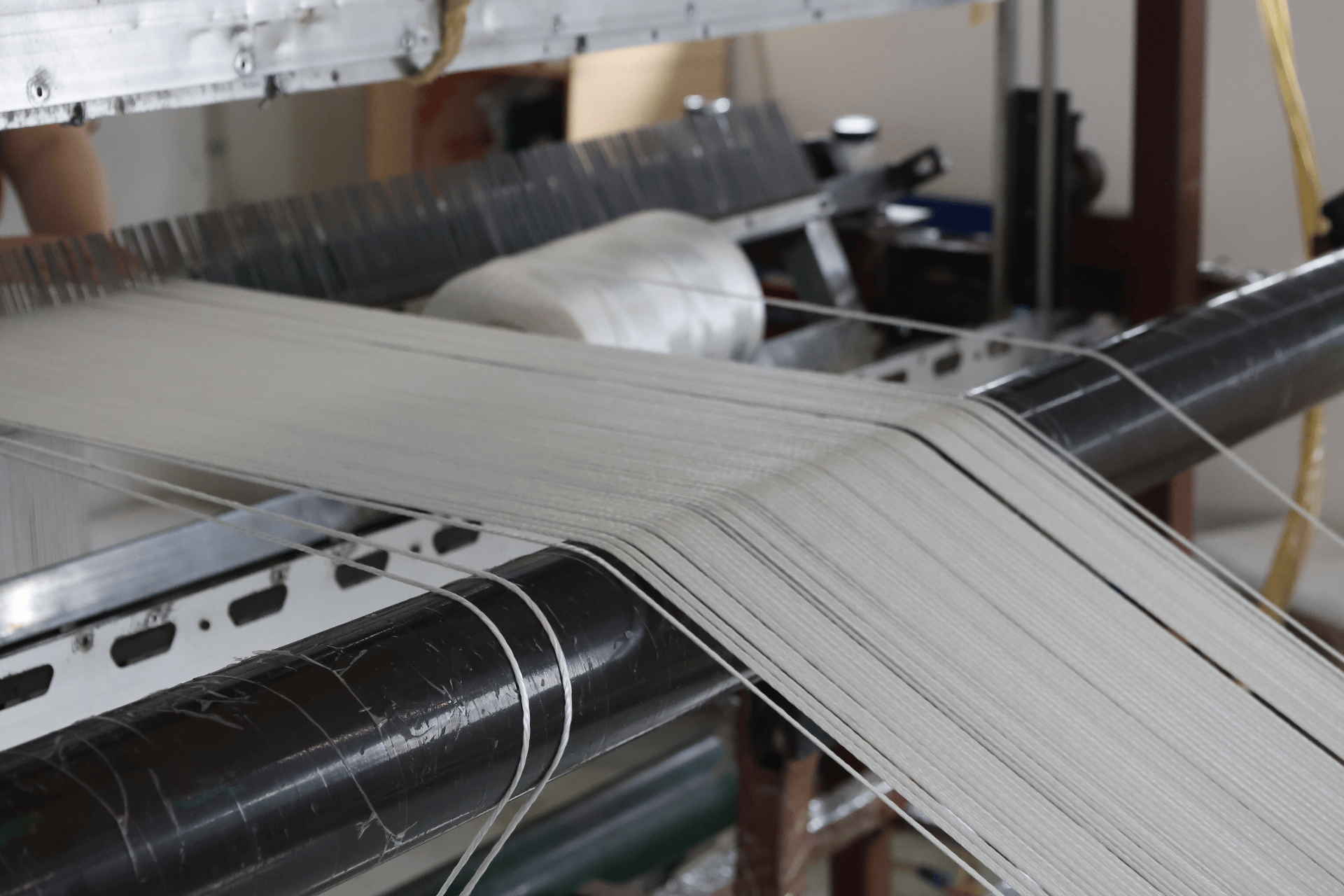
Proof: XZBELT operates two manufacturing bases with a combined production area of approximately 30,000 m².
Conclusion: Choose the Construction, Not the Claim
Seamless and spliced timing belts solve different problems. A truly endless belt removes the splice as a failure point and, in the case of seamlessly woven constructions, removes the joint from the carcass as well. A spliced belt buys length flexibility, open-end availability and the ability to close a loop on a machine that cannot be dismantled — and its joint is a rated part of the design envelope when it is specified properly.
The decision sequence that survives contact with a real machine is short. Define the motion function. Confirm the pulley system. Set the elongation budget against documented tension figures. Weigh the consequence of a joint failure in your own downtime economics. Check temperature, static and compliance requirements. Then choose the construction that meets those conditions, and never choose a seamless belt only because it has no splice.
XZBELT (Xuanze Industrial Drive Systems (Shanghai) Co., Ltd.) manufactures and supplies conveyor belts, timing belts, power transmission belts and specialty industrial belts for customers in more than 150 countries and regions, with ISO 9001:2015 quality management certification and customization and secondary processing capability covering splicing, coating, perforation and special belt structures.
Send Your Belt Specification
Share the tooth profile, pitch, tooth count or length, width and operating conditions of your drive or conveying application. XZBELT will confirm whether a seamless, jointed endless or open-end construction fits the machine, and return a sample and quotation for the exact specification.
Email: stevensang@xzbelt.com | Tel / WhatsApp: +86 139-1694-6090 | Website: www.xzbelt.com
Download the full catalogue: XZBELT product brochure (PDF)
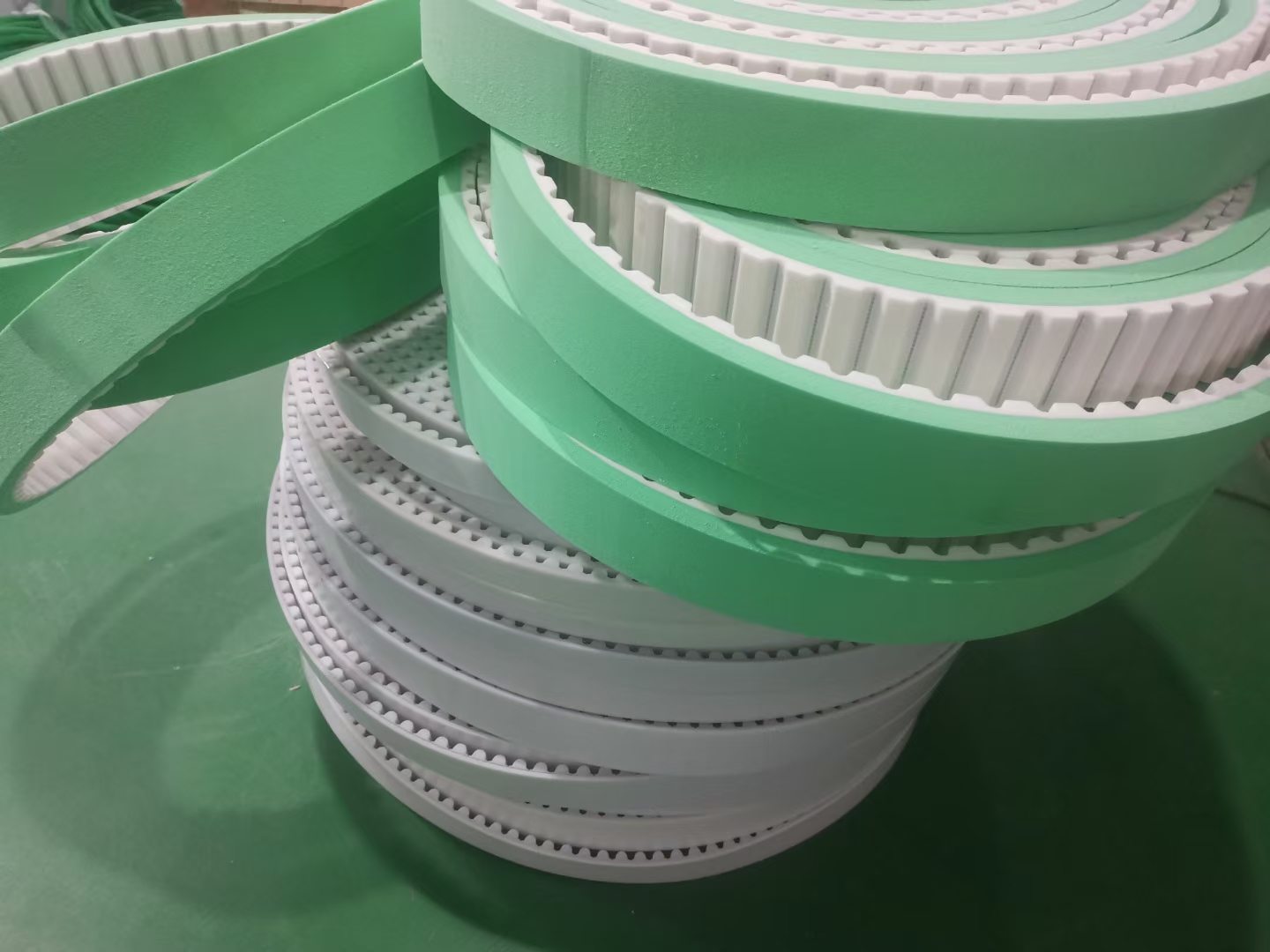
Next step: request a sample of the exact supply form and tooth profile you intend to order.
Have Questions or Need More Details?
Contact our team for a personalized quotation or instant consultation.
Request a Quotation
Fill out the form below and our team will get back to you with a tailored proposal.
WhatsApp Direct Chat
Prefer to chat in real-time? Message us on WhatsApp for instant assistance & quick answers.
- Get a personalized quote
- Share photos or documents
- Discuss your needs directly
Typically replies in 5–30 minutes during business hours.