Timing Belt Tooth Wear and Tear: Causes, Diagnosis and Selection Parameters
A timing belt rarely loses teeth because the belt material suddenly became weak. Worn flanks, cracked tooth roots, sheared teeth and lifted fabric are usually the last visible stage of a drive-system problem that started earlier — tension outside the calculated value, pulleys that are worn or do not match the tooth geometry, shaft misalignment, shock loads the profile was never sized for, or too few teeth in mesh on a small pulley. The belt specification then sets the limit of how much of that stress the teeth can absorb before damage becomes visible.
At a glance
- Tooth wear is progressive; tooth tear (shear, missing teeth) is normally an overload event.
- Five drive-side conditions damage teeth: tension, pulley condition and profile match, alignment, load and shock, and tooth engagement.
- Five belt-side parameters decide resistance: profile and pitch, tension member, backing and coating, joint or supply construction, and secondary processing.
- A replacement belt identified from outside circumference alone is a common reason the same failure returns.
Problem Definition: What “Tooth Wear and Tear” Actually Covers
In industrial maintenance the phrase describes at least five distinct failure modes, and each one points to a different root cause and a different purchasing response.
- Tooth flank wear. Material is lost on the loaded face of the tooth. The belt still runs, but positioning drifts, noise increases and backlash grows.
- Tooth root cracking. Cracks form at the base of the tooth, where bending stress concentrates.
- Tooth shear or missing teeth. Teeth are torn away from the backing, typically suddenly and under load.
- Fabric or coating separation. The tooth facing, backing fabric or cover lifts away from the belt body.
- Ratcheting. Teeth jump the pulley without immediate material loss, but repeated jumping converts into damaged flanks and roots.
The commercial distinction matters. Flank wear responds to environment, tension and alignment, so a belt change alone can visibly improve the line. Tooth shear responds to overload, and a new belt of the same specification will fail in the same way if the load path is unchanged. Tooth damage of this type is therefore best treated as a drive-system diagnosis before it is treated as a purchasing task.
Mapping the visible symptom to the first thing to check
| Visible symptom | Condition typically involved | First check on site |
|---|---|---|
| Flank wear spread across many teeth | Incorrect belt tension; abrasive foreign material | Measured pretension against the specified value; condition of the belt guard and environment |
| Cracked or rounded tooth roots | Excessive tension; defective or worn pulleys | Pulley tooth profile and drive centre distance |
| Missing teeth in one localised area | Excessive load, shock load, seized idler or pulley | Torque and start-stop profile; freedom of every rotating component |
| Uneven wear across the belt width | Pulley misalignment; insufficient tooth engagement | Shaft and pulley alignment; number of teeth in mesh |
| Interrupted ratcheting under load | Wrong tooth profile; low tension; worn pulley teeth | Profile identification against the pulley, then tension |
| Fabric or coating lifting from teeth | Tooth-profile mismatch, contamination, or a cover unsuitable for the application | Profile match and the actual operating conditions of the cover |
Industry Background: Why Tooth-Level Selection Has Become More Demanding
The commercial context explains why buyers are being asked to specify more, not less. The global timing belt market was valued at approximately USD 9.10 billion in 2025 and is projected to reach roughly USD 9.57 billion by 2030, according to Mordor Intelligence. The polyurethane segment is where the disagreement appears: Credence Research estimates a 12.57% CAGR reaching USD 25.5 billion by 2032, while 24ChemicalResearch estimates 3.10%. The gap is best read as a scope difference — one estimate leans toward high-value custom and robotics-driven demand, the other toward standard industrial replacement. Buyers should treat segment growth rates as directional rather than as a planning figure.
Rubber remains the dominant material in the automotive timing belt segment, with a market size estimated at USD 7.23 billion in 2024 by Market Research Future. Taken together, the data describes a market where volume still sits with standard profiles and rubber construction, while growth in specification work — custom profiles, coatings, perforation, high-speed handling — sits with engineered PU and fabricated belts.
Standardisation has not removed the identification risk. ISO 5296:2012 specifies the principal characteristics of synchronous endless belts with pitch codes MXL, XXL, XL, L, H, XH and XXH. In parallel, industrial drives also run T5, T10, T20, AT5, AT10, AT20, HTD 3M through HTD 20M, STS S2M through S14M and RPP P3M through P14M profiles. Two belts can share a pitch length and still fail to engage correctly, because tooth geometry — not length — carries the load. That is why a tooth-wear investigation and a belt-selection exercise are effectively the same task.
Detailed Solution: The Five Drive-Side Conditions That Damage Teeth
1. Tension outside the calculated value
Correct tension keeps the teeth properly engaged without loading the belt, shafts and bearings unnecessarily. Too little tension allows vibration, unstable positioning and tooth jumping under load; excessive tension raises shaft and bearing load and increases stress in the belt itself. The correct setting changes with belt profile, width, load, span and drive geometry, so it must come from design data rather than hand feel.
What buyers should watch for is the trigger, not just the symptom: incorrect initial installation, a changed centre distance, a poor tensioning method, pulley misalignment, worn components or a belt that was sized incorrectly in the first place. Re-tensioning a new belt against a worn pulley simply restarts the cycle.
2. Pulley condition and profile match
Teeth wear against teeth. A pulley with worn, hooked or damaged teeth transfers load onto a smaller contact area of the belt tooth, and the belt root takes the difference. Profile mismatch is the more expensive version of the same problem: a T10 belt on an AT10 pulley, or an HTD belt on an imperial-profile pulley, may appear to fit while engaging incorrectly. If the original markings are gone, pulley measurement and photographs are more reliable than the damaged belt teeth.
3. Alignment and tracking
Shaft and pulley misalignment loads one edge of the belt first. The result is a wear pattern that is uneven across the width rather than uniform around the circumference, and it is often misread as a material problem. Alignment should be verified whenever a belt is replaced, not only when a failure has already occurred.
4. Load, torque and shock
Tooth shear is a load story. Continuous torque above the belt's capacity, plus shock loads from frequent start-stop cycles, produce root cracks and eventually missing teeth. In high-cycle indexing machinery the load profile — acceleration, deceleration and reversal — matters as much as the nominal running torque, and it should be part of the specification rather than something discovered after installation.
5. Tooth engagement and pulley diameter
Too few teeth in mesh concentrates force on a small number of teeth; too small a pulley increases bending stress in the belt. XZBELT's timing belt data states a minimum pulley size of 10–25 teeth depending on tooth profile, and a minimum turning diameter range of 10 mm to 108.7 mm depending on profile. Both figures are selection limits, not suggestions: an axis designed around a small pulley must be checked against them before a profile is chosen.
The Belt-Side Parameters That Decide How Teeth Survive
Once the drive side is under control, the remaining variables are in the belt itself.
- Tooth profile and pitch. XZBELT manufactures MXL, XL, L, H, XH, XXH, DXL, DL, DH, T5, T10, T20, AT5, AT10, AT20, HTD 3M, 5M, 8M, 14M and 20M, STS S2M through S14M and RPP P3M through P14M, plus customized profiles. Common pitches include 2.032 mm, 5 mm, 9.525 mm and 14 mm.
- Tension member. Steel cord, Kevlar cord and glass fiber cord are available, with steel cord diameters of Φ0.3 mm, Φ0.51 mm, Φ0.6 mm and Φ1.21 mm depending on profile. The tension member controls load-carrying ability, elongation and stiffness; a Kevlar intermediate layer is also offered.
- Backing and coating. PU, rubber, silicone, sponge and fabric backings are available, with matching surface coatings. Coating choice changes friction, compression behaviour and release, and therefore changes how the tooth is loaded in handling applications.
- Hardness and dimensional tolerance. Standard hardness is 90–92 Shore A, with tolerances of ±0.5 mm on width, ±0.3 mm on thickness and ±0.5 mm on length. On high-precision axes these tolerances are part of the positioning budget.
- Operating envelope. The timing belt range is rated from −20°C to +160°C, customized according to material, with an antistatic index of 108–109 available on request.
Selection by Application Function
Linear motion and positioning
Linear axes, gantries and reciprocating systems normally use an open-end belt fixed at both ends, converting pulley rotation into controlled linear movement. The dominant requirement is low elongation under repeated reversals, which puts the tension member at the centre of the decision. Grinding, fabric backing and tight thickness tolerance matter where the belt runs against a guide or carries a carriage.
Power transmission
Continuous synchronous drives use a closed loop around pulleys, so endless construction is the starting point. Here the tooth load is carried continuously by the same teeth, and the selection question becomes torque, speed, pulley tooth count and width rather than surface finish. A jointed belt can serve this duty where an open belt is joined for installation, provided the joint strength suits the width and profile.
Product handling
When the belt carries product rather than driving a shaft, the tooth system is still the engineering foundation, but the cover takes the application risk. Silicone, PU, rubber, sponge and fabric covers change grip, marking behaviour and release; perforation and machining support vacuum and pick-and-place systems. Selected PU timing belts can be drilled or machined for vacuum conveying, and coated constructions are used where the product must not slip or must not be marked.
Open-End, Jointed Endless and Truly Endless: What Changes for the Teeth
Construction is often treated as a delivery detail. It is not, because it changes where the load path is interrupted. An open-end belt has no joint in service but is clamped at its ends, so its behaviour is defined by the tension member and the clamping design. A jointed endless belt introduces a welded or flex joint — a discrete transition where thickness and flexibility differ from the rest of the circumference. A truly endless belt has no such transition, so tooth loading stays uniform around the loop, which is why seamless construction is chosen where vibration, high-speed cycling or joint-related failure is the main concern. A spliced construction remains the more practical option where dimensional flexibility and easy replacement matter more. Neither is universally better; the correct question is which failure mode the line can least tolerate.
Custom Profiles, Coatings and Secondary Processing
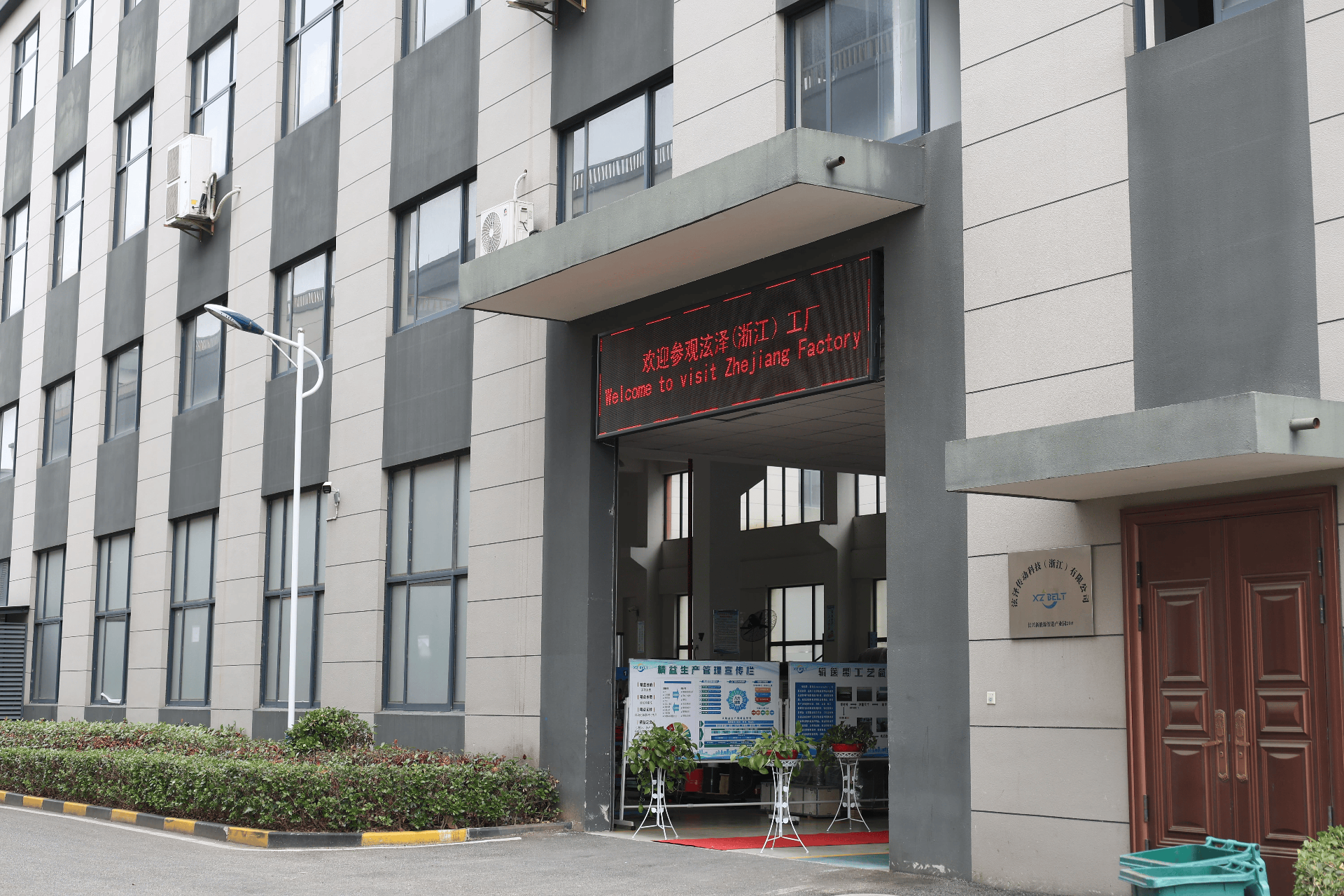
For buyers at the execution stage, the practical question is what a supplier can actually build. XZBELT — Xuanze Industrial Drive Systems (Shanghai) Co., Ltd., an industrial belt manufacturer established in 2013 — provides OEM, ODM, custom manufacturing, secondary processing and one-stop supply services. Customization covers material, width, length, thickness, colour, surface pattern, cleats, sidewalls, perforation, fabric reinforcement, silicone coating, sponge coating, special surface coating, splicing and special belt structure.
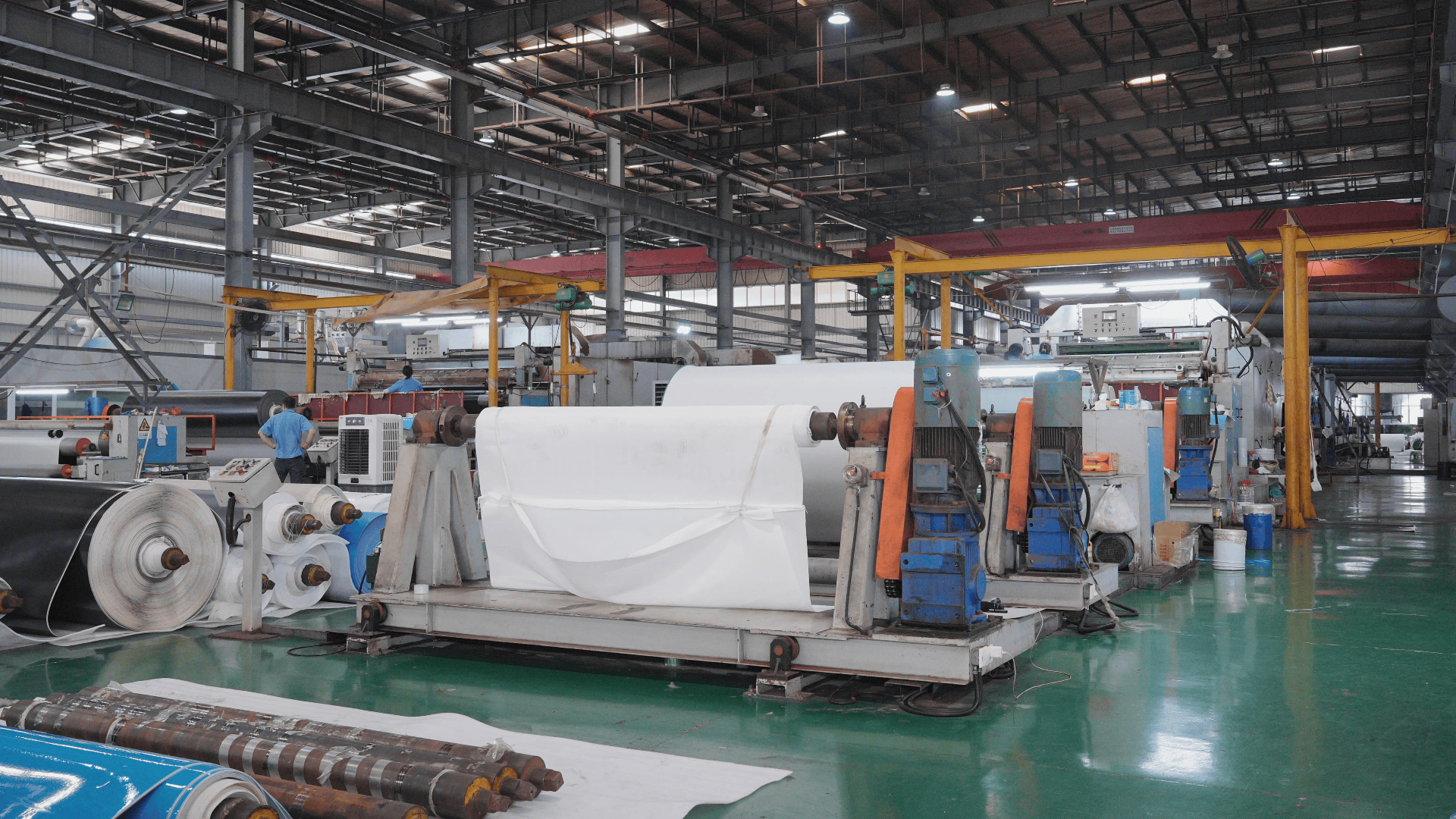
The manufacturing base behind that capability covers approximately 30,000 m² across two sites, with monthly capacity of approximately 166,000 m² for PU and PVC roll materials. Standard delivery is 7 days for selected standard products, while customized orders are quoted according to specification; MOQ is set by product type and specification. Quality control follows the ISO 9001 Quality Management System, supported by professional inspection equipment.
Secondary processing is where tooth wear is often designed out rather than compensated for. Perforation converts a timing belt into a vacuum carrier; silicone coating changes grip and release; fabric reinforcement on the tooth face reduces friction against the pulley; grinding controls thickness consistency on precision axes. Each of these decisions should be traced back to a specific failure mode observed on the machine, not added as a general upgrade.
Step-by-Step Breakdown: From Failed Belt to Purchase Specification
- Map the damage pattern across several teeth. Localised damage points to load, foreign objects or a seized component; uniform damage points to tension, alignment or environment.
- Verify the belt profile against the pulley profile. Confirm that both are T-series, AT-series, HTD, STS, RPP or imperial, and that the pitch matches.
- Inspect pulley teeth for wear, hooks, build-up or damage. Worn pulleys should be replaced with the belt, not after it.
- Measure tension against the specified value. Record the method used, so the next installation can repeat it.
- Check shaft and pulley alignment. Include every idler and driven component in the check.
- Review the load profile. Confirm running torque, acceleration, shock loads and duty cycle against the belt's sizing basis.
- Confirm tooth engagement. Compare the pulley tooth count and diameter against the minimum values for the chosen profile.
- Remove contamination and check rotating freedom. Foreign material and a seized idler or pulley will destroy a correctly specified belt.
- Re-specify construction if the failure repeats. Change supply form, tension member, backing or coating only against a documented failure mode.
What to Send a Supplier Before Ordering
A timing belt must match the pulley tooth system, so width and circumference alone are not enough. The identification sequence is: any printed code first; then tooth pitch, tooth shape, belt width, tooth count or pitch length, material and construction. If the belt is badly worn, pulley measurements and photographs are more reliable than the damaged teeth. Do not identify a timing belt by outside circumference alone.
- Close-up photograph of the tooth profile
- Measured tooth pitch
- Belt width
- Total tooth count or pitch length
- Pulley photograph and tooth count
- Application, load and operating temperature
- Required supply form: open-end, jointed endless or truly endless
Material and Compliance Checks That Belong in the Specification
Material choice is a wear decision and a compliance decision at the same time. Polyurethane is the common base for open-end linear and machined handling belts; rubber constructions remain dominant in automotive and general transmission, and high-temperature felt-backed rubber timing belts are among the specialty products built for heat-exposed machinery. Silicone-coated constructions are used where release and heat resistance matter — XZBELT's SIBR-5M synchronous silicone tape, for example, is designed for hygiene-product applications running at 1,200–1,400 pcs/min.
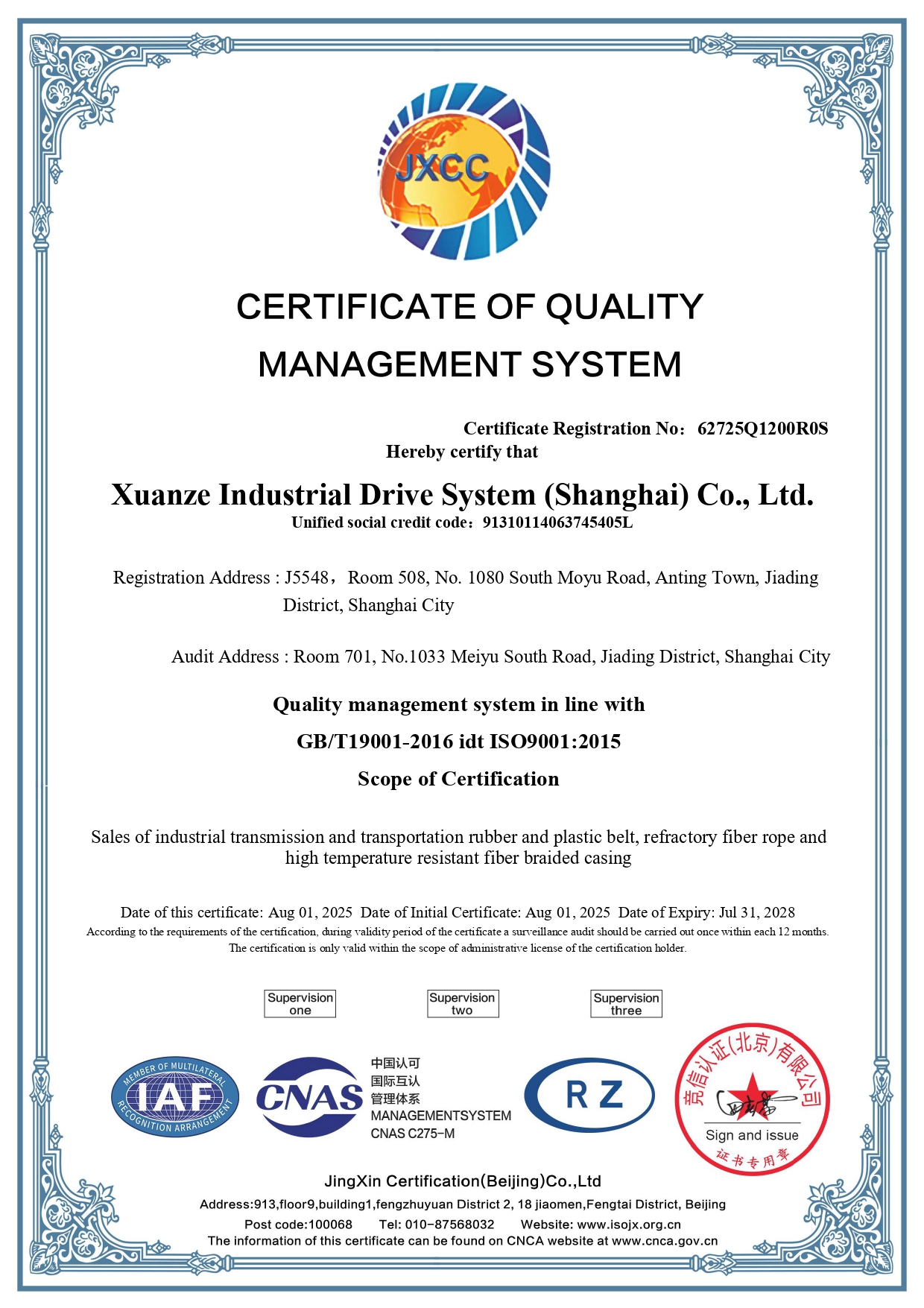
On the compliance side, supplier-level and product-level evidence should be separated. XZBELT holds ISO 9001:2015 certification (certificate 62725Q1200R0S, issued 1 August 2025 by JingXin Certification, valid to 31 July 2028), which covers the quality management system rather than a specific belt. Product-level evidence is separate: an FDA compliance test report to 21 CFR 177.2600 (report A2260699898101001, issued 20 August 2026 by Centre Testing International Group, covering total extractives in distilled water and n-hexane), alongside earlier reports under 21 CFR 175.300 (SHAFD2101526402 and SHAFD2102055302 A01, SGS, 2021). A PASS result applies to the sample tested: it does not automatically extend to another colour, compound, coating or construction, so the report scope must match the belt actually supplied.
Use Cases: Where Tooth Damage Shows Up First
Carton packaging and folder-gluing lines
High-speed carton feeding, folding and pressing combine frequent start-stop cycles with precise positioning — a duty that loads teeth repeatedly rather than continuously. A packaging machinery distributor and carton packaging manufacturer running 1,000+ belts annually reported 24–30 months of continuous operation with replacement frequency reduced by approximately 40%, together with improved feeding accuracy and less slippage. The specification factors named in that case were abrasion resistance, consistent friction, low elongation, joint strength and customized hardness and surface finishing — the same parameters that decide tooth life.
Aluminium profile extrusion lines
Extrusion lines need stable synchronous transmission plus a surface that will not mark the profile. A large aluminium profile manufacturer using 50+ belts annually over more than 12 months of continuous operation reported maintenance frequency down by approximately 30% and production efficiency up by approximately 20%, with repeat orders continuing. The relevant belt properties were a protective felt surface, low elongation and dimensional stability — a reminder that surface specification and tooth specification have to be decided together.
Printing and paper converting
Printing presses, sheet feeders and folder-gluers run at high speed with lightweight products and rapid acceleration. Positioning accuracy, non-marking surfaces, abrasion resistance and low elongation dominate, and vacuum perforation is often part of the belt function. Tooth wear in this segment usually appears first as registration drift rather than as a visible break.
Automation and precision equipment
Servo axes and indexing stations use frequent acceleration and deceleration. Low elongation, controlled backlash, positioning accuracy and low vibration are the selection criteria, which is why open-end PU constructions with suitable reinforcement are the usual starting point.
Comparison Table: Construction Options and Tooth-Relevant Checks
| Construction (supply form) | Typical motion function | What to verify at tooth level | Customization available |
|---|---|---|---|
| Open-end timing belt | Linear axes, gantries, reciprocating positioning | Profile and pitch match; tension-member elongation under repeated reversals; clamping at both ends | Custom width, length and tooth count; perforation; coating; splicing into jointed endless |
| Jointed endless (welded or flex joint) | Closed-loop synchronous drives where an open belt is joined for installation | Joint as a discrete transition in thickness and flexibility; joint strength against belt width and profile | Custom length and width; coatings; cleats; sidewalls |
| Truly endless | Continuous synchronous transmission and conveying without a joint | Uniform tooth loading around the circumference; consistency of thickness | Profile, backing and coating options |
| Double-sided timing belt | Drives engaging teeth on both faces | Tooth geometry on both sides; pulley arrangement | Customized according to profile and width |
| Coated or perforated timing belt | Product handling, vacuum conveying, pick-and-place | Cover adhesion and wear; perforation position relative to tooth pitch | Silicone, PU, rubber, sponge and fabric coatings; perforation and machining |
Comparison Table: Parameter Priorities by Application Function
| Application function | Construction starting point | Tension member focus | Surface or secondary processing | Confirm before ordering |
|---|---|---|---|---|
| Linear motion and positioning | Open-end | Low elongation; steel or Kevlar cord | Grinding, fabric backing, thickness tolerance | Minimum pulley teeth (10–25 by profile); minimum turning diameter (10–108.7 mm) |
| Power transmission | Endless or truly endless | Load-carrying capacity for width and profile | Standard backing; fabric on tooth face where friction must be reduced | Running torque, speed, pulley tooth count, duty cycle |
| Product handling | Endless, coated or perforated | Dimensional stability under tension | Silicone, PU, rubber, sponge or fabric coating; perforation | Friction and release requirement; product contact and temperature |
| High-temperature zones | Endless, material-specific | Material-matched construction | Felt or silicone surfaces as required | Actual operating temperature within the −20°C to +160°C range, customized by material |
Frequently Asked Questions
What documents should come with a custom timing belt order?
Separate supplier-level evidence from product-level evidence. ISO 9001:2015 certification demonstrates the quality management system — XZBELT holds certificate 62725Q1200R0S, issued 1 August 2025 and valid to 31 July 2028. Product-level documents should define the exact belt: profile, pitch, tooth count, width, tension member, hardness and tolerances. Where food contact applies, request the test report for the specific material, such as an FDA 21 CFR 177.2600 report covering total extractives, and confirm that its scope matches the belt being supplied.
Can a supplier produce a PU open-end timing belt to a custom profile and length?
Yes, where the supplier offers OEM and secondary processing rather than catalogue sales only. XZBELT provides OEM, ODM, custom manufacturing and secondary processing, with tooth profiles from MXL through RPP P14M plus customized profiles, supply in open-end, jointed endless and truly endless form, and customization of length, width, thickness, perforation, coating and splicing. Standard tolerances are ±0.5 mm on width, ±0.3 mm on thickness and ±0.5 mm on length, with monthly capacity of approximately 166,000 m² for PU and PVC roll materials.
What determines MOQ and the commercial terms on a timing belt order?
MOQ is set by product type and specification rather than by a single company-wide figure, because profile, width, tension member and secondary processing all change the production setup. Delivery terms are EXW, FOB or CIF subject to quotation, and payment terms are T/T subject to quotation. The practical way to control cost is to specify only the processing the failure mode requires — for example, perforation where vacuum conveying is used, or a coating where grip is the issue — instead of adding options that do not address a documented problem.
How do I identify an unknown belt before ordering a replacement?
Start with any printed code. If it is gone, measure tooth pitch, tooth shape, belt width, and tooth count or pitch length, and send a close-up photograph of the teeth together with a photograph and tooth count of the pulley. Belt material and construction (open-end, jointed endless or truly endless) should be confirmed as well. Do not identify a timing belt from outside circumference alone — a belt with the correct length but the wrong tooth geometry will not engage correctly and will damage the teeth again.
What lead time should be expected for standard and custom belts?
XZBELT quotes a standard delivery time of 7 days for selected standard products; customized orders are scheduled according to specification. Because tooth-damage investigations often involve a pulley change as well as a belt change, the practical lead time should be confirmed together with the full order scope. Technical support and customized solution support are available during specification, including review of the failed belt photographs and pulley data.
Conclusion
Tooth wear and tooth tear are different problems with different fixes. Wear is progressive and usually responds to tension, alignment, pulley condition and environment. Tear is an overload event and usually responds to load review, tooth engagement and construction choice. In both cases the replacement belt is only as good as the specification behind it: profile and pitch that match the pulley, a tension member sized for the duty, a backing or coating that suits the product, and a supply construction that matches how the belt is installed and run.
XZBELT — Xuanze Industrial Drive Systems (Shanghai) Co., Ltd. — was established in 2013 and manufactures conveyor belts, timing belts and power transmission belts at production bases covering approximately 30,000 m², serving customers in more than 150 countries and regions. The company holds ISO 9001:2015 certification and 11 patents, including 2 invention patents and 9 utility model patents.
Send the failed belt, not just the part number
Share tooth photographs, pitch and pulley data, and the operating conditions, and the specification can be matched to the failure mode rather than to the old label.
Request a timing belt quotation Download the product catalogue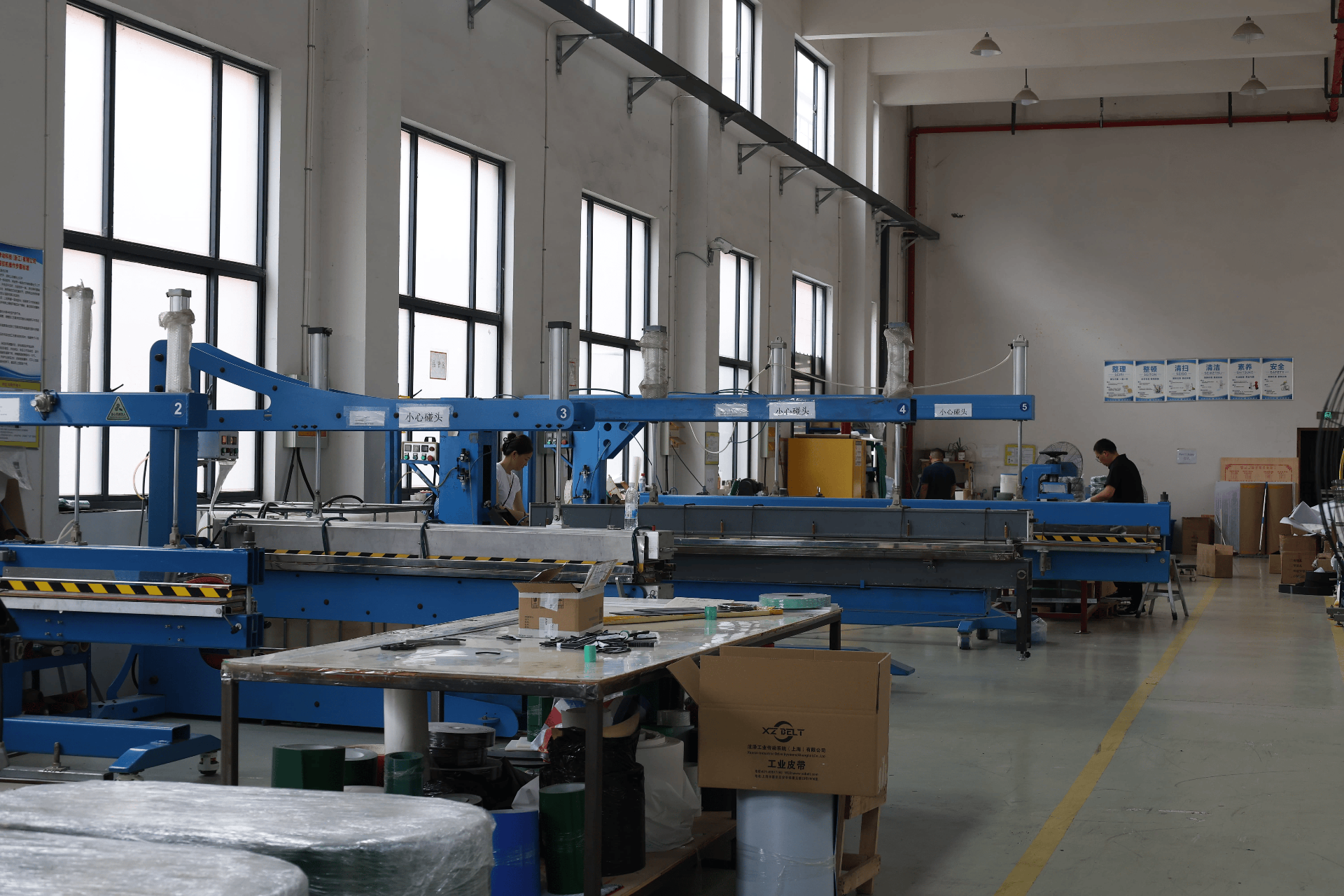
Have Questions or Need More Details?
Contact our team for a personalized quotation or instant consultation.
Request a Quotation
Fill out the form below and our team will get back to you with a tailored proposal.
WhatsApp Direct Chat
Prefer to chat in real-time? Message us on WhatsApp for instant assistance & quick answers.
- Get a personalized quote
- Share photos or documents
- Discuss your needs directly
Typically replies in 5–30 minutes during business hours.