XZBELT Deep Dive: Inside a Chinese Timing Belt Manufacturer
Searching for China timing belt manufacturers returns hundreds of supplier listings but very little comparable engineering data. This analysis looks at one of them — XZBELT, the trade brand of Xuanze Industrial Drive Systems (Shanghai) Co., Ltd. — and sets out what the company builds, how its production and R&D resources are structured, and what a timing belt buyer should verify before placing an order.
XZBELT is an industrial belt manufacturer founded in Shanghai in 2013. The company manufactures conveyor belts and timing belts, operates two production bases with a combined area of approximately 30,000 m², reports an annual output of 2,000,000 units, exports around 60% of its production to customers in more than 150 countries and regions, and holds ISO 9001 certification along with 11 belt-related patents. Its timing belt range covers polyurethane (PU) and rubber constructions in open-end, jointed endless and truly endless forms, with tooth profiles from MXL through HTD 20M.
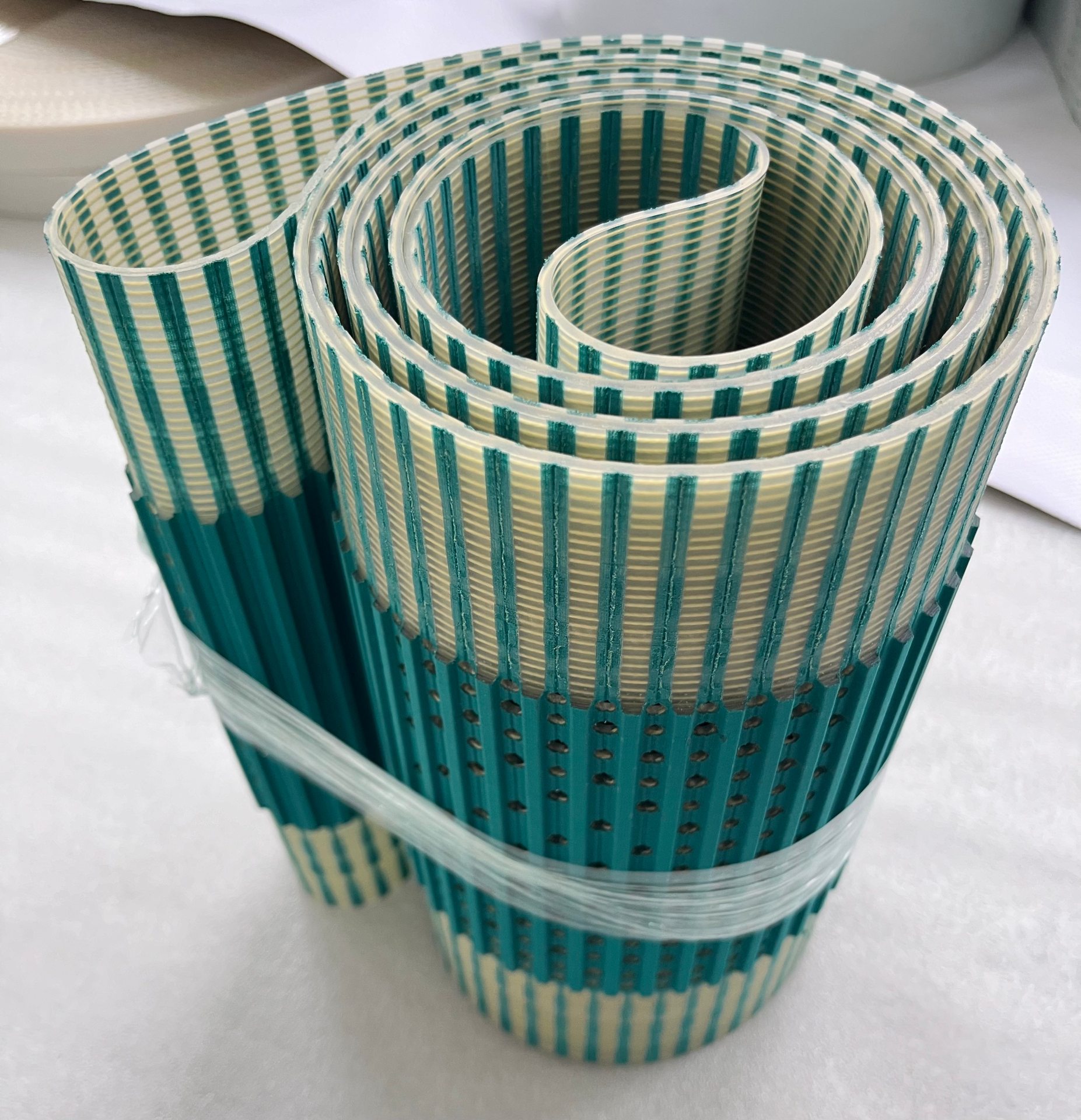
1. Company Overview: What XZBELT Is and Where It Operates
XZBELT is a belt manufacturer rather than a trading desk with a catalogue. Its legal entity, Xuanze Industrial Drive Systems (Shanghai) Co., Ltd., was established in 2013 and specialises in the manufacturing and sales of industrial belts. The company states that its main products are conveyor belts and timing belts, within a broader range that also includes power transmission belts, silicone belts, high-temperature conveyor belts, polyamide flat belts, coiler wrapper belts, easy-to-clean homogeneous conveyor belts and seamless belts.
| Item | Detail |
|---|---|
| Legal entity | Xuanze Industrial Drive Systems (Shanghai) Co., Ltd. (brand: XZBELT) |
| Founded | 2013 — more than 13 years of manufacturing experience |
| Headquarters | Room 701, No. 1033, Moyu South Road, Anting Town, Jiading District, Shanghai, China |
| Additional operations | Changxing (Huzhou, Zhejiang); Kaifeng (Henan); Suzhou (Jiangsu) |
| Core business | Manufacturing and sales of industrial belts, with specialty belt customisation and secondary processing |
| Main products | Conveyor belts and timing belts, plus flat belts, round belts, seamless belts, felt belts and coil wrapper belts |
| Manufacturing area | Two production bases, approximately 30,000 m² combined |
| Annual output | 2,000,000 units |
| Workforce | Approximately 50 staff, including an R&D team of 5 engineers |
| Export ratio | 60% |
| Markets served | Global — 150+ countries and regions |
| Quality system | ISO 9001 Quality Management System certification |
| Recognition | Shanghai High-Tech Enterprise, 2019–2022 and 2022–2025 certification periods |
| Intellectual property | 11 belt-related patents: 2 invention patents and 9 utility model patents |
The Shanghai headquarters sits next to Anting Station on Shanghai Metro Line 11, roughly 60 km from Shanghai Pudong International Airport and just over 10 km from Shanghai Hongqiao International Airport — about a 30-minute drive. Beyond Shanghai, the company maintains business and service operations in Changxing (Huzhou, Zhejiang Province), Kaifeng (Henan Province) and Suzhou (Jiangsu Province), which is how it supports both domestic and export customers.
On experience, XZBELT states that its team brings more than 20 years of accumulated industrial belt industry experience through technical expertise and industry resources, on top of 13 years of manufacturing since 2013. It has served customers in more than 150 countries and regions and reports experience with more than 1,000 customers. According to its company profile, it has supplied products and services to internationally recognised companies including Mercedes-Benz, POSCO, Nike and Baosteel. Two corporate milestones frame the company's recent development: recognition as a Shanghai High-Tech Enterprise across the 2019–2022 and 2022–2025 certification periods, and the accumulation of 11 belt-related patents.
2. Problem Definition: Why the Real Sourcing Question Is “Who Makes the Belt”
Timing belt sourcing fails for engineering reasons, not for a shortage of suppliers. Tooth damage is usually the result of a drive-system problem rather than ordinary surface wear: incorrect tension, excessive load, worn or incorrect pulleys, foreign objects, misalignment and tooth-profile mismatch can all overload the tooth and root area. The visible symptoms include tooth flank wear, damaged tooth roots, missing teeth, tooth shear, fabric separation and intermittent ratcheting.
The underlying difficulty is that two belts of identical length are not interchangeable. Tooth geometry and pitch must match the pulley system; belt length alone is an unsafe identifier when pitch is unknown, because pitch length equals tooth count multiplied by pitch. Buyers who specify only “a T10 timing belt, 1,200 mm long” leave the failure mode undefined.
That is why supplier selection here is not really about picking a belt. It is about a supplier's ability to control tooth geometry, compound consistency and repeat-order reproducibility across a multi-year maintenance programme or an OEM platform. The sections below apply that standard to XZBELT.
3. Industry Background: Where Timing Belt Demand Is Heading
Global timing belt demand is expanding, and the fastest growth sits in custom and fabricated product rather than commodity replacement stock. Mordor Intelligence projects the global timing belt market to reach approximately USD 9.57 billion by 2030, growing from a 2025 base of USD 9.10 billion. Credence Research forecasts the polyurethane timing belt segment at a CAGR of 12.57%, reaching USD 25.5 billion by 2032, while 24ChemicalResearch estimates the same segment at 3.10%; a note in the source data attributes that spread to whether high-growth niche sectors such as robotics are included in the segment definition.
Published valuations for the same 2025–2026 window vary widely — USD 7.8 billion (IMARC, 2025), USD 9.10 billion (Mordor Intelligence, 2025) and USD 8.1 billion for the automotive-specific segment in 2026 (Grand View Research). The variance reflects differing definitions of what a timing belt market includes, not disagreement about direction, so buyers should treat market-size figures as framing rather than as procurement inputs.
Two structural signals matter more. First, rubber remains dominant in automotive applications: Market Research Future estimates the rubber timing belt segment in that market at USD 7.23 billion in 2024. Second, on the standards side, ISO 5296:2012 specifies the principal characteristics of synchronous endless belts with pitch codes MXL, XXL, XL, L, H, XH and XXH — still the shared vocabulary buyers and manufacturers use to specify geometry.
What this means for a buyer researching Chinese manufacturers: the commodity end of the timing belt market is mature and price-competitive, while the growth is in application-specific belts — coated, perforated, high-temperature and precision variants. Supplier differentiation therefore comes from engineering and fabrication capability, not from catalogue breadth alone.
4. Core Products and Solutions
Timing belts are the company's primary transmission product, supported by a wider belt portfolio that lets a maintenance or OEM buyer consolidate suppliers.
4.1 Timing Belt Range: Profiles, Construction and Reinforcement
A synchronous belt — also called a toothed belt — transmits motion through tooth engagement rather than friction, which is why geometry defines the product. XZBELT manufactures timing belts in polyurethane and rubber, with a stated hardness of 90–92 Shore A and an operating temperature range of −20 °C to +160 °C.
Profile coverage is the first differentiator. Available tooth profiles include MXL, XL, L, H, XH, XXH, DXL, DL, DH, T5, T10, T20, AT5, AT10, AT20, HTD 3M, HTD 5M, HTD 8M, HTD 14M, HTD 20M, STS S2M through S14M, and RPP P3M through P14M, with tooth pitches of 2.032 mm, 5 mm, 9.525 mm and 14 mm depending on profile. That spread covers everything from small-pitch precision drives to high-torque industrial transmission.
Construction is the second differentiator. Belt types include single-sided, double-sided, open-end, endless and flex belt versions, supplied as open-end belt, jointed endless belt or truly endless belt, with welded joint, flex joint or endless joint methods. Reinforcement controls load behaviour: tension members can be steel cord, Kevlar cord or glass fiber cord — steel cord diameters of Φ0.3 mm, Φ0.51 mm, Φ0.6 mm and Φ1.21 mm are available — and the intermediate layer material is Kevlar. Minimum pulley teeth range from 10 to 25 and minimum turning diameters from 10 mm to 108.7 mm depending on profile, which sets the limit on how compact a drive can be.
Dimensional discipline is specified rather than implied: width tolerance ±0.5 mm, thickness tolerance ±0.3 mm and length tolerance ±0.5 mm, with an antistatic index of 10⁸–10⁹ available. For selected MXL types, tensile strength is stated at 6 N/mm.
4.2 Coated, Perforated and Fabricated Timing Belts
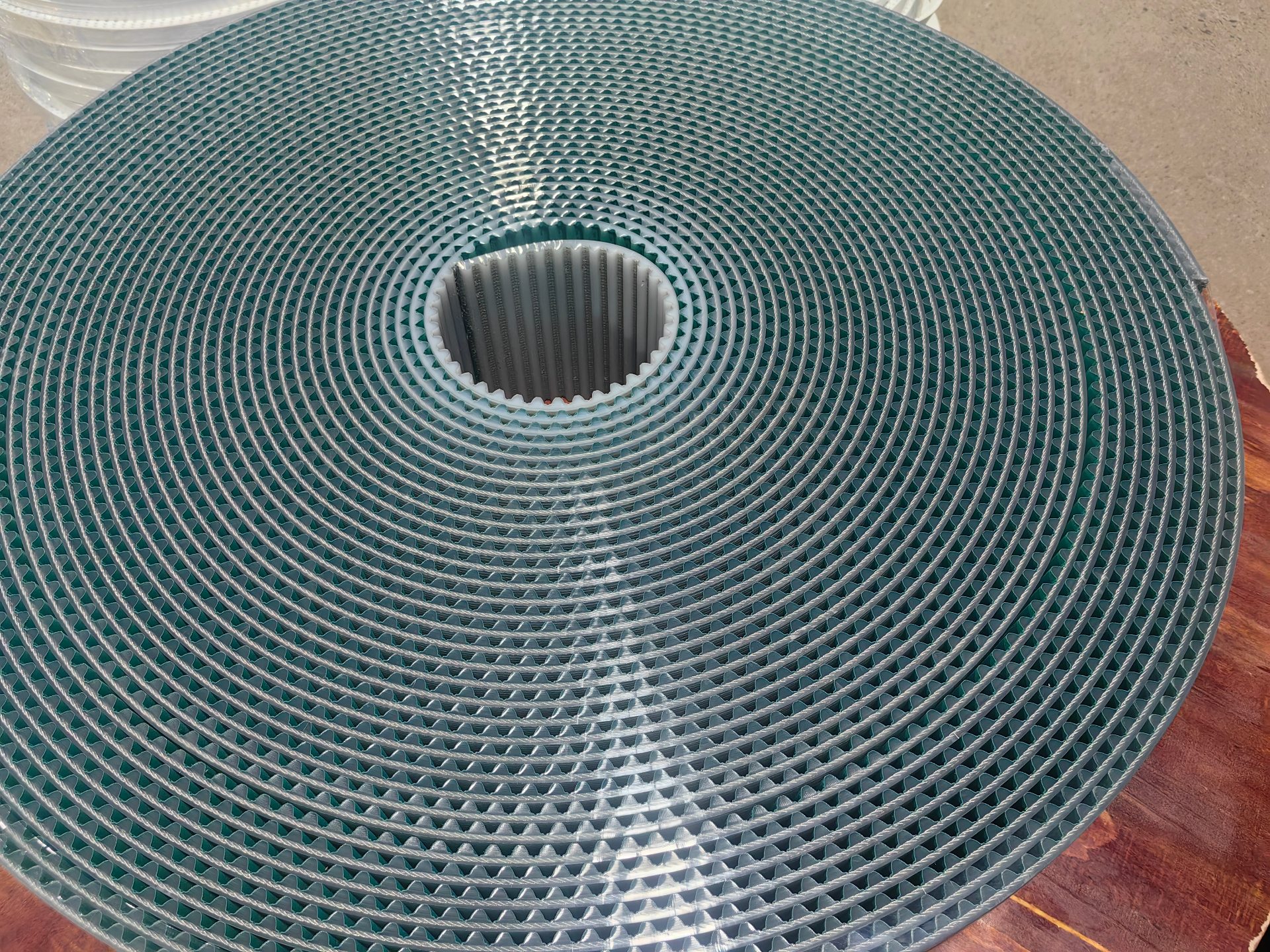
Coating and fabrication are where a timing belt becomes application-specific. Backing material can be PU, rubber, silicone, sponge or fabric; surface coating options include silicone, PU, rubber, sponge and fabric; and surface treatment options include tooth fabric, backing fabric, grinding and perforation. Belts can be customised with perforations, cleats, profiles and V-guides.
The functional logic behind these options is straightforward. A silicone or PU coating changes friction and release behaviour for product handling; a red rubber coated belt increases grip; perforation supports vacuum and pick-and-place handling; cleats and profiles carry product along the belt; V-guides control tracking on long or misalignment-prone runs. Perforated PU timing belts are used in vacuum feeding systems, which is why perforation, machining and profile need to be specified together rather than added later.
Silicone-coated timing belts are one of the company's specialty lines. A supplier listing for XZBELT's SIBR-5M synchronous silicone tape states that it was developed to break the monopoly in the hygiene products industry and is capable of speeds of 1,200–1,400 pieces per minute. Reported performance figures of this type should always be validated against the actual machine, product and duty cycle.
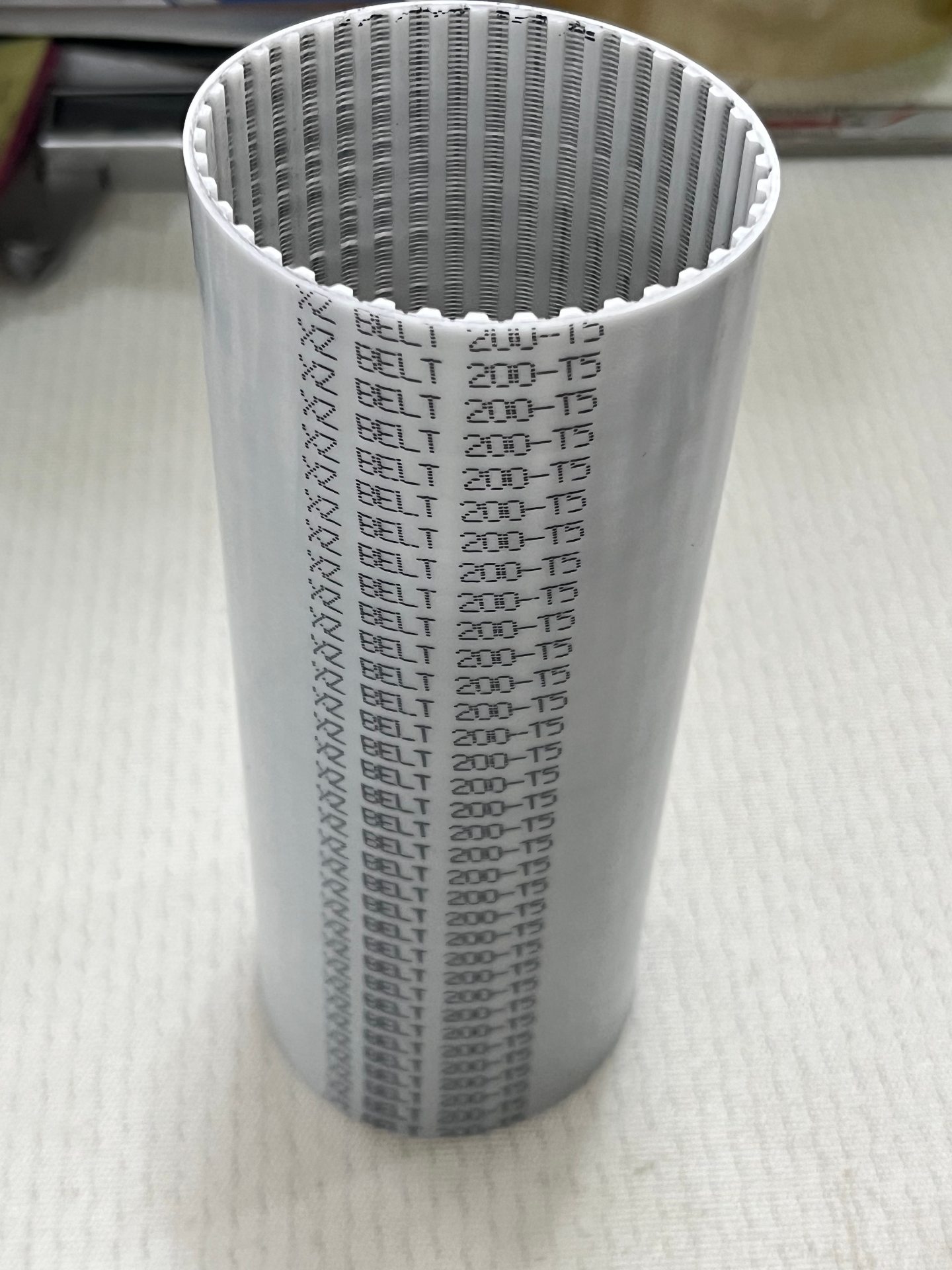
One design decision deserves explicit treatment: endless versus spliced. A genuine seamless or endless-woven belt has no localised splice, so thickness, flexibility and mechanical behaviour can remain more uniform around the circumference. A spliced belt retains greater manufacturing and installation flexibility and is simpler to replace. Seamless construction is the right answer when uniformity, precision, high-speed cycling or splice-related failure is the main concern; spliced construction is the right answer when dimensional flexibility, installation convenience or replaceability has priority.
4.3 Beyond Timing Belts: the Supporting Belt Portfolio
- Flat belts: nylon, polyamide, polyester, aramid, PU, rubber, leather and fabric versions; thickness 0.8–6 mm; temperature range −20 °C to +120 °C; FDA compliance available according to product type. Joint methods include thermofix, miter overlap, Z-splice, wedge splice, butt splice, finger splice, endless and mechanical clipper, with Clipper UCM36 as the specified fastener. Applications include printing, paper processing, packaging, folder gluing, corrugated board, post-press, bookbinding, postal sorting, logistics, textile, yarn spinning and general power transmission.
- Round belts: PU, TPU and reinforced PU/TPU with polyester cord; diameters from 2 mm to 20 mm; maximum belt tension from 0.3 kg at 2 mm to 31.3 kg at 20 mm; roll lengths from 400 m for 2–3 mm diameters down to 30 m for 12–20 mm.
- Seamless belts: silicone-coated, high-temperature and seamless woven types; thickness 9 ± 0.5 mm; tensile force at 1% elongation 30 N/mm; tensile strength at 3% elongation 350 N/mm; maximum operating speed 400 m/min; temperature range −40 °C to +210 °C.
- Felt belts: 1,300 ± 150 g/m², thickness 2.5 ± 0.15 mm, tensile strength 110 ± 30 N/mm, minimum turning diameter 30 mm, maximum width 3,100 mm.
- Coil wrapper belts and conveyor belts: endless woven constructions for coil wrapping on rolling lines, plus PVC, PU, PE, TPU, PVK, silicone and high-temperature conveyor belts.
5. Enterprise Strength Analysis
5.1 Manufacturing Footprint
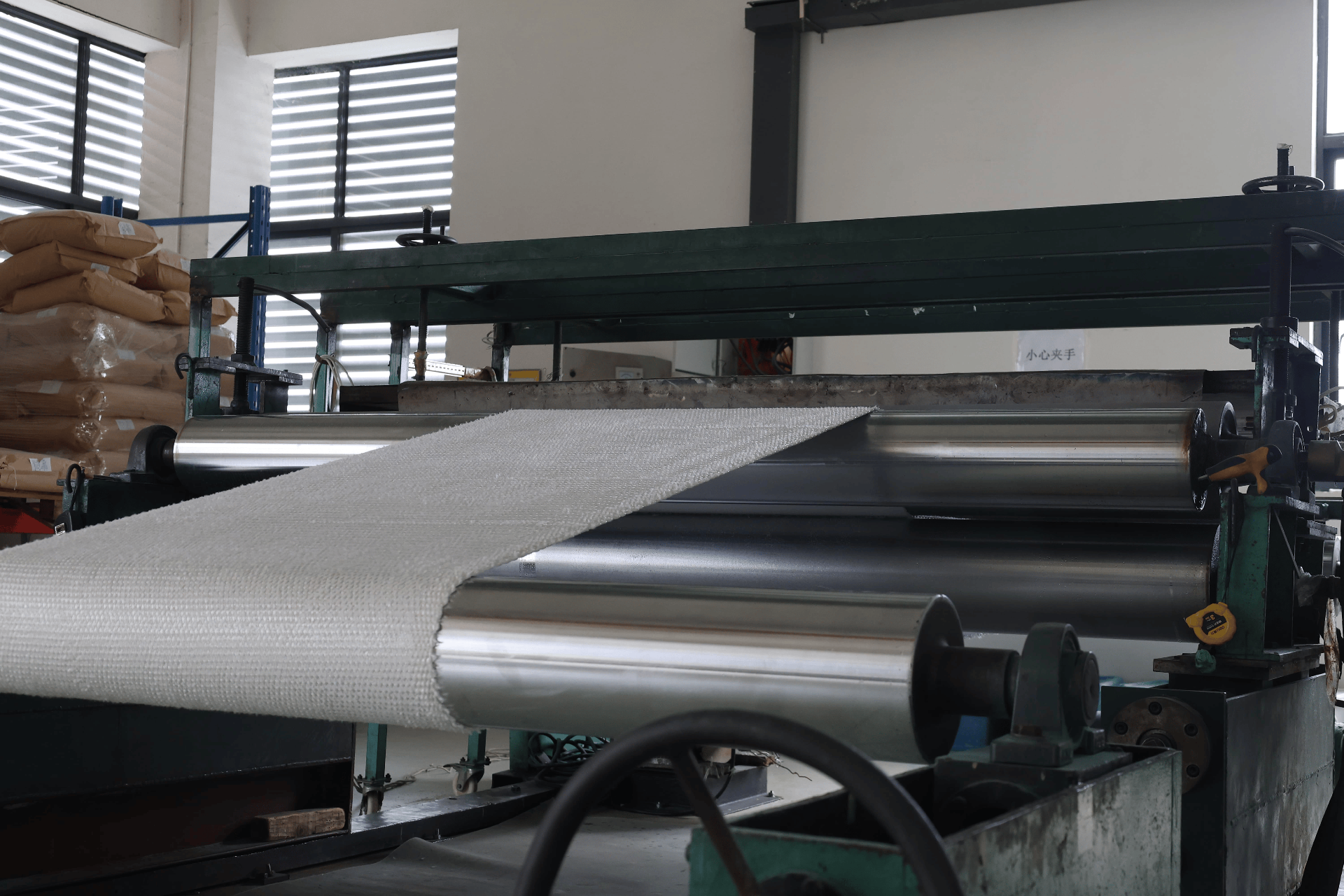
Production is split across two bases with complementary roles — one built for specialty belt processing, the other for roll-material volume.
| Production base | Area | Equipment and capacity |
|---|---|---|
| Specialty industrial belt processing and manufacturing facility, Changxing County, Huzhou, Zhejiang | Approximately 3,000 m² of standardised production space | More than 20 sets of specialised production and processing equipment, including 6 belt splicing machines, 2 coiler wrapper belt coating production lines, 2 seamless fabric weaving machines, 3 silicone coating production lines and 3 seamless PU coating production lines |
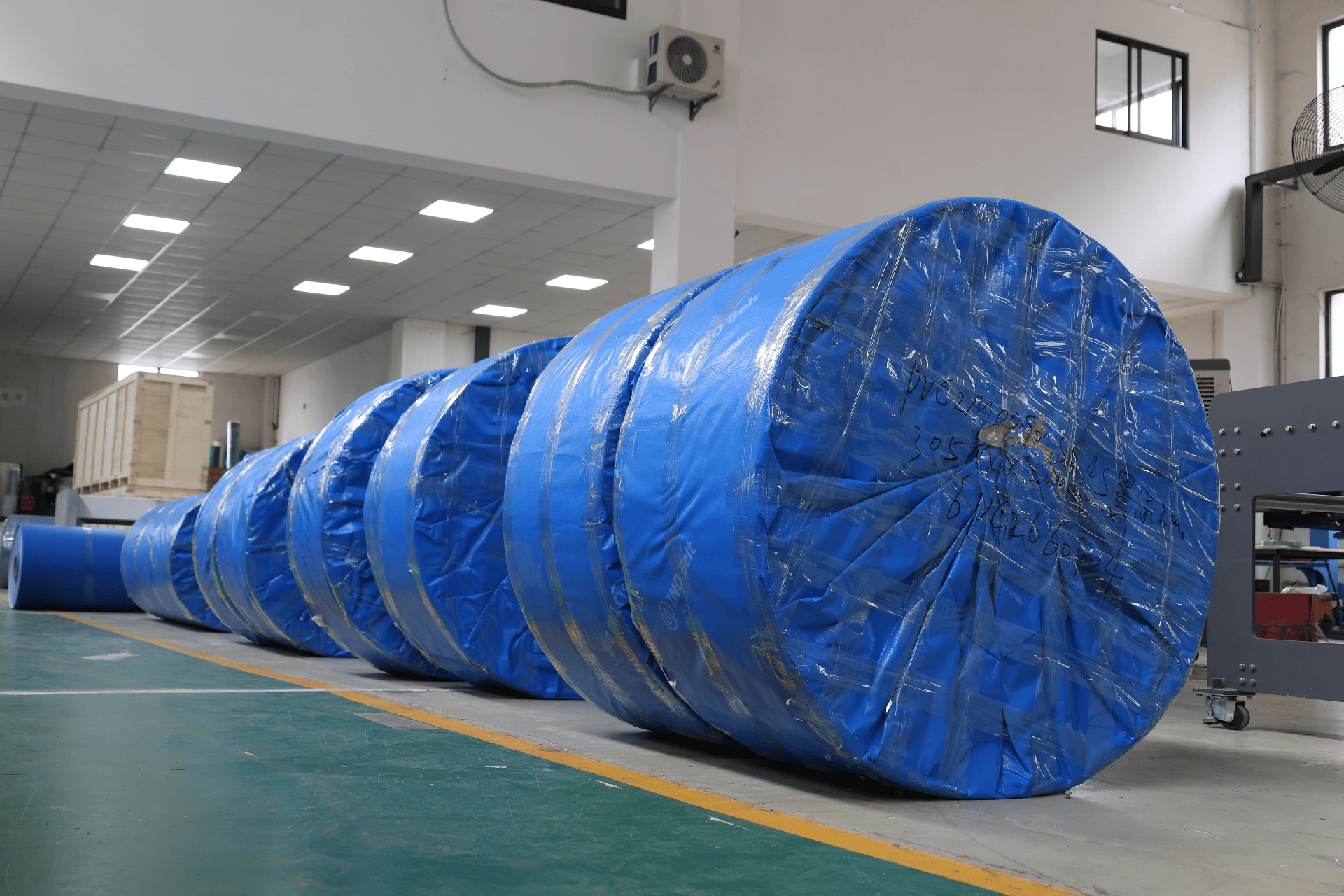
| Joint-venture production base for conveyor belt roll materials | Approximately 27,000 m² | 12 production lines — 2 PU and 10 PVC. PU: one easy-to-clean homogeneous extrusion line with maximum width 1.2 m and annual capacity approximately 1,000,000 m²; one 3.5 m wide PU extrusion line with annual capacity approximately 73,000 m². PVC: one 4.1 m coating line (approximately 300,000 m²/year); three 3.0–3.5 m coating lines (approximately 240,000 m²/year combined); four 2.0 m coating lines (approximately 240,000 m²/year combined); two 2.0 m casting lines (approximately 144,000 m²/year combined) |
Read together, the two bases explain the product mix. The Changxing facility is the customisation engine — splicing, silicone coating, seamless PU coating and seamless fabric weaving are exactly the processes required for coated timing belts, seamless belts and specialty fabricated belts. The joint-venture base supplies roll-material scale for conveyor belt programmes, where volume and price per square metre dominate.
5.2 R&D, Patents and Quality Management
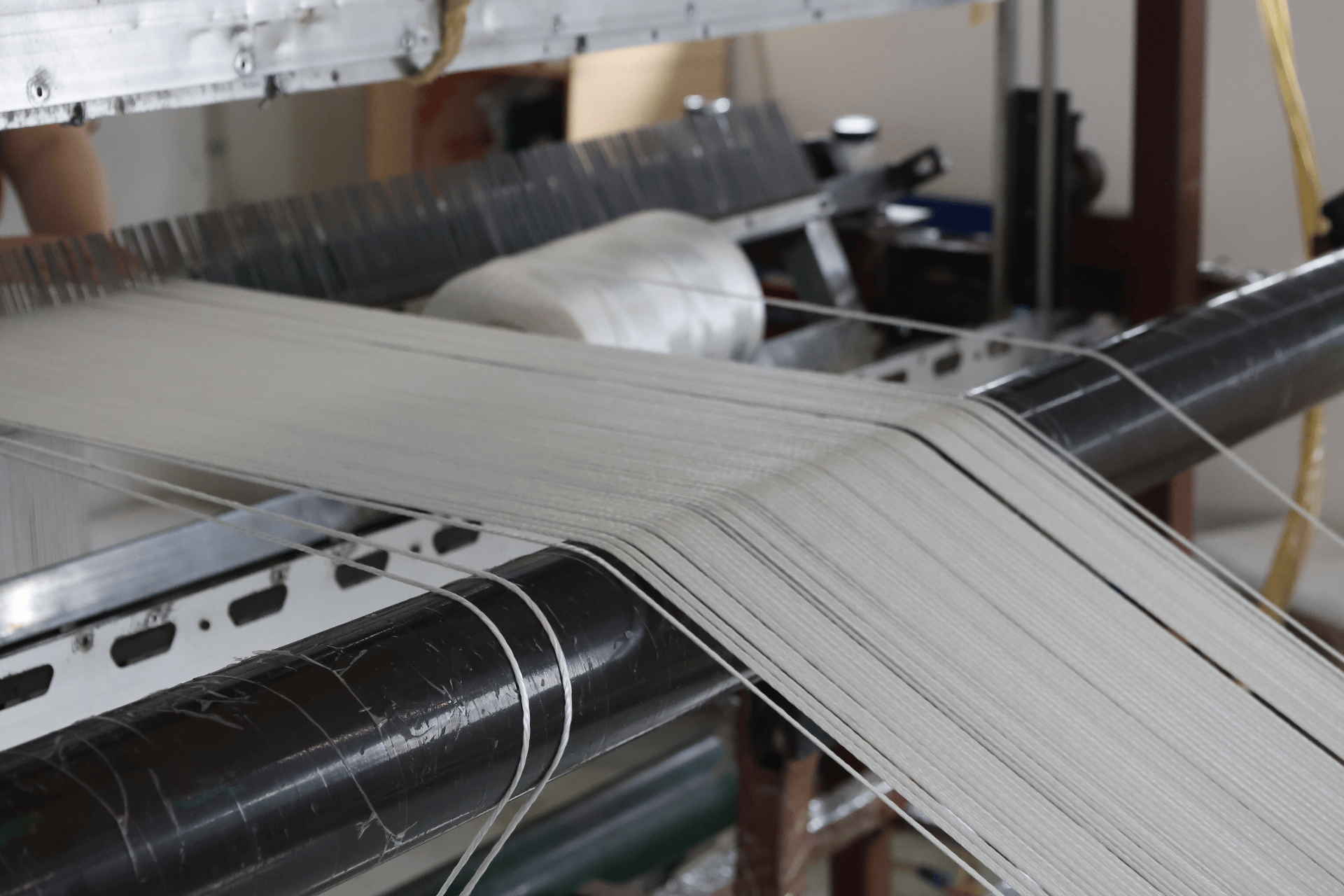
The R&D team consists of 5 engineers. Headcount alone would say little, so the more meaningful indicators are the patent record and the processing capability. XZBELT holds 11 belt-related patents, comprising 2 invention patents and 9 utility model patents, and operates a quality management system certified to ISO 9001. It was recognised as a Shanghai High-Tech Enterprise in both the 2019–2022 and 2022–2025 certification periods.
The company states that specialty industrial belts are customised and secondarily processed based on customer machine structures, operating conditions, production processes and automation requirements. The concrete form of that claim is the fabrication list: single-side and double-side sidewalls, fabric reinforcement and lamination, cleats, perforation, silicone coating, sponge coating, special surface coating, belt splicing, and customised widths and lengths.
Representative specialty products include extra-wide timing belts, EZLink belts, coiler wrapper belts, silicone-coated timing belts, seamless belts, PE conveyor belts for tobacco machinery, timing belts for sausage processing machines, rubber timing belts with high-temperature felt, fabric belts for tobacco machinery and meat-bone separator belts. These are the products that distinguish a specialty belt processor from a standard stockist.
5.3 Supply Chain Integration and Global Service
With a 60% export ratio and customers in more than 150 countries and regions, XZBELT operates as an export-oriented manufacturer rather than a domestic supplier with occasional overseas sales. The company reports experience with more than 1,000 customers and states that it maintains long-term business cooperation and technical exchange with leading international industrial belt brands such as Habasit, Ammeraal Beltech and Forbo Siegling.
For a procurement team, that last point is more than a logo list. Access to established application experience across different belt systems shortens the diagnostic work on unfamiliar conveying or drive problems — particularly where a customer is replacing or retrofitting a belt on imported machinery.
6. Step-by-Step Breakdown: How to Evaluate a Timing Belt Manufacturer
The following sequence reflects how timing belt failures actually occur, and can be used as a pre-purchase checklist for any Chinese supplier.
- Define the motion function before the part number. Linear positioning, continuous synchronous drive and product handling on the same belt face are three different specifications. Linear axes generally favour open-end belts with low-elongation reinforcement; continuous drives favour endless constructions; product handling may require silicone, rubber or sponge covers for friction and release; vacuum and pick-and-place systems may require perforation or machining. Tooth system and load capacity remain the engineering foundation beneath all of these.
- Lock tooth geometry. Confirm that the belt profile and pulley profile match, and that pitch and tooth count are internally consistent. Two belts with the same length but different tooth profiles cannot be interchanged.
- Choose construction and sidedness. Decide between open-end, jointed endless and truly endless, and between single-sided and double-sided, based on whether a joint is acceptable at the duty cycle and speed involved.
- Select the tension member. Steel cord, Kevlar cord and glass fiber cord differ in elongation and stiffness behaviour. Low elongation matters most where positioning accuracy and backlash control are the limiting factors.
- Select compound and coating. Polyurethane is widely chosen for oil resistance, wear resistance and machinability; rubber remains the dominant choice in automotive applications; silicone coatings support release and higher-temperature handling.
- Specify fabrication and tolerances. Perforation, cleats, profiles, V-guides, grinding, tooth fabric and backing fabric all change the delivered part. Published tolerances — ±0.5 mm width, ±0.3 mm thickness, ±0.5 mm length — give you something to inspect against.
- Verify repeatability, not just the first order. Check the quality management system, patent and recognition records, and the supplier's ability to reproduce the identical specification in twelve or twenty-four months' time. A belt that cannot be re-ordered to the same drawing creates a hidden maintenance liability.
On the machine side, three checks prevent most premature failures: inspect the damage pattern across several teeth rather than one; verify pulley teeth for wear and correct profile; and confirm tension, shaft and pulley alignment, drive load and freedom from foreign material. Where teeth are already damaged, replacing the belt without addressing a worn or incorrect pulley usually repeats the failure.
7. Use Cases: Where These Belts Run
XZBELT belts are used across electronics, packaging, logistics and warehousing, airport baggage handling, food processing, pharmaceutical manufacturing, woodworking, printing, petrochemical processing, metallurgy, steel production, automation equipment and machinery manufacturing. The table below maps the working conditions that drive belt specification in the most common timing belt applications.
| Application | Working conditions | Special requirement | Relevant belt family |
|---|---|---|---|
| Packaging machinery and filling, labelling, cartoning lines | High speed, frequent start-stop, repetitive cycles | Accurate positioning, low elongation, high grip, vacuum perforation, dimensional stability | PU and rubber timing belts; PU-coated and perforated timing belts |
| Printing and paper converting | High speed, lightweight products, rapid acceleration, precise sheet positioning | High friction consistency, non-marking surface, abrasion resistance, low elongation | Timing belts; flat belts for feeding and folding |
| Industrial automation and precision equipment | Frequent acceleration and deceleration, servo positioning, high cycle rate | Low elongation, backlash control, positioning accuracy, low vibration | Open-end PU timing belts with low-elongation tension members |
| Electronics, medical and office equipment | Clean operation, small pulley diameter, frequent cycling | Low noise, no lubrication, compact drive, positioning accuracy | Small-pitch timing belts (MXL, XL, T5, HTD 3M/5M); round belts |
| Food processing and beverage | Wet, oily, frequent washing, continuous production | Food-contact compliance where applicable, hydrolysis and oil resistance, easy cleaning | Food-grade conveyor belts; timing belts for drive and indexing |
| Tobacco processing | Dust, changing temperature, inclined conveying, continuous processing | Dust control, profiles and cleats, temperature resistance | Timing belts, conveyor belts and flat belts per machine section |
| Textile and nonwovens | High speed, long continuous operation, static generation | Antistatic performance, precise tracking, low elongation, dimensional stability | Timing belts, flat belts, felt belts, seamless belts |
| Metal and steel processing — coil wrapping | Heavy load, oil and emulsion exposure, sharp edges, elevated temperature | Cut and impact resistance, seamless construction, high tensile strength | Coil wrapper belts (endless woven) |
| Automotive and tire production | Heavy loads, oil, dust, heat, continuous production | Wear, oil and heat resistance, high load capacity, stable tracking | Timing belts and conveyor belts |
| Logistics, warehousing and parcel sorting | High throughput, long running hours, repeated impact | Wear resistance, antistatic performance, low noise, stable tracking | Conveyor belts, flat belts, timing belts, round belts |
8. Comparison Tables: Construction Choices and Supplier Evaluation Criteria
Because a “timing belt” is a category rather than a product, the useful comparison is between constructions and specifications — not between brands' marketing claims.
8.1 Timing Belt Construction and Specification Comparison
| Decision point | Available options | When it fits |
|---|---|---|
| Belt material | Polyurethane (PU), CPU; rubber, neoprene rubber; silicone-coated PU; silicone-coated rubber | PU where oil resistance, wear resistance, open-end splicing and machining are needed; rubber for general industrial transmission and automotive-type duties; silicone-coated variants for release and higher-temperature handling |
| Construction / supply form | Open-end belt; jointed endless belt; truly endless belt | Open-end for linear axes and on-site splicing; truly endless where a joint is itself the failure risk; jointed endless as a practical middle option |
| Belt type | Single-sided; double-sided; open-end; endless; flex belt | Double-sided when both faces must drive; flex belt where bending behaviour demands it |
| Tooth profile | MXL, XL, L, H, XH, XXH, DXL, DL, DH, T5, T10, T20, AT5, AT10, AT20, HTD 3M–20M, STS S2M–S14M, RPP P3M–P14M (custom profiles possible) | Must match the pulley system; pitch of 2.032 mm, 5 mm, 9.525 mm or 14 mm depending on profile |
| Tension member / core | Steel cord (Φ0.3, Φ0.51, Φ0.6, Φ1.21 mm), Kevlar cord, glass fiber cord; Kevlar intermediate layer | Higher load and stiffness requirements versus lower-elongation precision positioning |
| Backing and coating | Backing: PU, rubber, silicone, sponge, fabric. Coating: silicone, PU, rubber, sponge, fabric | Grip, release, compression or product-handling requirements |
| Fabrication and surface treatment | Perforation, cleats, profiles, V-guides, grinding, tooth fabric, backing fabric; custom widths and lengths | Vacuum handling, product carrying, tracking control and reduced marking |
| Dimensional tolerance | Width ±0.5 mm; thickness ±0.3 mm; length ±0.5 mm | Precision positioning and repeatable replacement across production batches |
| Antistatic | Index 10⁸–10⁹, customised | Static-sensitive conveying, textile and electronics environments |
| Joint method | Welded joint, flex joint, endless joint | Determined by construction choice and access to the drive at installation |
8.2 Seamless versus Spliced Construction
| Criterion | Seamless / endless-woven belt | Spliced belt |
|---|---|---|
| Structural behaviour | No localised splice, so thickness, flexibility and mechanical behaviour can remain more uniform around the circumference | Joint acts as a localised geometric and mechanical transition |
| Recommended when | Uniformity, precision, high-speed cycling or splice-related failure is the major concern; vibration, repeated flexing or precise product movement is involved | Dimensional flexibility, installation convenience or replaceability has greater priority |
| Practical trade-off | Higher construction discipline; less dimensional flexibility | Wider dimensional flexibility and simpler replacement |
8.3 What to Ask Any Chinese Timing Belt Manufacturer
| Evaluation criterion | Question to ask | Evidence that counts |
|---|---|---|
| Quality system | Which management system certification do you hold, and what is its scope? | ISO 9001 certification |
| Corporate standing | What independent recognition or high-tech enterprise status do you hold? | Shanghai High-Tech Enterprise recognition across the 2019–2022 and 2022–2025 periods |
| Technical depth | How many patents and what type? | 11 belt-related patents — 2 invention patents, 9 utility model patents |
| Manufacturing capability | What equipment handles coating, splicing and seamless construction? | 30,000 m² across two bases; 6 belt splicing machines, 3 silicone coating lines, 3 seamless PU coating lines, 2 seamless fabric weaving machines |
| Customisation | Can you engineer from machine structure and operating conditions rather than a part number? | Customised belt solutions and application-specific processing based on machine structure, operating conditions, production process and automation requirements |
| Consistency | What tolerances do you guarantee? | Width ±0.5 mm, thickness ±0.3 mm, length ±0.5 mm |
| Export track record | Which markets and how many customers? | 150+ countries and regions; more than 1,000 customers; 60% export ratio |
9. Market Evaluation and Industry Recognition
XZBELT's recognition rests on four categories that can be independently checked rather than on self-declared ranking. Corporate recognition comes from Shanghai High-Tech Enterprise status across two consecutive certification periods. Technical recognition comes from 11 belt-related patents. Quality recognition comes from ISO 9001 certification. Commercial recognition comes from a customer base spanning more than 150 countries and regions and more than 1,000 customers, with reported supply to internationally recognised companies including Mercedes-Benz, POSCO, Nike and Baosteel, per the company profile.
On the sourcing side, the company also appears as an audited supplier on Made-in-China, where its SIBR-5M silicone timing belt listing reports the 1,200–1,400 pieces per minute capability described above. On the technical-exchange side, XZBELT states long-term business cooperation and technical exchange with leading international industrial belt brands including Habasit, Ammeraal Beltech and Forbo Siegling.
What is absent is equally informative. The company does not publish market-share claims or self-declared rankings, and this profile does not reference any third-party ranking of Chinese timing belt manufacturers. For a buyer, that argues for leaning on the verifiable items: certification scope, patent records, production equipment, published tolerances, and — most decisively — how a belt performs on your own machine.
10. Procurement Value: What This Profile Means for a Buyer
- Consolidation across belt types. Timing belts, flat belts, round belts, seamless belts, felt belts, coil wrapper belts and conveyor belts from one supplier reduces the number of vendors a maintenance or OEM programme has to qualify and audit.
- Engineering from machine data. Customised solutions are developed from the customer's machine structure, operating conditions, production process and automation requirements — the practical answer to profile, pitch and construction questions that catalogues cannot resolve.
- In-house secondary processing. Silicone coating, sponge coating, special surface coating, perforation, grinding, cleats, profiles, V-guides, sidewalls, fabric reinforcement and lamination, belt splicing, and custom widths and lengths can be produced and controlled under one roof.
- Geometry control with stated tolerances. ±0.5 mm width, ±0.3 mm thickness and ±0.5 mm length give inspection criteria rather than vague “standard” claims.
- Construction flexibility. Open-end belts for on-site splicing and linear axes, jointed endless belts for general replacement, and truly endless belts where a joint cannot be tolerated.
- Material and reinforcement choice. PU, rubber, silicone-coated PU, silicone-coated rubber and neoprene, with steel cord, Kevlar cord or glass fiber tension members.
- Supply continuity. Approximately 30,000 m² of production area, 2,000,000 units of annual output and a 60% export ratio indicate the volume and administrative capability to support repeat international orders.
The limits are worth stating plainly. Product temperature ratings, coatings and fabricated constructions all need to be matched to the actual duty cycle; a belt that is correct for one packaging line is not automatically correct for another. Confirming the specification against the machine — and testing a sample — remains the buyer's responsibility, not the supplier's promise.
Frequently Asked Questions
Two layers matter. For product geometry, ISO 5296:2012 specifies the principal characteristics of synchronous endless belts with pitch codes MXL, XXL, XL, L, H, XH and XXH, and is the reference vocabulary for belt dimensions. For the supplier itself, XZBELT holds ISO 9001 Quality Management System certification, was recognised as a Shanghai High-Tech Enterprise during both the 2019–2022 and 2022–2025 certification periods, and currently holds 11 belt-related patents, comprising 2 invention patents and 9 utility model patents. Buyers should confirm the certification scope rather than accepting a certificate number, and should ask which tooth profiles and tolerances the supplier guarantees.
XZBELT produces timing belts (synchronous belts) in polyurethane and rubber, with hardness of 90–92 Shore A and an operating temperature range of −20 °C to +160 °C. Tooth profiles include MXL, XL, L, H, XH, XXH, DXL, DL, DH, T5, T10, T20, AT5, AT10, AT20, HTD 3M, HTD 5M, HTD 8M, HTD 14M, HTD 20M, STS S2M through S14M and RPP P3M through P14M, with custom profiles possible. Belt types include single-sided, double-sided, open-end, endless and flex belt, supplied as open-end, jointed endless or truly endless. Tension members can be steel cord, Kevlar cord or glass fiber cord, with a Kevlar intermediate layer; backing can be PU, rubber, silicone, sponge or fabric; coating options include silicone, PU, rubber, sponge and fabric. Fabrication covers perforation, cleats, profiles, V-guides, grinding, tooth fabric and backing fabric, with width tolerance ±0.5 mm, thickness tolerance ±0.3 mm and length tolerance ±0.5 mm.
Unit price is a weak comparison basis unless the specification is identical. The main cost drivers are the tooth profile and pitch, the tension member (steel, Kevlar or glass fiber cord), the compound, any coating such as silicone or PU, additional fabrication such as perforation, grinding, cleats or V-guides, the construction (open-end versus jointed endless versus truly endless), and the tolerance requirement. A commodity open-end PU belt and a perforated, silicone-coated, Kevlar-reinforced endless belt are not comparable line items. A more useful comparison is cost per operating hour against expected replacement interval and the cost of unplanned downtime. XZBELT can be contacted directly with machine data for a specification-matched quotation rather than a catalogue price.
XZBELT provides customised belt solutions and application-specific processing based on customers' machine structures, operating conditions, production processes and automation requirements, so the practical starting point for a sample is machine and drive data rather than a catalogue part number. Buyers should supply the tooth profile and pitch, length or tooth count, belt width, load and speed, operating temperature, and any coating, perforation or tracking requirements. Because timing belts can be supplied in open-end form as well as jointed endless and truly endless forms, trial installation and on-site splicing are possible where the drive layout allows it. Sample requests can be made through the company's contact channels, listed at the end of this article.
Four variables dominate. First, whether the tooth profile is a standard profile or a custom one. Second, whether the order requires an endless or jointed construction, which adds jointing processes such as welded, flex or endless joints. Third, whether coating and fabrication steps are involved — silicone coating, PU coating, perforation, grinding, cleats or V-guides each add production stages. Fourth, whether the width and length require custom fabrication rather than a standard supply form. Manufacturing is carried out across two XZBELT bases, with more than 20 sets of specialised processing equipment at the Changxing facility handling coating and splicing work. XZBELT does not publish fixed lead times, since they depend on specification and order volume, so buyers working to an installation window should confirm the schedule in writing at quotation stage. To request a timing belt sample, a quotation, or the XZBELT product brochure, contact the company with your profile, dimensions and machine conditions.
Conclusion: Positioning, Procurement Value and Outlook
XZBELT occupies a specific position in the Chinese industrial belt landscape: a mid-sized specialty belt manufacturer with roughly 50 staff, two production bases totalling approximately 30,000 m², ISO 9001 certification and 11 belt-related patents, whose differentiator is customisation and secondary processing rather than commodity volume alone. Its timing belt range is broad enough to cover small-pitch precision drives and high-torque industrial transmission, and its fabrication capability — silicone and PU coating, perforation, seamless construction, splicing, cleats and V-guides — is what converts a standard synchronous belt into an application-specific component.
For buyers, the procurement value is consolidation plus specification control: one supplier covering timing belts, flat belts, round belts, seamless belts, felt belts and conveyor belts, with published tolerances and engineering input driven by machine data. The due-diligence checklist is equally clear — verify certification scope, review the patent and equipment record, insist on dimension data, and test a sample under real operating conditions.
The outlook points in the same direction as the market data. Global timing belt demand is projected to grow to approximately USD 9.57 billion by 2030, with the polyurethane segment forecast to expand faster than the market as a whole, and the fastest growth concentrated in custom and fabricated product. Manufacturers whose advantage lies in coating, perforation, seamless construction and engineering support are positioned to benefit from that shift more than suppliers competing only on unit price. XZBELT's existing equipment base and specialty product line — extra-wide timing belts, silicone-coated timing belts, seamless belts and machine-specific belts for tobacco, food and metal processing — sit squarely in that higher-value segment.
Request a Timing Belt Sample, Quotation or Catalogue
XZBELT manufactures PU and rubber timing belts in open-end, jointed endless and truly endless constructions, with custom tooth profiles, coatings, perforation, cleats and V-guides. To receive a specification-matched quotation or sample, send your tooth profile and pitch, length or tooth count, belt width, load, speed and operating temperature, plus any coating or fabrication requirements.
Contact: Steven Sang — Email: stevensang@xzbelt.com | Tel / WhatsApp: +86 139-1694-6090
Website: https://www.xzbelt.com/
Download the XZBELT product brochure (PDF): https://cdn.socialarks.com/sbsp/25263/common/2026/0917/xzbelt.pdf
Have Questions or Need More Details?
Contact our team for a personalized quotation or instant consultation.
Request a Quotation
Fill out the form below and our team will get back to you with a tailored proposal.
WhatsApp Direct Chat
Prefer to chat in real-time? Message us on WhatsApp for instant assistance & quick answers.
- Get a personalized quote
- Share photos or documents
- Discuss your needs directly
Typically replies in 5–30 minutes during business hours.