Timing Belts for Logistics Sorting and Accumulation: Application Guide for 24/7 Operations
Sortation and accumulation systems live or die on repeatability. A belt that positions a parcel tray accurately at the start of a shift must still do it after thousands of continuous hours, while scanners read barcodes, merge conveyors feed the main line, and telescopic conveyors extend and retract at the dock.
This guide is written for engineers, maintenance planners and procurement teams specifying timing belts for logistics and intralogistics projects — distribution centers, fulfillment centers and parcel sorting centers — where throughput, static control, noise and tracking stability dominate the specification rather than a single headline number.
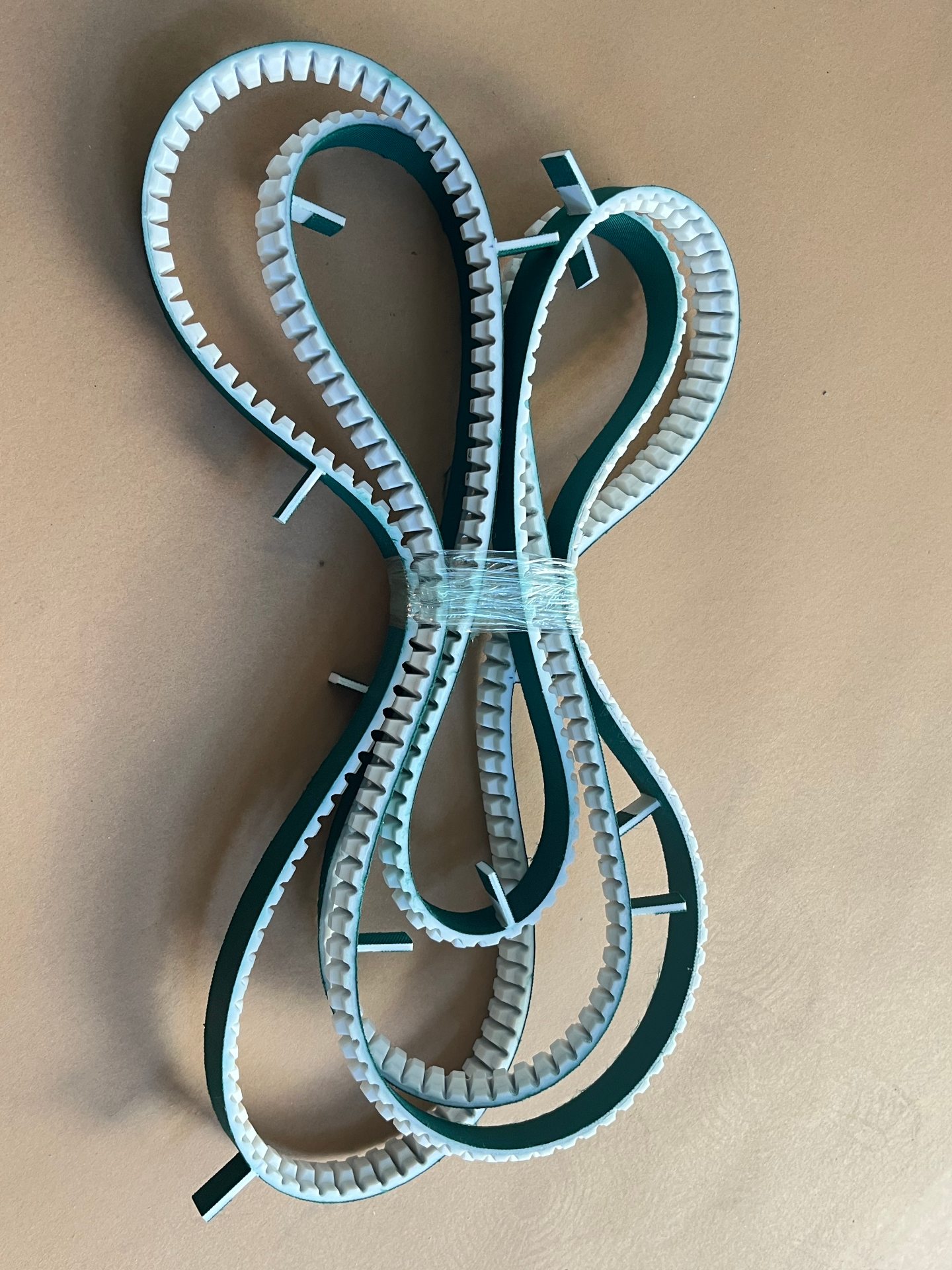
Synchronous timing belts drive positioning, indexing and transfer functions inside sorters, merge conveyors and accumulation zones.
Direct answer: timing belt selection for sorting and accumulation is driven by six operating requirements rather than by a single catalog figure — wear resistance, antistatic performance, low noise, low rolling resistance, stable tracking and high throughput. These are the exact requirements listed for logistics and intralogistics applications running 24/7 continuous operation with sorters, scanners, rollers, telescopic conveyors, merge conveyors and warehouse automation systems.
Problem Definition: Why a Belt That Runs Well in Packaging Fails in a Sorting Hall
The failure is almost never caused by the belt material alone. It comes from a duty cycle the belt was never specified for.
- Duty cycle. A packaging machine indexes in start-stop cycles with defined dwell time. A sorting line runs continuously, often around the clock, with parcels arriving in unpredictable bursts.
- Repeated parcel impact. In logistics and intralogistics conditions, the working environment is described as high throughput, long running hours, and repeated parcel impact under accumulation and sorting — a materially different load profile from intermittent conveying.
- Accumulation contact. Accumulation zones hold products under low-speed continuous contact. That produces sustained friction, surface wear and heat build-up that is not present in a simple transport section.
- Static generation. Moving belts and sliding parcels generate electrostatic charge. Static affects scanner read rates, attracts dust, and can interfere with sensors and control electronics.
- Noise. A line running 24/7 must meet a noise environment that operators can work in for a full shift. Belt construction, tooth engagement quality and tracking all contribute.
- Tracking drift. A small lateral drift that is invisible on a short cycle becomes a jam on a high-throughput merge conveyor.
One further problem is specification by dimension alone. Two timing belts with the same length but different tooth profiles cannot be interchanged — the tooth geometry and pitch must match the pulley system. Replacing a belt by measuring only its length, and not its tooth profile, pitch and tooth count, is a common root cause of premature failure in maintenance-driven environments.
Industry Background: How Timing Belts Sit Inside Modern Intralogistics
The commercial context is expanding. Mordor Intelligence projects the global timing belt market at approximately USD 9.10 billion in 2025, growing to about USD 9.57 billion by 2030. Within that market, research firms disagree on the pace of the polyurethane segment: Credence Research forecasts a CAGR of 12.57% reaching USD 25.5 billion by 2032, while other research places PU segment growth far lower. The variance is generally explained by whether custom engineered solutions and high-growth application sectors such as robotics and automation are counted inside the segment definition — which is precisely the part of the market that logistics projects draw from.
On the standards side, ISO 5296:2012 defines the principal characteristics of synchronous endless belts with pitch codes MXL, XXL, XL, L, H, XH and XXH. In automation and conveying equipment, T-series profiles (T5, T10, T20), AT-series profiles (AT5, AT10, AT20) and HTD profiles (HTD 3M through HTD 20M) are equally common. For replacement and quotation purposes, the identification set is always the same: tooth profile, pitch, tooth count or pitch length, and width.
Inside a distribution center, timing belts are not the largest belt consumption item, but they sit on the functions that are hardest to run without: sorter drive and indexing, merge conveyor drives, telescopic conveyor extension drives, accumulation zone indexing, and positioning of scanner gantries and transfer units. When one of these stops, the entire line downstream stops with it.
XZBELT — Xuanze Industrial Drive Systems (Shanghai) Co., Ltd. — is an industrial belt manufacturer established in 2013 in Shanghai, China, producing conveyor belts and timing belts for logistics and warehousing, airport baggage handling, packaging, printing, food processing, electronics and general automation. Its logistics and warehousing and airport baggage handling experience places it directly inside the application environment this guide addresses.
Detailed Solution: Matching Belt Construction to the Function
There is no single "logistics timing belt". There are five or six distinct functions on a sortation floor, and each one pushes a different requirement to the front of the specification. The sections below map function to construction, using the actual specification data available for PU and rubber timing belts.
Positioning drives on sorters and scanners
Sorter drives and scanner gantry positioning are synchronous functions: the belt must transmit rotation without slip and hold position between cycles. The relevant properties here are high positioning accuracy, slip-free transmission, low elongation and stable high-speed operation. Open-end PU timing belts with low-elongation reinforcement are the natural starting point for linear axes and cut-to-length installations; truly endless construction is preferred where the drive is continuous and a splice would be a recurring weak point.
Merge and accumulation zones
Merge conveyors and accumulation sections are where friction behaviour matters most. Here the specification moves toward surface control: consistent grip for acceleration, controlled release in accumulation, and low rolling resistance so that drive motor sizing and energy consumption stay predictable. Where accumulation runs at low speed over long periods, wear resistance and dimensional stability across the full width of the belt become the practical life limit.
Telescopic conveyors and dock loading
Telescopic conveyors extend, retract and reposition multiple times per hour. Their drive belts see frequent cycling rather than continuous high speed, so low elongation and consistent tooth engagement dominate. Undersized pulley geometry is a common source of premature failure on these units: minimum pulley tooth counts for timing belts are specified between 10 and 25 teeth depending on profile, and minimum turning diameter ranges from 10 mm to 108.7 mm depending on tooth profile. Both must be verified against the actual pulley on the machine.
Antistatic performance and read-rate protection
Antistatic performance is listed as a core special requirement for logistics and intralogistics operations because static affects both product flow and sensor performance. For timing belts, the listed antistatic index is 10⁸–10⁹, customizable. For flat belts used in postal sorting, logistics, material handling and live roller conveying, antistatic property is available and customizable. Where a project specifies a resistance target, it should be stated at belt level and confirmed on the drawing, not assumed from the material family.
Noise, tracking and rolling resistance
Noise reduction in a 24/7 hall comes from three things: correct tooth engagement, correct tension and alignment, and belt construction. Round belts used in logistics conveying and roller conveyors are listed with low noise operation as a characteristic, and timing belts are listed with stable high-speed operation — both outcomes depend on the drive being set up correctly. Tracking stability is a geometry issue first and a material issue second: crowned or flanged pulleys, parallel shafts and correct take-up are prerequisites before any belt property can help.
Surface treatment: coatings, perforation and profiles
Timing belts for handling functions are frequently not plain. Surface coating options include silicone, PU, rubber, sponge and fabric, and backing material options are PU, rubber, silicone, sponge and fabric. This is what allows a silicone-coated timing belt for release-critical transfer, a PU-coated timing belt for grip on inclined transfers, or a red rubber coated timing belt where higher friction is specified. Beyond coatings, belts can be customized with perforation, cleats, profiles and V-guides, and surface treatments include tooth fabric, backing fabric, grinding and perforation. Perforated PU timing belts are the standard approach when a vacuum hold-down or handling system needs airflow through the belt.
Tension members and dimensional control
The tension member determines load-carrying ability, elongation and stiffness. Available core types are steel cord, Kevlar cord and glass fiber cord, with steel cord diameters listed at Φ0.3 mm, Φ0.51 mm, Φ0.6 mm and Φ1.21 mm depending on tooth profile, and Kevlar used as intermediate layer material. Mechanical properties are matched by tolerance: width tolerance ±0.5 mm, thickness tolerance ±0.3 mm and length tolerance ±0.5 mm are the listed values, with hardness at 90–92 Shore A and an operating temperature range of −20 °C to +160 °C, customized according to material.
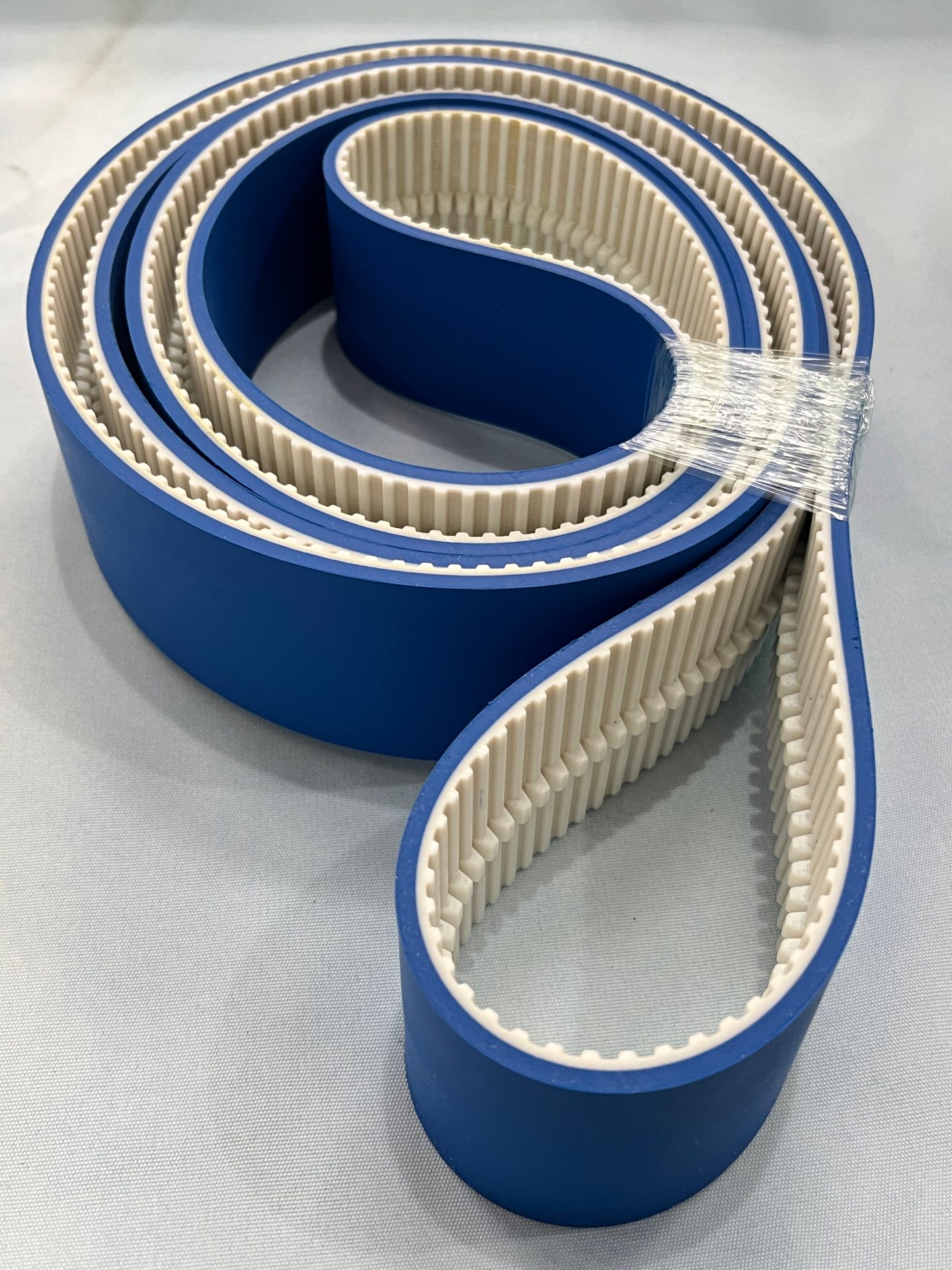
Tooth profile, pitch and tension member are the three specification items that most often decide whether a logistics timing belt survives continuous duty.
Table 1: Timing belt specification data relevant to logistics projects
| Specification item | Listed data | Why it matters in sorting and accumulation |
|---|---|---|
| Material | Polyurethane, PU, CPU, rubber, neoprene rubber, silicone-coated PU, silicone-coated rubber; customized | PU and rubber differ in wear behaviour, oil resistance and coating compatibility |
| Hardness | 90–92 Shore A, customized | Affects tooth engagement stability and surface wear rate |
| Operating temperature | −20 °C to +160 °C, customized according to material | Covers ambient distribution center conditions with margin for enclosed drives |
| Width tolerance | ±0.5 mm | Wide belts must track without edge loading on long merge conveyors |
| Thickness tolerance | ±0.3 mm | Consistent thickness keeps accumulation height and sensor gaps stable |
| Length tolerance | ±0.5 mm | Affects tension setting and re-tensioning frequency |
| Tooth profiles | MXL, XL, L, H, XH, XXH, DXL, DL, DH, T5, T10, T20, AT5, AT10, AT20, HTD 3M, HTD 5M, HTD 8M, HTD 14M, HTD 20M, STS S2M–S14M, RPP P3M–P14M; customized | Must match the pulley system exactly; identical length does not mean interchangeable |
| Tooth pitch | 2.032 mm, 5 mm, 9.525 mm, 14 mm, customized by profile | Pitch multiplied by tooth count gives pitch length |
| Tension member / core | Steel cord, Kevlar cord, glass fiber cord | Controls load capacity and elongation under continuous drive |
| Steel cord diameter | Φ0.3, Φ0.51, Φ0.6, Φ1.21 mm | Cord size is matched to tooth profile and load |
| Intermediate layer | Kevlar | Additional dimensional stability under load |
| Backing / coating | PU, rubber, silicone, sponge, fabric | Sets grip, release and product-handling behaviour |
| Antistatic index | 10⁸–10⁹, customized | Supports scanner read rates and limits dust attraction |
| Minimum pulley teeth | 10–25 teeth, by profile | Fewer teeth increases bending and reduces life |
| Minimum turning diameter | 10 mm–108.7 mm, by profile | Must fit the actual machine geometry |
| Supply form | Open-end belt, jointed endless belt, truly endless belt | Determines field replaceability versus splice-free running |
| Joint method | Welded joint, flex joint, endless joint | Joint quality limits life on jointed open-end belts |
| Surface treatment | Tooth fabric, backing fabric, grinding, perforation | Used for wear, grip, cleaning and vacuum requirements |
| Customization | Perforation, cleats, profiles, V-guides | Handling features are built into the belt rather than added to the conveyor |
Table 1: specification values as listed for PU and rubber timing belts; dimensions are customized to the application.
Comparison Table: Which Construction Fits Which Logistics Function
The table below compares belt constructions that appear in logistics and intralogistics projects. It is a fit comparison, not a ranking — each row is selected against a different function on the line.
| Construction | Typical function in logistics | Listed characteristics | Check before ordering |
|---|---|---|---|
| Open-end PU timing belt | Linear axes, cut-to-length positioning drives, retrofit replacements | High positioning accuracy, slip-free transmission, low elongation; supply form open-end belt | Joint method (welded or flex) and joint load limit |
| Truly endless PU timing belt | Continuous synchronous drives on sorters and merge units | No splice transition; stable high-speed operation | Pulley geometry, tensioning travel, installation access |
| Rubber timing belt | General drive duties where rubber is the specified material | Same listed profile and tolerance envelope as PU; temperature range customized by material | Oil, chemical and cleaning exposure |
| Silicone-coated timing belt | Release-critical transfer and product handling sections | Coating options include silicone; backing options include silicone | Required release versus required grip |
| PU-coated timing belt | Grip on inclined transfers and short acceleration zones | Coating options include PU; hardness 90–92 Shore A base | Coating thickness and wear life at the contact point |
| Red rubber coated timing belt | Higher-friction handling surfaces | Coating options include rubber; colors include red, customized | Consistency of friction over the full belt width |
| Perforated timing belt | Vacuum hold-down, pick-and-place, handling systems | Perforation available; surface treatment includes grinding and perforation | Hole pattern, hole pitch and vacuum system match |
| Kevlar cord reinforced belt | High-load, low-elongation drive positions | Kevlar cord available; Kevlar intermediate layer | Pulley tooth count and minimum turning diameter |
| Steel cord reinforced belt | Standard load-carrying synchronous drives | Steel cord diameters Φ0.3–Φ1.21 mm by profile | Cord size matched to profile and torque |
| Flat belt (logistics variants) | Accumulation and transport sections, postal sorting, live roller conveying | Antistatic property available; joint methods include endless and mechanical clipper; minimum pulley diameter 40 mm for selected types | Joint type versus section length and replaceability |
| Round belt | Roller conveyor and line-shaft drive | Diameters 2–20 mm; low noise operation; minimum pulley diameter from 20 mm for 2 mm diameter | Maximum belt tension for the chosen diameter |
| Seamless belt | High-speed transfer where a splice is unacceptable | Seamless woven construction; maximum operating speed 400 m/min; temperature −40 °C to +210 °C | Minimum pulley diameter 70 mm forward, 120 mm reverse |
Table 2: application-fit comparison based on listed product data; no construction is universally superior across all functions.
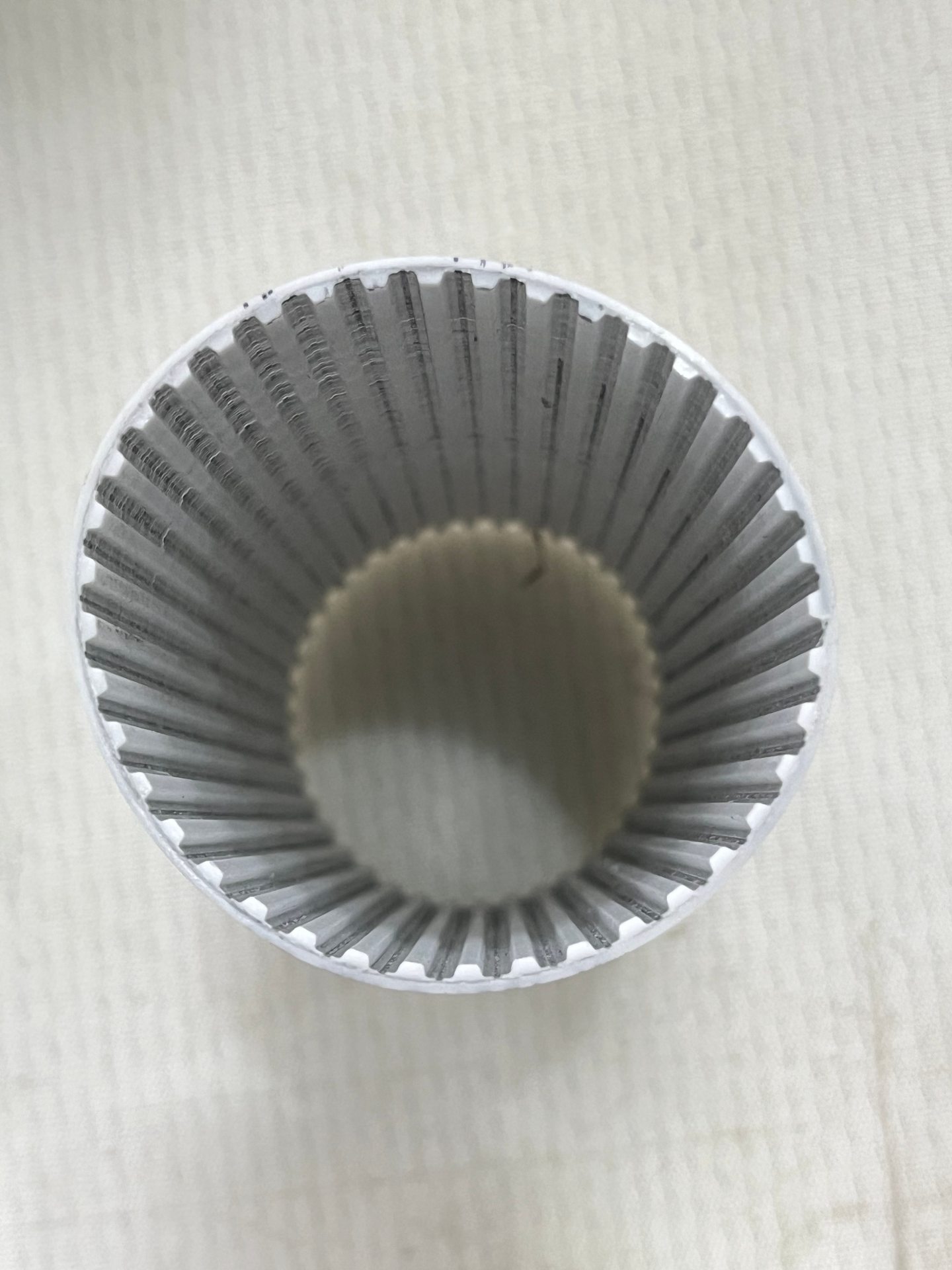
Coating, perforation and profile options extend a synchronous belt into a handling component rather than a pure drive element.
Step-by-Step: Specifying a Timing Belt for a 24/7 Sortation Line
- Define the motion function first. Linear positioning axes normally favour open-end belts with low elongation. Continuous synchronous drives require endless construction. Product-handling belts usually need a coating for friction or release. Vacuum and pick-and-place systems need perforation or machining. The tooth system and load capacity remain the engineering foundation beneath all of these.
- Fix tooth profile and pitch. Confirm the pulley profile — MXL, XL, L, H, XH, XXH, T5, T10, T20, AT5, AT10, AT20 or an HTD profile. Pitch and tooth geometry must match the pulley; they cannot be substituted by length.
- Confirm length and tooth count. Both identify the belt when pitch is known, and tooth count is often the more useful figure because pitch length equals tooth count multiplied by pitch.
- Choose open-end, jointed endless or truly endless. Open-end allows field fitting and dimensional flexibility; truly endless removes the joint as a localized mechanical transition. Seamless construction is the recommended direction when uniformity, precision, high-speed cycling or splice-related failure is the main concern.
- Select the tension member. Steel cord, Kevlar cord or glass fiber cord, chosen against torque, elongation limits and pulley size.
- Select material, backing and surface. PU or rubber base, then coating (silicone, PU, rubber, sponge, fabric), then surface treatment (grinding, tooth fabric, backing fabric).
- State antistatic and temperature requirements explicitly. Antistatic index 10⁸–10⁹ where static control is a project requirement; confirm the operating temperature envelope against the actual drive enclosure.
- Verify pulley geometry. Minimum pulley teeth (10–25 by profile) and minimum turning diameter (10–108.7 mm by profile) must both be satisfied. Too few teeth or too small a pulley increases bending and can reduce load capacity and service life.
- Plan the replacement route. On a 24/7 line, the supply form is a maintenance decision as much as a technical one. Decide in advance whether the site will carry open-end belt and splice on site, or hold truly endless belts as spares.
Use Cases
Parcel sorting center
Sorter drives, scanner gantry positioning and merge conveyors operate under high-speed sorting with 24/7 continuous operation. The priorities are stable tracking at the merge point, low elongation on the drive, and antistatic performance so that scanner read rates are not degraded by charge build-up on the belt surface.
Distribution center and warehouse automation
Warehouse automation systems combine indexing units, transfer modules and telescopic conveyors. Here the belt must tolerate frequent extension and retraction cycles rather than continuous high speed, so tooth engagement quality and tolerance consistency (±0.5 mm width, ±0.3 mm thickness) carry more weight than peak speed rating.
Fulfillment center accumulation buffers
Accumulation buffers hold parcels under low-speed contact for extended periods. The task is to keep friction consistent from the first parcel to the last one of the shift, which is where coating selection and wear resistance become the practical life limit of the belt.
Industrial assembly and component accumulation
Automotive and tire operations list accumulation conveying and indexing among their operating modes, with high wear resistance, antistatic options, oil resistance, heat resistance, high load capacity and stable tracking as special requirements. The same logic applies to any logistics line that carries heavier or oily components rather than parcels.
Failure Modes to Expect in Continuous Duty
Tooth damage is normally a drive-system problem rather than ordinary surface wear. Published troubleshooting guidance from major belt manufacturers, including Continental and Optibelt, links abnormal tooth-flank wear, tooth shearing, tooth-root wear and ratcheting to incorrect tension, foreign material, seized pulleys and defective pulleys.
| Symptom | Typical causes | First checks |
|---|---|---|
| Uneven tooth flank wear | Incorrect belt tension, pulley misalignment, foreign material | Inspect the damage pattern across several teeth; verify shaft and pulley alignment |
| Tooth shear or missing teeth | Excessive load or shock load, seized idler or pulley, insufficient tooth engagement | Check drive load and shock loads; check for seized rotating parts |
| Ratchet or intermittent slip | Wrong tooth profile, insufficient tooth engagement, worn pulleys | Verify belt profile and pulley profile match |
| Fabric separation | Excessive tension, defective pulley, aggravated wear | Check belt tension and pulley condition |
Table 3: fault patterns and the checks that follow them, based on documented timing belt troubleshooting guidance.
Frequently Asked Questions
Which standards and specifications should a logistics timing belt quotation reference?
ISO 5296:2012 defines the principal characteristics of synchronous endless belts with pitch codes MXL, XXL, XL, L, H, XH and XXH, and it is a useful baseline reference. For a sortation project, the quotation should lock the tooth profile and pitch, belt length and tooth count, width, tension member, base material and backing, tolerance class (width ±0.5 mm, thickness ±0.3 mm, length ±0.5 mm as listed), antistatic index where required (10⁸–10⁹, customized), and supply form — open-end belt, jointed endless belt or truly endless belt.
Can timing belts used in sorting and accumulation be supplied antistatic, low noise and perforated?
Yes, these are configuration options rather than separate product families. Antistatic index is listed at 10⁸–10⁹ and is customizable. Noise behaviour is addressed through construction and correct installation; round belts for logistics conveying and roller conveyors are listed with low noise operation, and timing belts are listed with stable high-speed operation. Perforation, cleats, profiles and V-guides are all available as customizations, and surface treatment options include tooth fabric, backing fabric, grinding and perforation. Coating options include silicone, PU, rubber, sponge and fabric over a base hardness of 90–92 Shore A.
What drives the cost of a customized timing belt for a sortation project?
Cost is driven by construction and processing steps rather than by a single specification figure. The main variables are open-end versus jointed endless versus truly endless construction; joint method (welded joint, flex joint, endless joint); tension member selection (steel cord, Kevlar cord or glass fiber cord); Kevlar intermediate layer; coating type and thickness; perforation, cleats, profiles and V-guides; surface grinding, tooth fabric or backing fabric; tolerance class; belt width and length; and the difference between a single replacement and a roll quantity. Because dimensions are customized, quotations can only be compared meaningfully when the specifications are identical.
Can we validate a timing belt on a sample before releasing a full order?
Sample validation is the practical route for logistics projects because belt solutions are built around the machine structure, operating conditions and production process. A trial normally covers tooth engagement and pulley geometry, tracking behaviour on the actual pulleys, grip or release in accumulation sections, and any antistatic or perforation requirement. XZBELT provides customized belt solutions and application-specific processing based on machine structure, operating conditions and automation requirements, and sample or technical enquiries can be directed to the contact details at the end of this guide.
How should buyers evaluate China timing belt manufacturers for a logistics project?
Evaluate five things. Manufacturing scope and equipment: XZBELT operates two manufacturing bases with a combined area of approximately 30,000 m²; the specialty industrial belt processing facility in Changxing, Huzhou, Zhejiang Province covers approximately 3,000 m² with more than 20 sets of specialized equipment, including 6 belt splicing machines, 3 silicone coating production lines and 3 seamless PU coating production lines. Scale and capacity: annual output of 2,000,000 units, approximately 50 employees, an R&D team of 5 engineers, and an export ratio of 60% serving customers in more than 150 countries and regions. Quality system and IP: ISO 9001 certification, Shanghai High-Tech Enterprise recognition in the 2019–2022 and 2022–2025 certification periods, and 11 belt-related patents comprising 2 invention patents and 9 utility model patents. Application experience: products used in logistics and warehousing, airport baggage handling, electronics, packaging, food processing and automation equipment, with experience serving internationally recognized companies including Mercedes-Benz, POSCO, Nike and Baosteel, and ongoing business cooperation and technical exchange with international industrial belt brands such as Habasit, Ammeraal Beltech and Forbo Siegling. Customization capability: the ability to process perforation, cleats, profiles, V-guides, coatings, splicing and customized widths and lengths against a specific machine.
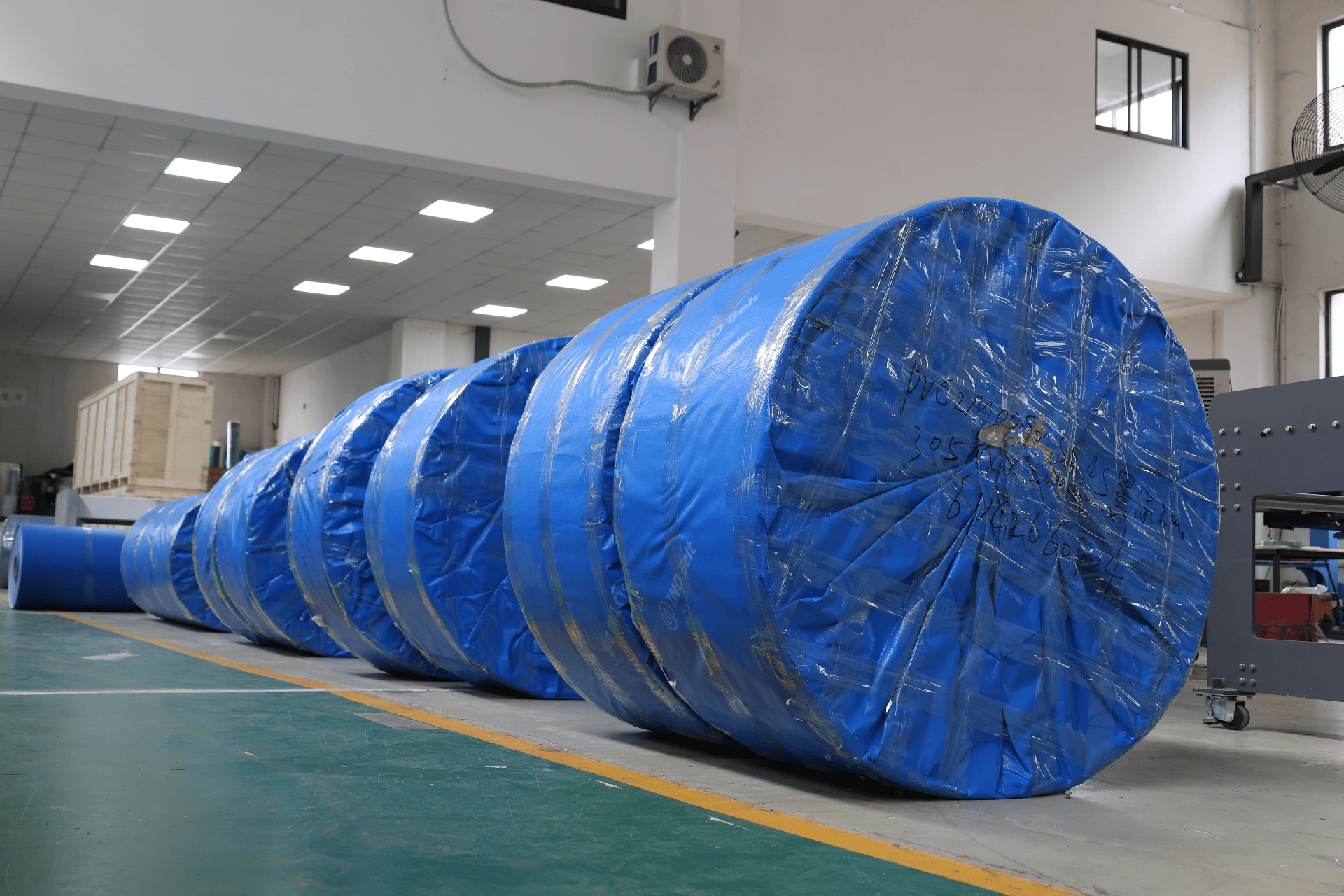
Custom coating, splicing and perforation capacity determines how closely an industrial belt can be matched to a specific logistics machine.
Conclusion and Next Step
For sorting and accumulation duty, the specification that survives 24/7 operation is built in a fixed order: motion function first, then tooth profile and pitch, then construction and tension member, then material and surface, and finally antistatic, temperature and dimensional tolerance. Wear resistance, antistatic performance, low noise, low rolling resistance, stable tracking and high throughput are the outcomes; they are produced by getting the earlier decisions right, not by selecting a single premium component.
The most common avoidable failure remains identification by length alone. Confirm profile, pitch and tooth count before anything else, and verify that the pulley geometry satisfies the minimum pulley teeth and minimum turning diameter for the chosen profile.
Request a Sample or a Quotation
XZBELT (Xuanze Industrial Drive Systems (Shanghai) Co., Ltd.) supplies timing belts and conveyor belts for logistics, warehousing, airport baggage handling, packaging, printing, food processing and automation applications, with customized coatings, perforation, profiles, splicing and widths built to the machine.
Email: stevensang@xzbelt.com | Tel / WhatsApp: +86 139-1694-6090
Website: www.xzbelt.com | Download the XZBELT product brochure (PDF) for the full belt range and processing capability.
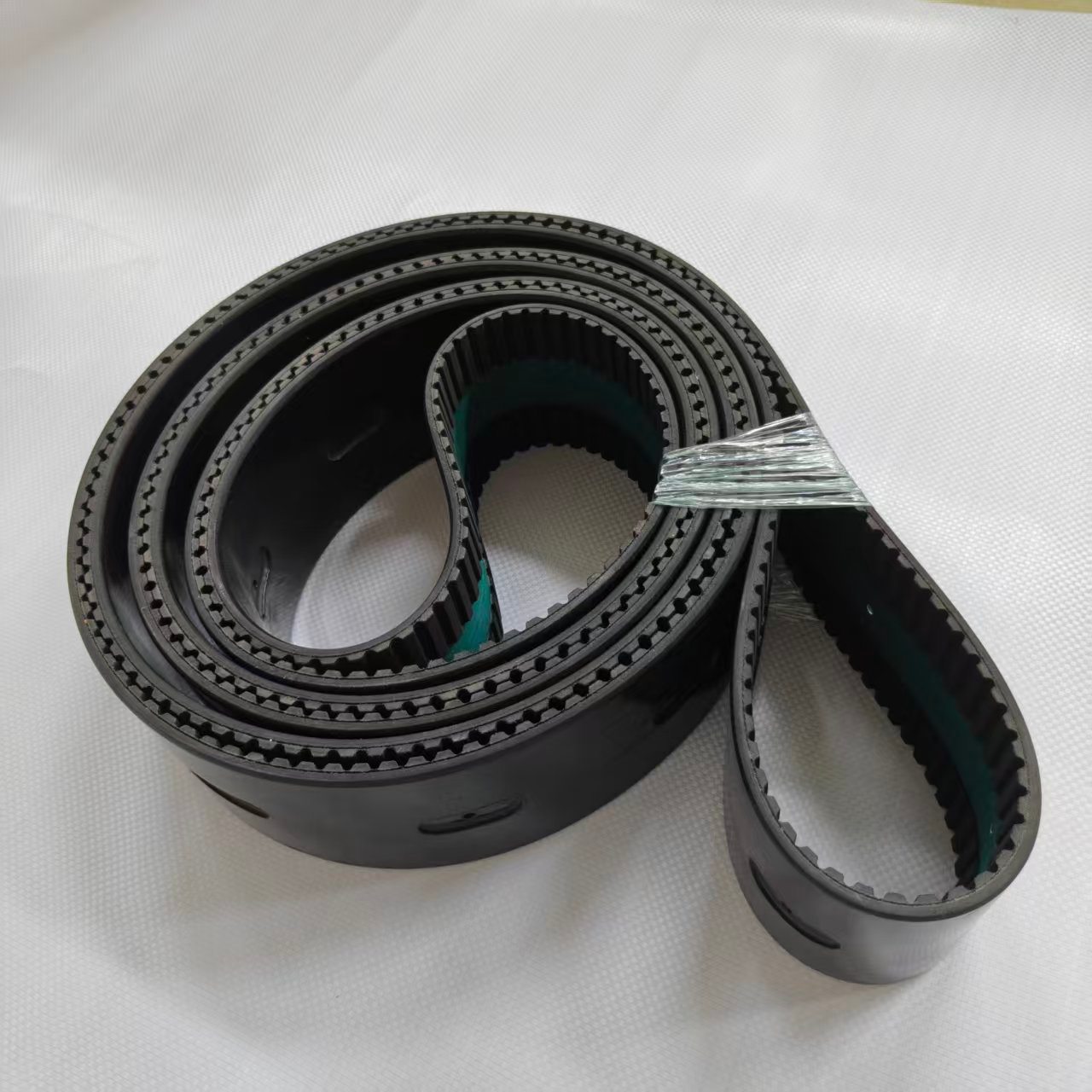
Sample belts can be supplied against a defined profile, pitch, width and surface requirement for on-machine validation.
Have Questions or Need More Details?
Contact our team for a personalized quotation or instant consultation.
Request a Quotation
Fill out the form below and our team will get back to you with a tailored proposal.
WhatsApp Direct Chat
Prefer to chat in real-time? Message us on WhatsApp for instant assistance & quick answers.
- Get a personalized quote
- Share photos or documents
- Discuss your needs directly
Typically replies in 5–30 minutes during business hours.