Timing Belt Guide: Types, Materials, Tooth Profiles and How to Choose
A timing belt — also written as synchronous belt or toothed belt — is a power transmission belt with teeth formed on its inner surface that mesh with a matching grooved pulley. Because the teeth carry torque mechanically instead of relying on friction, a timing belt maintains a fixed angular relationship between the driving and the driven shaft. That is why synchronous drives are specified wherever indexing, positioning or synchronized movement matters more than simple pulling force.
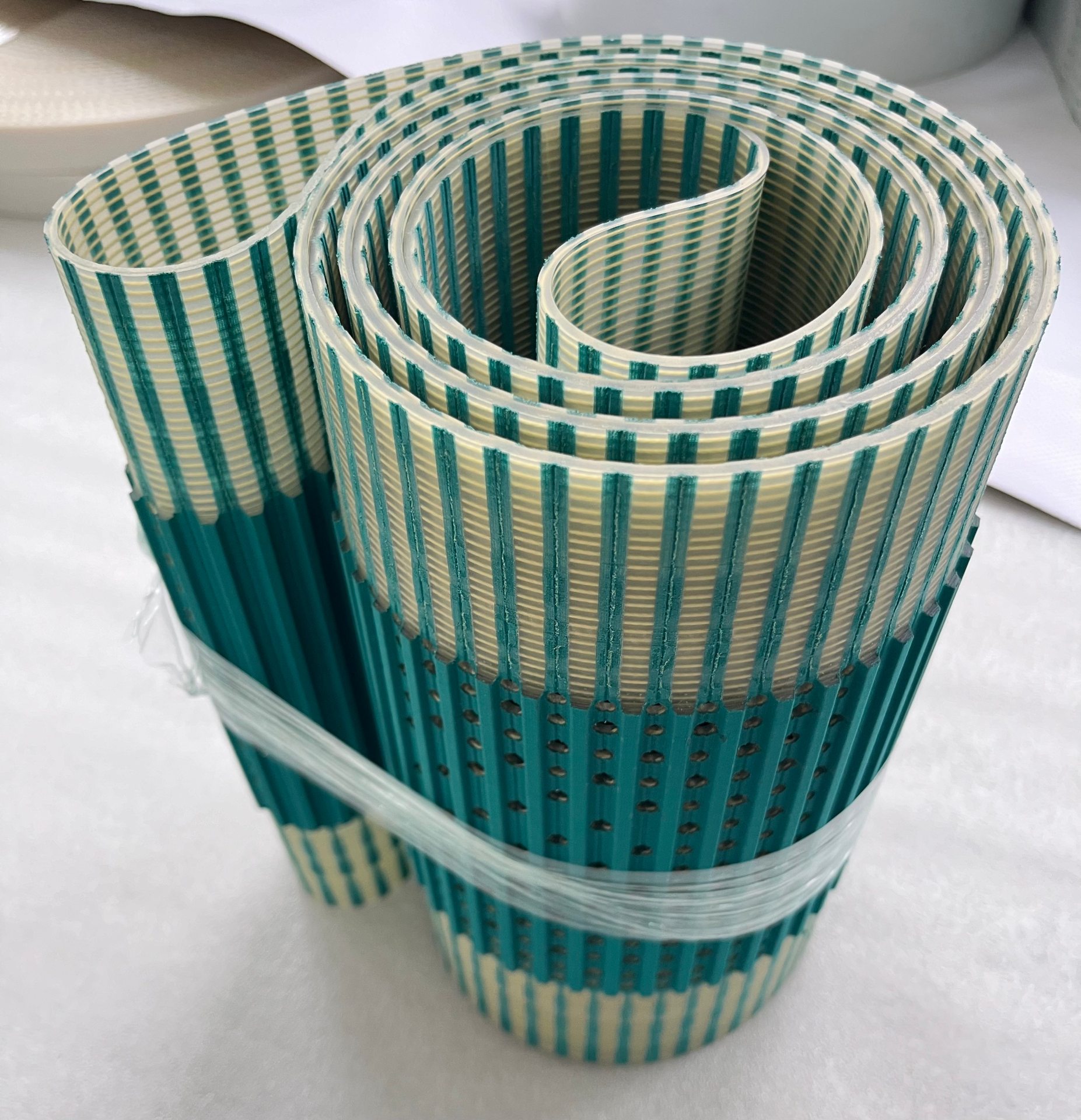
Quick answer: identify a timing belt by four facts before anything else — tooth profile, pitch, width, and length or tooth count. Material (PU or rubber), tension member (steel cord, Kevlar cord or glass fiber cord), construction (open-end, jointed endless or truly endless) and surface processing (coating, perforation, cleats) are decided only after those four are confirmed.
XZBELT is the industrial belt brand of Xuanze Industrial Drive Systems (Shanghai) Co., Ltd., a manufacturer established in Shanghai in 2013 that produces conveyor belts, timing belts, power transmission belts and specialty industrial belts. The timing belt range covers PU and rubber synchronous belts, open-ended and endless constructions, double-sided belts, HTD and T-series profiles, and coated or perforated versions for product handling. This guide explains the types and the specification logic behind them, and it flags the details that most often produce a wrong order.
Timing Belt Basics: What a Synchronous Drive Does That a Friction Belt Cannot
A friction belt carries load by gripping the pulley. A timing belt carries load by tooth engagement, so the drive is slip-free as long as the teeth and pulley grooves are matched, tensioned correctly and aligned. In practical terms, that changes what the belt contributes to the machine: high positioning accuracy, slip-free transmission, high tensile strength, low elongation, wear resistance, oil resistance and stable high-speed operation are the characteristics that make toothed belts the default choice in indexing and servo-driven equipment.
The same mechanism defines the limits. A synchronous drive depends on a matched pulley, correct tension and correct alignment, and it depends on the tension member rather than on belt surface friction. When tension, alignment, load or pulley condition is wrong, the timing belt becomes the visible failure point even though the drive caused the damage — a pattern that shows up repeatedly in field troubleshooting.
Problem Definition: Why Timing Belts Fail or Get Ordered Wrong
Tooth damage is usually the result of a drive-system problem rather than ordinary surface wear. Published troubleshooting guidance from Continental links abnormal tooth-flank wear and tooth shearing to incorrect tension, foreign material and seized pulleys, while Optibelt identifies excessive tension and defective pulleys as causes of tooth-root wear. The visible symptoms — tooth flank wear, damaged tooth roots, missing teeth, tooth shear, fabric separation or intermittent ratcheting — sit at the end of a chain that normally starts with tension, alignment, load or pulley condition.
The causes most frequently recorded for this damage pattern are:
- Incorrect belt tension (too loose or too tight)
- Excessive or shock load on the drive
- Worn or damaged pulley teeth
- Wrong tooth profile or pitch for the pulley
- Pulley and shaft misalignment
- Foreign material entering the tooth mesh
- Insufficient tooth engagement (too few pulley teeth in mesh)
- Seized idler or pulley bearing
The second failure mode is identification rather than wear. Two timing belts can share the same length and still not be interchangeable, because tooth geometry and pitch must match the pulley system. Length and tooth count are both useful identifiers: when pitch is known, pitch length equals tooth count multiplied by pitch, which is often the fastest way to confirm a replacement belt.
The third failure mode is system-level. Minimum pulley tooth count matters because too small a pulley increases bending stress and can reduce load capacity and service life, and the tension member defines load-carrying ability, elongation and stiffness. A belt that is correct in profile and length can still be wrong for the drive if the reinforcement or the pulley geometry does not match the duty.
Industry Background: Timing Belt Demand, Materials and Standards
Demand for synchronous belts continues to track industrial automation rather than any single end market. Mordor Intelligence projects the global timing belt market growing from USD 9.10 billion in 2025 to approximately USD 9.57 billion by 2030. Within the category, Credence Research estimates the polyurethane timing belt segment growing at a 12.57% CAGR to USD 25.5 billion by 2032, while 24ChemicalResearch places PU segment growth at 3.10% — a methodology difference that likely reflects whether high-value custom solutions and robotics applications are included in the scope. On the material side, Market Research Future estimates rubber remains the dominant material in the automotive timing belt market, at USD 7.23 billion in 2024.
Standardisation on the industrial side is long established. ISO 5296:2012 specifies the principal characteristics of synchronous endless belts with pitch codes MXL, XXL, XL, L, H, XH and XXH, which is why those profile codes appear consistently across suppliers and why profile identification is a reliable starting point for replacement sourcing.
For buyers, the practical reading of this background is simple: PU and rubber constructions coexist because they solve different problems, not because one has replaced the other. PU covers clean, oil-exposed and positioning-critical drives; rubber constructions remain central where heat, load and automotive duty dominate. Selection should follow the application, not a material trend.
Timing Belt Types, Materials, Tooth Profiles and Constructions
Material: PU, Rubber and Silicone-Coated Timing Belts
Timing belts are made of polyurethane (PU), rubber or neoprene rubber, with silicone-coated PU and silicone-coated rubber available for specific handling duties. Hardness is typically 90–92 Shore A and can be customized, and the operating temperature range is −20°C to +160°C, customized according to the material selected.
PU timing belts are chosen for oil resistance, wear resistance, clean running without lubrication and stable high-speed operation. Rubber timing belts are chosen where heat, load and general industrial duty dominate, including automotive-related applications. Silicone-coated timing belts add a release or grip surface on top of a synchronous drive; XZBELT's SIBR-5M synchronous silicone tape, developed for hygiene-product production, is listed in the company's audited supplier information as capable of 1200–1400 pcs/min in that application.
Tooth Profiles and Pitch: HTD, T10, AT10, MXL and More
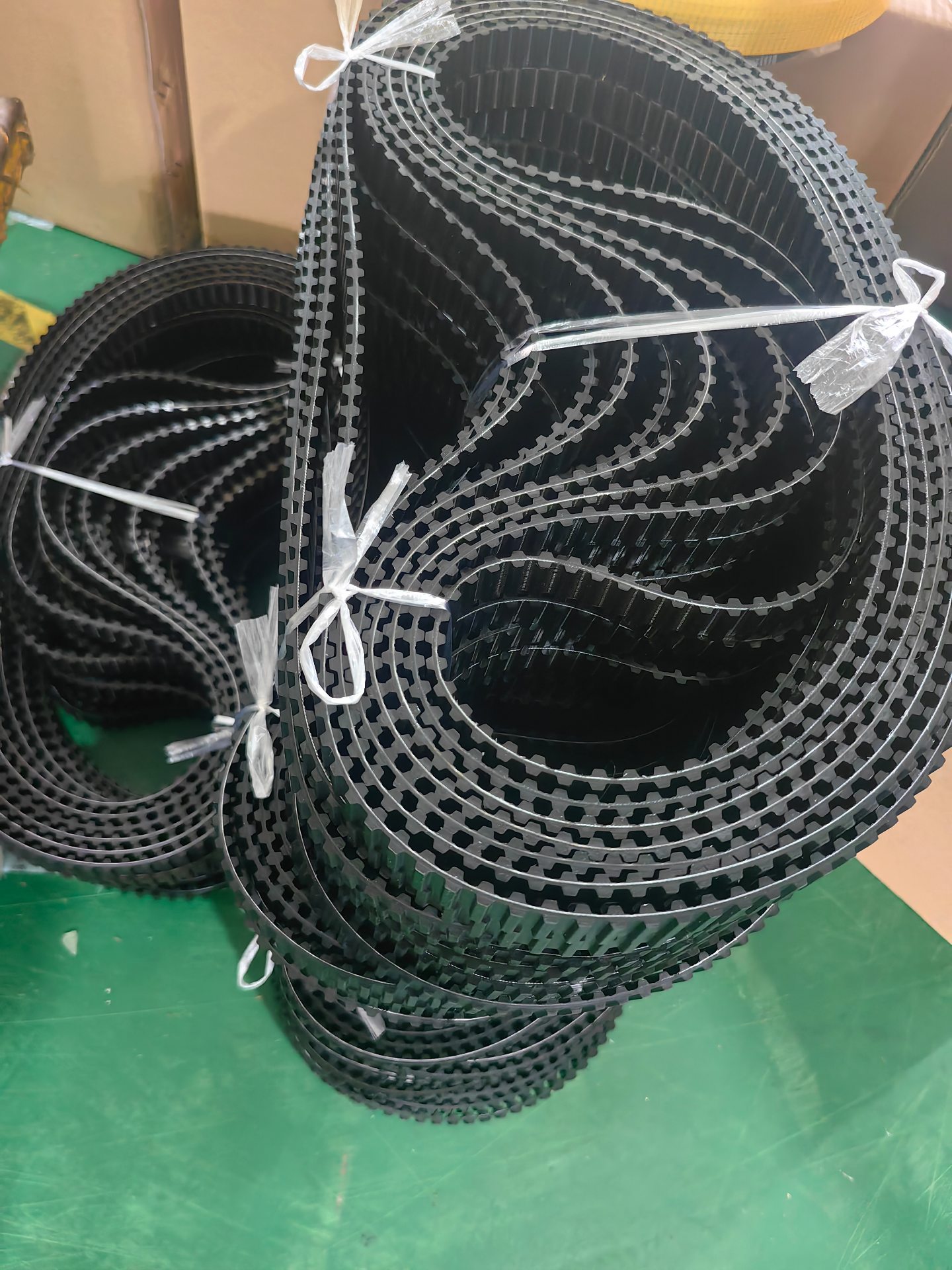
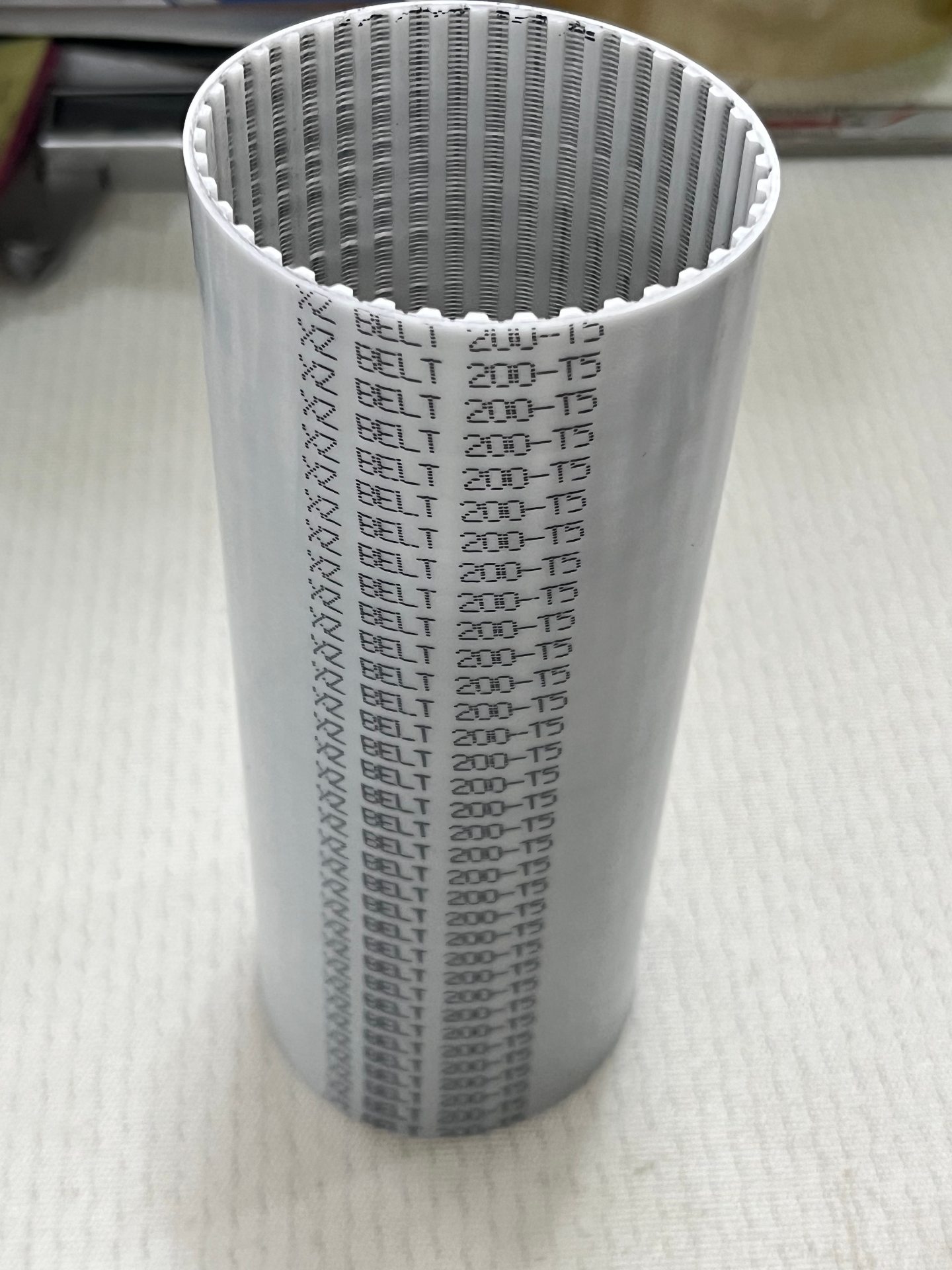
Available tooth profiles include MXL, XL, L, H, XH, XXH, DXL, DL, DH, T5, T10, T20, AT5, AT10, AT20, HTD 3M, HTD 5M, HTD 8M, HTD 14M, HTD 20M, STS S2M, S3M, S4.5M, S5M, S8M, S14M, and RPP P3M, P5M, P8M, P14M, plus customized profiles. Common pitches are 2.032 mm, 5 mm, 9.525 mm and 14 mm, customized according to the profile.
Profile naming matters commercially. An HTD timing belt, a T10 timing belt and an AT10 timing belt are not interchangeable, even where pitch looks similar, because tooth geometry differs. That is the single most common source of a wrong replacement order in maintenance purchasing.
Constructions: Open-Ended, Endless, Double-Sided and Flex
Belt types include single-sided, double-sided, open-end, endless and flex belts. Supply forms are open-end belt, jointed endless belt and truly endless belt, and joint methods include welded joint, flex joint and endless joint.
- Open-ended timing belt — supplied as an open length, typically used for linear axes, custom centre distances and field-fitted drives.
- Jointed endless belt — an endless loop produced with a joint, useful where replacement without dismantling the machine has priority.
- Truly endless timing belt — manufactured as a closed loop with no joint, appropriate for continuous synchronous drives and high-speed cycling.
- Double-sided timing belt — teeth on both faces (DXL, DL, DH among the available profiles) for reversing or two-sided drive arrangements.
Tension Members: Steel Cord, Kevlar Cord and Glass Fiber Cord
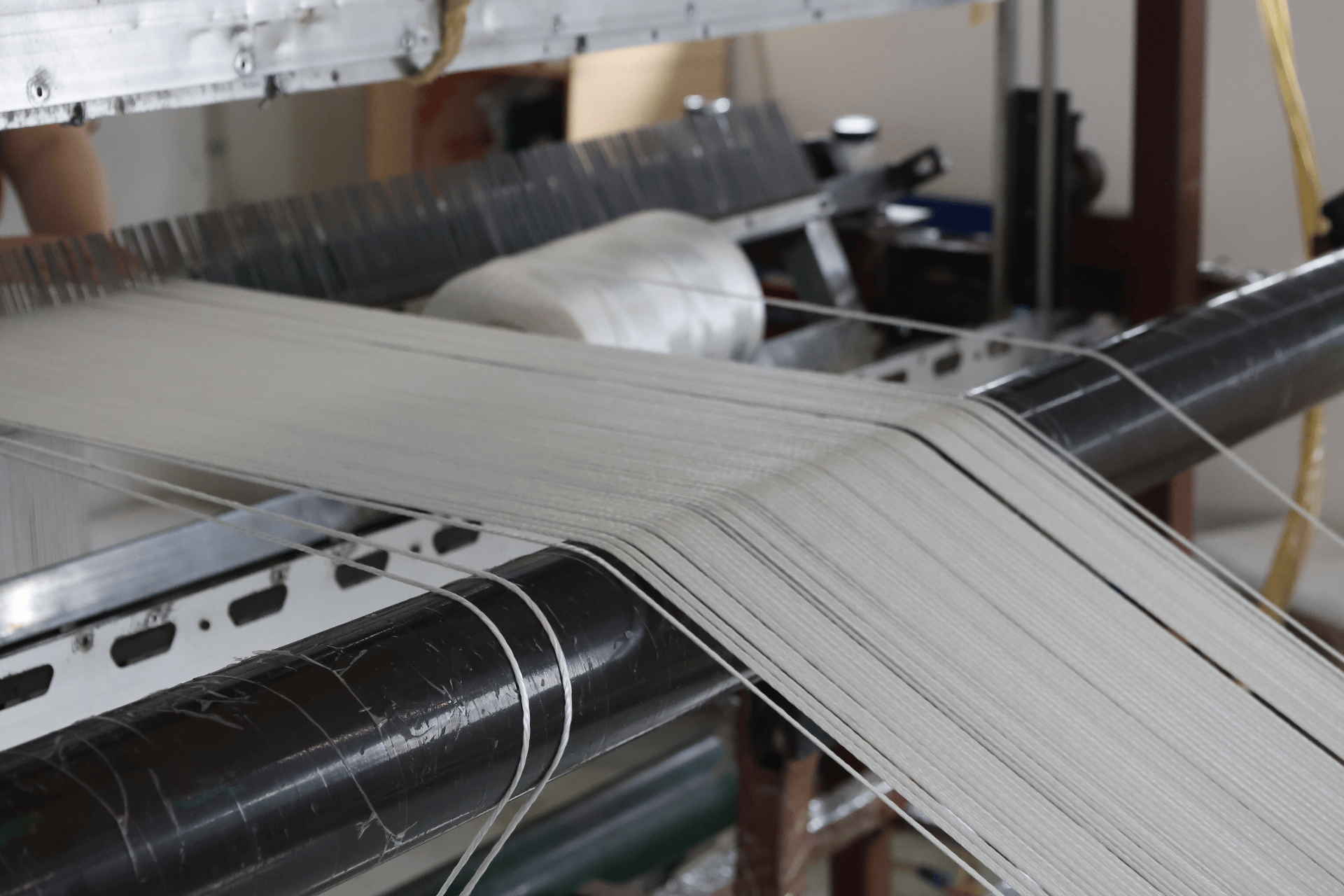
The tension member (core) can be steel cord, Kevlar cord or glass fiber cord, with steel cord diameters including Φ0.3 mm, Φ0.51 mm, Φ0.6 mm and Φ1.21 mm, customized according to profile. Kevlar is also used as the intermediate layer material in reinforced constructions.
The core controls load capacity, elongation and stiffness — the three properties that decide whether a drive holds position under acceleration. A Kevlar-reinforced timing belt and a steel-cord belt of the same profile behave differently under load, which is why high-precision timing belt specifications should always name the reinforcement rather than assume it. Related geometry figures: minimum pulley teeth 10–25 (customized according to profile) and minimum turning diameter 10 mm–108.7 mm.
Coatings, Perforation and Secondary Processing
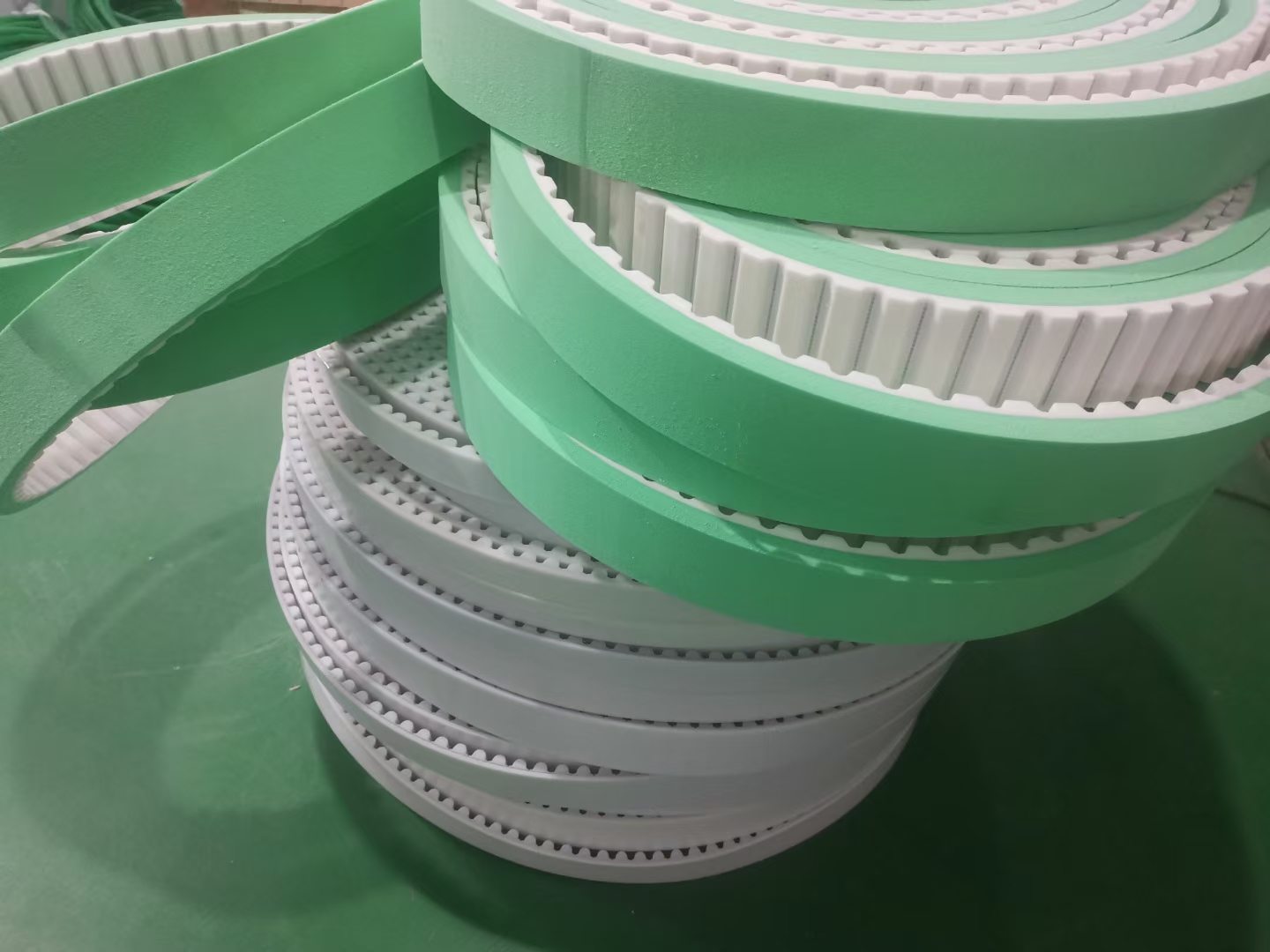
Backing and coating materials include PU, rubber, silicone, sponge and fabric. Surface treatments include tooth fabric, backing fabric, grinding and perforation, and belts can be customized with perforations, cleats, profiles and V-guides. Colour options include transparent, white, black, green, red and blue, which is how a red rubber coated timing belt or a coloured PU-coated timing belt is specified in practice.
XZBELT's secondary processing services for specialty belts include single-side and double-side sidewalls, fabric reinforcement and lamination, cleats, perforation, silicone coating, sponge coating, special surface coating, belt splicing, and customized widths and lengths. Representative specialty timing belt products include extra-wide timing belts, silicone-coated timing belts and rubber timing belts with high-temperature felt.
A perforated timing belt is a machining operation rather than a material choice: selected PU timing belts can be drilled or machined for vacuum and pick-and-place handling systems, which is why perforation is usually specified together with the vacuum system rather than on its own.
Step-by-Step: How to Specify a Timing Belt for Your Machine
Timing belt selection should begin with the required motion function rather than with a material preference. The sequence below follows that logic and matches how a manufacturer reads an enquiry.
- Define the motion function. Linear positioning, continuous synchronous drive, high-grip product handling, vacuum feeding and high-temperature handling each point to a different construction. Linear axes normally favour open-end belts with low elongation; continuous drives require endless or truly endless constructions; handling belts may need silicone, rubber or sponge covers; vacuum systems may need perforation or machining.
- Fix tooth profile and pitch. Match the existing pulley system, or confirm the pulley profile if the drive is new. Note that profile and pitch must both match.
- Fix width and length or tooth count. Where pitch is known, pitch length equals tooth count multiplied by pitch, which cross-checks the length figure.
- Select the material. PU for clean, oil-exposed, positioning-critical drives; rubber or neoprene rubber for heat and load; silicone-coated grades where release or high-temperature handling is required.
- Select the construction. Choose single-sided or double-sided, and open-end, jointed endless or truly endless, according to drive layout and service access.
- Select the tension member. Steel cord, Kevlar cord or glass fiber cord, based on load, acceleration and permissible elongation.
- Add surface function. Coating, perforation, cleats, profiles, V-guides, grinding, tooth fabric or backing fabric — only where the application demands it.
- Check pulley geometry and tolerances, then validate. Confirm minimum pulley teeth and turning diameter, verify alignment and tension, and run the belt on the machine before committing to volume.
Reference figures from XZBELT's timing belt specification data are useful as a checklist when writing an enquiry:
| Specification checkpoint | Reference figure (XZBELT timing belt data) |
|---|---|
| Width tolerance | ±0.5 mm |
| Thickness tolerance | ±0.3 mm |
| Length tolerance | ±0.5 mm |
| Hardness | 90–92 Shore A (customized) |
| Operating temperature | −20°C to +160°C (customized according to material) |
| Minimum pulley teeth | 10–25 teeth (customized according to profile) |
| Minimum turning diameter | 10 mm–108.7 mm (customized according to profile) |
| Antistatic index | 10⁸–10⁹ (customized) |
| Tensile strength | 6 N/mm for selected MXL type (customized according to belt structure) |
Belt tension and alignment are checked at this stage because tooth damage is usually a drive-system outcome. Inspect the damage pattern across several teeth, verify profile match, inspect pulley teeth, check tension, confirm shaft and pulley alignment, review load and shock conditions, and remove contamination before fitting a new belt.
Use Cases: Where Timing Belts Are Applied
Timing Belts for Packaging Machines
Packaging machinery runs at high speed with frequent start-stop cycles and repetitive indexing, so the drive must hold position. Working conditions typically combine high speed, repeated cycles and precise positioning, with matched equipment including packaging machines, filling machines, labelling machines, cartoners, case packers, servo motors and vacuum systems. Requirements concentrate on accurate positioning, low elongation, high grip, vacuum perforation, wear resistance and dimensional stability.
Timing Belts for Printing Machines
Printing and paper converting equipment handles lightweight products with rapid acceleration and precise sheet positioning. Matched equipment includes printing presses, sheet feeders, folders, folder gluers, cutters, stackers and binders, and the required characteristics are high friction consistency, precise positioning, abrasion resistance, low elongation and a non-marking surface.
Industrial Automation and Precision Equipment
Automation machines, linear motion systems, robotic equipment and precision conveyors operate with frequent acceleration and deceleration, servo positioning and high cycle rates. Matched equipment includes servo motors, stepper motors, timing pulleys, linear guides and robotic axes. The critical requirements are low elongation, backlash control, positioning accuracy, high tensile strength and low vibration.
Electronics, Medical and Office Equipment
These applications run clean, with small pulley diameters, low-noise motion and frequent cycling. Matched equipment includes diagnostic equipment, office machines, data handling equipment, robotics and small precision drives. Low noise, no lubrication, positioning accuracy, compact drive design and wear resistance are the deciding criteria.
Food Processing, Automotive and General Industry
Food and beverage lines operate wet, with frequent wash-down and food-contact considerations; automotive and tire production runs heavy loads with oil, dust and heat; general conveying and machinery manufacturing applications prioritise stable transmission and long service life. XZBELT products are used across electronics, packaging, logistics and warehousing, airport baggage handling, food processing, pharmaceutical manufacturing, woodworking, printing, petrochemical processing, metallurgy, steel production, automation equipment and machinery manufacturing.
Comparison Table: Timing Belt Types at a Glance
The comparison below uses specification facts from XZBELT's timing belt data and publicly attributed market information. It compares types, not brands.
| Type | Construction and specification basis | Function it fits |
|---|---|---|
| PU timing belt | Polyurethane body; hardness 90–92 Shore A; −20°C to +160°C (material-dependent) | Clean, oil-exposed and positioning-critical drives; stable high-speed operation |
| Rubber timing belt | Rubber or neoprene rubber body; rubber remains the dominant material in automotive timing belts (USD 7.23 billion, 2024, Market Research Future) | Heat and load duty, general industrial and automotive-related drives |
| Open-ended timing belt | Supplied as open-end belt; welded, flex or endless joint options; length customized | Linear axes, custom centre distances, on-site fitting |
| Truly endless timing belt | Truly endless construction without a joint; endless joint method available | Continuous synchronous drives and high-speed cycling |
| Double-sided timing belt | Teeth on both faces; DXL, DL and DH among available profiles | Reversing drives and two-sided drive arrangements |
| Coated timing belt (silicone / PU / rubber / sponge / fabric) | Coating and backing options include silicone, PU, rubber, sponge and fabric | Product handling that needs extra grip, release or compression |
| Perforated timing belt | Perforation listed as a surface treatment and customization option on selected PU belts | Vacuum feeding and pick-and-place systems |
| Steel cord / Kevlar-reinforced timing belt | Tension member steel cord (Φ0.3–Φ1.21 mm), Kevlar cord or glass fiber cord; Kevlar intermediate layer | High load and high-precision drives where low elongation and backlash control matter |
Two selection rules follow from the table. First, construction and reinforcement are engineering decisions, while coating and perforation are handling decisions — mixing them up usually produces a belt that fits the machine but not the product. Second, high-strength and high-precision are properties of the core and tolerance set, not of the colour or surface finish.
FAQ: Sourcing Timing Belts from China Manufacturers
What certifications and standards should buyers verify when sourcing timing belts from China?
Three checks matter. First, a quality management system: XZBELT holds ISO 9001 certification. Second, the applicable product standard: ISO 5296:2012 specifies the principal characteristics of synchronous endless belts with pitch codes MXL, XXL, XL, L, H, XH and XXH, so profile codes can be verified against a published international reference rather than a catalogue alone. Third, technical standing and engineering records — XZBELT was recognised as a Shanghai High-Tech Enterprise in both the 2019–2022 and 2022–2025 certification periods and holds 11 belt-related patents, including 2 invention patents and 9 utility model patents. Where static control matters, confirm the antistatic index, which is specified as 10⁸–10⁹ and customizable.
What customization and secondary processing can a timing belt manufacturer in China deliver?
Beyond standard profiles, a capable manufacturer should be able to produce open-end, jointed endless and truly endless supply forms; profiles from MXL and XXH through T5/T10/T20, AT5/AT10/AT20, HTD 3M–HTD 20M, STS and RPP series; steel cord, Kevlar cord and glass fiber cord cores; silicone, PU, rubber, sponge and fabric coatings; and secondary processing such as perforation, cleats, profiles, V-guides, grinding, tooth fabric, backing fabric, sidewalls, lamination and splicing. XZBELT supports this through two manufacturing bases with a combined area of approximately 30,000 square metres, including a specialty belt processing facility equipped with more than 20 sets of production and processing equipment such as belt splicing machines, coiler wrapper belt coating lines, seamless fabric weaving machines, silicone coating lines and seamless PU coating lines. Representative specialty timing belt products include extra-wide timing belts, silicone-coated timing belts and rubber timing belts with high-temperature felt.
What drives the cost of a timing belt, and how should buyers compare quotes?
Cost is driven by specification, not by length alone. Four variables dominate: material (PU, rubber, neoprene rubber or silicone-coated grades); tension member (steel cord, Kevlar cord or glass fiber cord); construction (open-end, jointed endless or truly endless, single-sided or double-sided); and secondary processing (coating, perforation, grinding, cleats, V-guides, splicing, custom widths and lengths). Tolerance requirements also matter, because a belt held to ±0.5 mm width, ±0.3 mm thickness and ±0.5 mm length tolerances is a different manufacturing task from a general-purpose one. Buyers comparing quotes should therefore compare identical specifications line by line, and should weigh replacement frequency and downtime against unit price rather than treating the cheapest open-end belt as a baseline for a coated, reinforced high-precision belt.
How can a buyer validate a timing belt before ordering production volumes?
Validation starts with identification, because two belts with the same length but different tooth profiles cannot be interchanged — tooth geometry and pitch must match the pulley system, and where pitch is known, pitch length equals tooth count multiplied by pitch. A practical validation set therefore contains the tooth profile and pitch, width, length or tooth count, the pulley data including minimum pulley teeth and turning diameter, the operating conditions (load, speed, temperature, oil or wash-down exposure) and any handling requirement such as grip, release, perforation or vacuum use. XZBELT provides customized belt solutions and application-specific processing based on the customer's machine structure, operating conditions, production process and automation requirements, so sending these details is the fastest route to a belt that can be tested on the machine rather than adjusted afterwards.
How does production capacity affect delivery and long-term supply when ordering from China?
Capacity and supply structure determine whether a supplier can repeat an order to the same specification. XZBELT operates two manufacturing bases with a combined production area of approximately 30,000 square metres and an annual production capacity of 2,000,000 units, with approximately 50 staff and an R&D team of 5 engineers, and has more than 13 years of manufacturing experience since being founded in 2013. Products are exported to more than 150 countries and regions, and the company has accumulated experience serving more than 1,000 customers, with supply to internationally recognised companies including Mercedes-Benz, POSCO, Nike and Baosteel, as well as long-term business cooperation and technical exchange with international industrial belt brands such as Habasit, Ammeraal Beltech and Forbo Siegling. For buyers, that combination of in-house processing and established supply relationships is what supports repeat orders of non-standard belts. To move from specification to sample validation or a quotation, send your profile, pitch, width, length or tooth count and working conditions to the technical team — the full product and processing range is documented in the XZBELT brochure.
Conclusion and Next Step
A timing belt is a specification, not a commodity. Tooth profile and pitch decide whether the belt fits the pulley; the tension member and tolerances decide whether it holds position under load; material and construction decide whether it survives the environment; and coating, perforation and cleats decide whether it can handle the product. Most field failures trace back to tension, alignment, load or pulley condition rather than to the belt alone, which is why inspection and correct specification matter as much as the purchase itself.
Speak to XZBELT About Your Timing Belt Specification
XZBELT (Xuanze Industrial Drive Systems (Shanghai) Co., Ltd.) manufactures and customises industrial belts, including PU and rubber timing belts, coated and perforated synchronous belts, and specialty industrial belt solutions.
- Website: www.xzbelt.com
- Product catalogue (PDF): Download the XZBELT brochure
- Contact: Steven Sang — stevensang@xzbelt.com
- Tel / WhatsApp: +86 139-1694-6090 | Chat on WhatsApp
- Address: Room 701, No. 1033, Moyu South Road, Anting Town, Jiading District, Shanghai, China
Send your tooth profile, pitch, width, length or tooth count and working conditions to discuss sample validation or a quotation.
Have Questions or Need More Details?
Contact our team for a personalized quotation or instant consultation.
Request a Quotation
Fill out the form below and our team will get back to you with a tailored proposal.
WhatsApp Direct Chat
Prefer to chat in real-time? Message us on WhatsApp for instant assistance & quick answers.
- Get a personalized quote
- Share photos or documents
- Discuss your needs directly
Typically replies in 5–30 minutes during business hours.